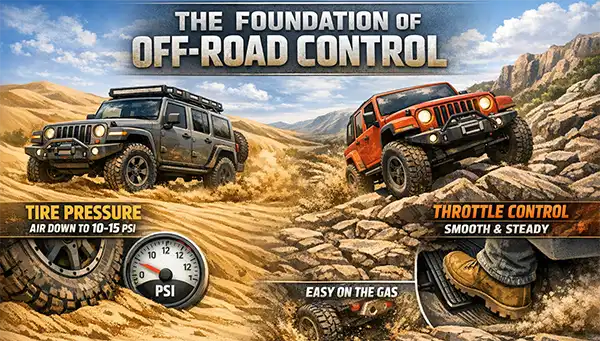
The Foundation of Off-Road Control
Many people buy a capable 4×4 and assume the vehicle will do all the work. The reality is that the most expensive suspension or biggest tires are secondary to the driver’s skill. True off-road mastery comes from understanding two fundamental principles: tire pressure and throttle control. These are the core off-road driving techniques that transform a passenger into a confident operator.
First, let’s talk about tire pressure. Airing down your tires to a range of 10 to 15 psi is not just a suggestion; it is a requirement for most trails. Think of it as giving your truck a bigger, softer footprint. This simple adjustment dramatically increases flotation on soft surfaces like sand and allows the tire to mold around sharp rocks for incredible grip. However, this technique requires a balanced approach. With lower pressure, you run the risk of unseating a tire bead from the wheel if you corner too aggressively or hit an obstacle at the wrong angle.
The second pillar is throttle control, which is the art of applying smooth, deliberate power. We have all seen the beginner’s mistake of mashing the gas pedal in a panic, which only results in spinning wheels that dig the vehicle deeper into sand or mud. The guiding mantra here is to move as slow as possible, but as fast as necessary. This brings us to the difference between momentum and speed. Momentum is a controlled force that carries your vehicle through an obstacle. Reckless speed, on the other hand, leads to a loss of control and expensive damage.
Mastering Sandy Trails and Dunes
With those foundational skills in mind, we can apply them to specific terrains, starting with sand. Whether you are exploring the vast dunes of Pismo Beach, California, or the wooded trails of Silver Lake, Michigan, the primary goal is to maintain flotation and momentum. On sand, low tire pressure is non-negotiable. Dropping to that 10 to 15 psi range distributes the vehicle’s weight, allowing it to float over the surface rather than plowing through it.
Your best friend on sand is steady forward momentum. Using low-range 4WD (4L) gives you maximum control while you maintain just enough speed to avoid bogging down. Here is a critical tip: never stop while facing uphill. The effort required to restart your climb on a soft, steep surface is immense and often impossible. Instead, crest the hill and find a flat or downhill spot to park.
Smooth inputs are everything. Any sharp turn or sudden change in throttle can break the sand’s surface tension, causing your tires to dig in and bring you to an abrupt halt. Plan your path with wide, gentle turns. Whenever possible, follow existing tracks where the sand is already compacted. Vehicles like the new 2025 Ford F-150 are engineered with advanced traction control systems that help manage power delivery in low-grip environments, making these sand driving tips easier to execute.
Techniques for Tackling Mud and Ruts
Unlike sand, where the challenge is flotation, mud is all about the desperate search for traction. The first and most important principle is to look before you leap. Before driving into a mud pit, get out and check its depth and consistency. Use a long stick to probe for hidden rocks, logs, or deep holes that could trap your vehicle. Sometimes, the smartest move is acknowledging the obstacle is too risky and finding a way around it.
When you decide to proceed, you must balance momentum with traction. While you need enough momentum to push through the thickest sections, excessive speed can cause you to hydroplane on slick surfaces or be violently thrown off course by deep ruts. Always engage your 4WD system before you enter the mud. This is where purpose-built 4×4 systems, like those found across the Jeep lineup, truly demonstrate their value.
If your tires start to slip, a useful technique is to gently “saw” the steering wheel back and forth. This small movement allows the aggressive side lugs of your tires to bite into the sides of the ruts for fresh grip when the main tread is clogged. This is a key part of how to drive in mud effectively. It is also why mud-terrain tires are so effective; their wide voids are designed to act like paddles and sling mud away to maintain traction.
Navigating Rocky Paths and Boulders
Rock crawling is a slow, precise discipline that feels more like a puzzle than driving. On iconic trails like those in Moab, Utah, success is measured in inches, not miles per hour. This terrain demands low-range 4WD (4L) to provide maximum torque with minimal throttle input, preventing the lurching and uncontrolled wheel spin that can lead to damage. The core skill here is learning to choose your line.
Choosing a line involves reading the terrain ahead to keep the vehicle as level as possible. A critical piece of advice for rock crawling basics is to aim to put your tires on top of the rocks rather than trying to straddle them. Straddling a large rock risks getting your vehicle “high-centered,” where the frame or differentials get stuck on the obstacle, leaving your wheels spinning uselessly in the air. This is where a spotter becomes essential. A spotter is your second set of eyes, guiding you through sections you cannot see from the driver’s seat. Simple hand signals for “come forward,” “stop,” and “turn driver or passenger” create a clear communication system.
As experts at MotorTrend often highlight in their guides, successful rock crawling is more about strategic tire placement than raw power. This careful approach is also about vehicle preservation. Knowing the lowest points of your undercarriage and protecting them with skid plates and rock sliders is fundamental. Modern SUVs, including the upcoming 2026 Jeep Grand Cherokee, are being designed with sophisticated air suspension and off-road modes that make navigating rocky terrain more manageable.
Safe Vehicle Recovery Strategies
Even with perfect technique, getting stuck is a part of off-roading. When it happens, the most important rule is to stop spinning your tires the moment forward progress ceases. Continuing to spin only digs you in deeper. Get out of the vehicle and calmly assess why you are stuck. Is it a loss of traction, or are you hung up on an obstacle?
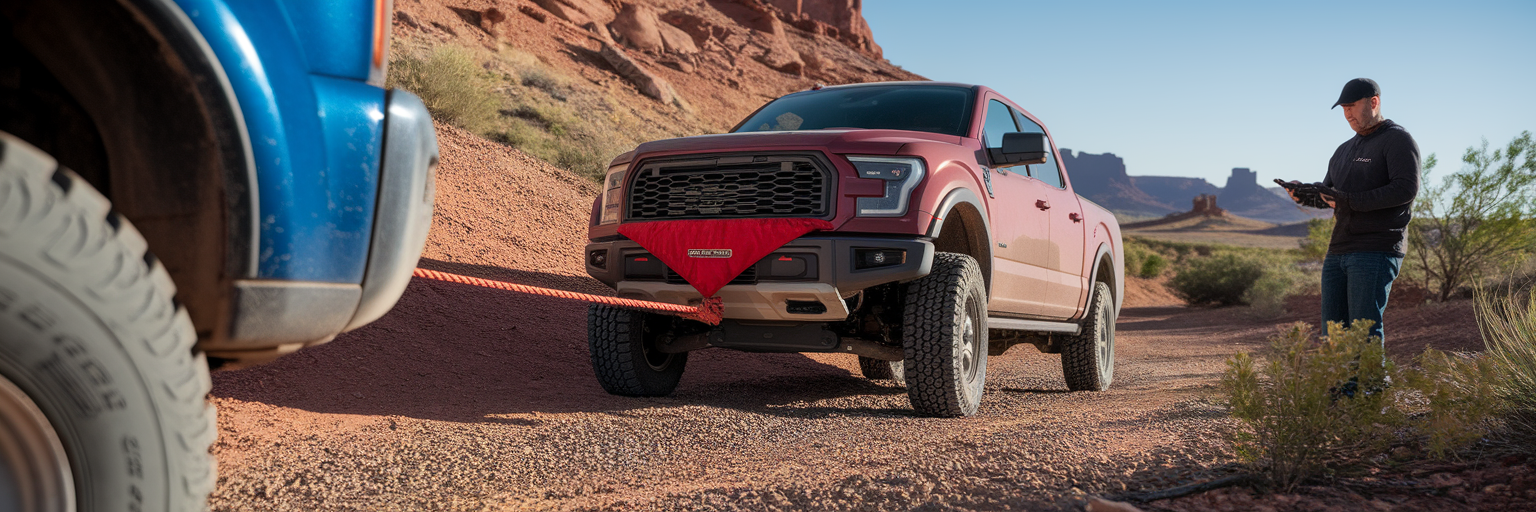
Your first line of defense should be the simplest and safest piece of vehicle recovery gear: traction boards. Clear any sand or mud from in front of the tires, wedge the boards as far underneath as possible, and apply slow, steady throttle to climb out. If that fails, you may need another vehicle. It is critical to know the difference between a static tow strap, which has no stretch and is for pulling on flat ground, and a kinetic recovery rope, which stretches to “snatch” a vehicle out of mud or sand. A non-negotiable safety rule is to only use rated recovery points on the vehicle’s frame. Never use a tow ball, which can snap off under load and become a deadly projectile.
For self-recovery, a winch is an invaluable tool, but it is also the most dangerous. Safe winching requires specific knowledge and protocols, including:
- Using a tree-saver strap to protect both the tree and your winch line.
- Placing a winch line damper (a heavy blanket or specialized weight) on the line to absorb energy if it snaps.
- Ensuring the pull is as straight as possible.
Given the risks, we strongly recommend seeking professional training before ever operating a winch.
| Recovery Method | Best Use Case | Safety Level | Key Equipment Needed |
|---|---|---|---|
| Traction Boards | Loss of traction in sand, mud, or snow. | High (Safest method) | Traction boards, shovel. |
| Kinetic Rope Recovery | Vehicle is significantly bogged down in mud or sand. | Medium (Requires knowledge) | Kinetic rope, soft shackles, rated recovery points on both vehicles. |
| Winching | Self-recovery or recovering another vehicle from a difficult position (e.g., ditch, steep incline). | Low (Requires training) | Winch, tree saver, damper, gloves, shackles, rated recovery points. |
This table outlines the appropriate scenarios and safety considerations for common recovery tools. Always choose the safest possible method first and never attempt a recovery you are not trained for.
Essential Pre-Trip Gear and Vehicle Checks
The techniques we have discussed are only effective when supported by proper preparation. The single most important safety rule in off-roading is to never wheel alone. A second vehicle is the most reliable recovery tool you can have, and a companion provides critical help in any situation.
Before you hit the trail, ensure you have a basic, non-negotiable recovery kit. This should always include:
- A properly rated tow strap or kinetic recovery rope
- Soft shackles (safer and more versatile than metal D-rings)
- Sturdy gloves to protect your hands
- A durable shovel
- A set of traction boards
An air compressor is also essential for airing your tires back up to highway pressures before you drive home. Take the time to identify your vehicle’s rated recovery points before you need them. They are attached directly to the frame for strength. Factory tie-down loops used for shipping are not strong enough for recovery forces and will fail dangerously.
Finally, perform a quick walk-around of your vehicle at the trailhead. Check that all your gear is secure, confirm your tires are aired down correctly for the terrain ahead, and look for any visible fluid leaks or loose parts. A successful off-road adventure begins long before you shift into 4WD. A well-prepared driver is a safe driver. For more insights into vehicle maintenance and performance, explore the resources available at CarPhanatics.