
The Early Dreams of an Automated Future
The concept of a car that drives itself feels distinctly modern, yet the autonomous vehicle history began long before the tech giants entered the race. In the 1980s, the first serious attempts were not happening in corporate R&D centers but in university laboratories. From the start, researchers were split between two competing philosophies. One vision focused on building intelligence into the infrastructure, creating automated highways that would guide vehicles. The other, more ambitious approach aimed to build self-sufficient cars equipped with their own onboard perception systems.
These early prototypes were a far cry from the sleek vehicles we see today. They were often bulky, slow, and could only operate in highly controlled environments like empty parking lots or specially marked tracks. They were never intended to be products. Instead, their purpose was to define the fundamental challenges of autonomous navigation. How does a machine distinguish a shadow from a pothole? How does it plan a path through a cluttered space?
This period was less about building a functional car and more about asking the right questions. The academic work from this era served as the essential intellectual foundation for the entire field. It established the core problems that engineers would spend the next several decades trying to solve, setting the stage for the breakthroughs that would eventually follow.
From Desert Races to Urban Challenges
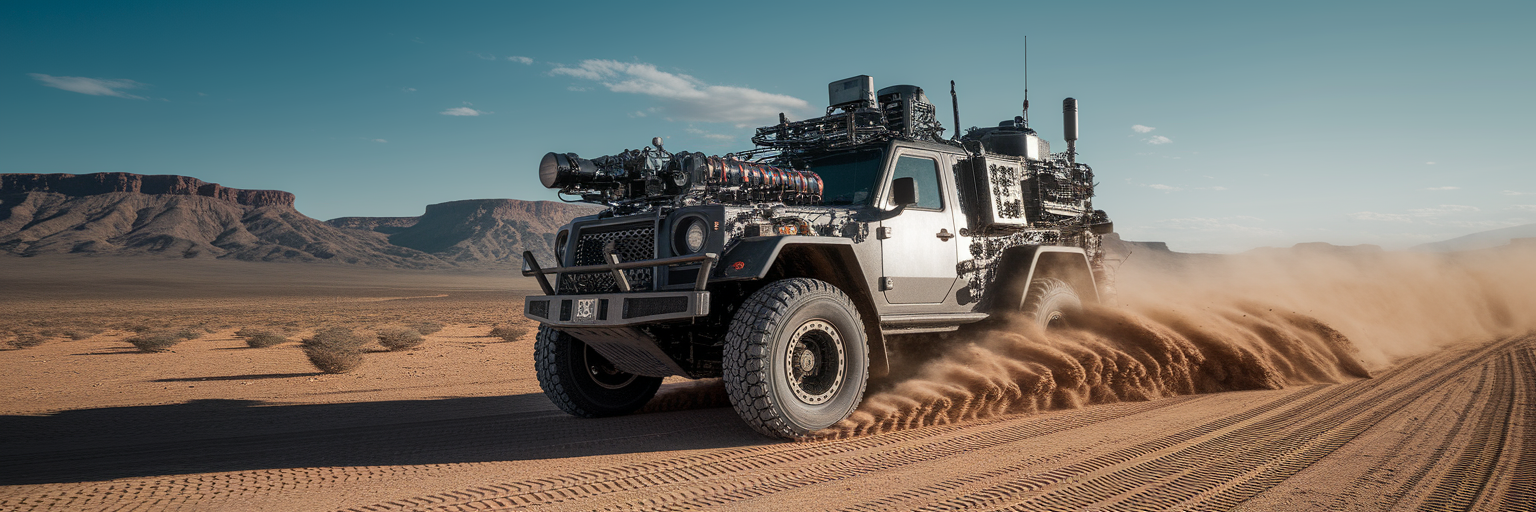
For years, autonomous research progressed steadily but quietly. That all changed in the early 2000s when the US military sparked a revolution with a series of competitions. The goal was to accelerate the development of driverless vehicles for supply convoys, and the method was the DARPA Grand Challenge. The first event in 2004 was a humbling public failure; not a single vehicle managed to complete the 150-mile desert course. It seemed the dream was still far from reality.
However, the story took a dramatic turn just one year later. In the 2005 challenge, five teams successfully crossed the finish line, demonstrating an incredible leap in capability. The competition had forced a pace of innovation that isolated research simply could not match. The real test came in 2007 with the Urban Challenge. This time, vehicles had to navigate a simulated city environment, obey traffic laws, merge, park, and interact with other moving vehicles. It was proof that autonomy was viable beyond empty landscapes.
These challenges acted as a crucible for technology. They forced teams to master sensor fusion, real-time computing, and the integrated use of lidar, radar, and cameras under intense pressure. For car enthusiasts, learning about these early, rugged prototypes is fascinating, and some of the insights we shared about these extreme vehicle facts show the raw beginnings of today’s polished systems. A study from the University of Michigan’s Center for Sustainable Systems documents how these competitions accelerated the development of core AV technologies, turning academic theory into practical application.
The Technology That Makes It Possible
So, how self-driving cars work today is a result of decades of refinement across three critical areas. It’s a symphony of hardware and software working together to perceive, think, and act. Understanding these components demystifies the magic behind a car that navigates on its own.
The Brain: AI and Deep Learning
At the core of every autonomous vehicle is an artificial intelligence brain. This system relies on a technique called deep learning, specifically using convolutional neural networks (CNNs). These networks are trained on millions of miles of driving data, learning to recognize and classify objects with remarkable accuracy. The AI can identify a pedestrian, a cyclist, a stop sign, or another car, and predict their likely behavior. It’s this pattern recognition that allows the car to make sense of a chaotic world.
The Senses: Sensor Fusion
No single sensor is perfect, which is why autonomous vehicles use a combination of them in a process called sensor fusion. Think of it like how humans use sight, hearing, and balance to navigate. The car combines data from multiple sources to create a robust, 3D model of its environment. This approach provides redundancy, ensuring the system remains reliable even if one sensor is compromised.
| Sensor | How It Works | Strengths | Weaknesses |
|---|---|---|---|
| Lidar (Light Detection and Ranging) | Emits laser pulses to measure distances and create a precise 3D map. | High-resolution 3D mapping, excellent depth perception, works in darkness. | Expensive, can be affected by heavy rain, fog, or snow. |
| Radar (Radio Detection and Ranging) | Uses radio waves to detect objects and measure their velocity. | Excellent at detecting speed, works well in bad weather, long-range detection. | Lower resolution than lidar, can struggle to identify stationary objects. |
| Cameras | Provide high-resolution 2D color video to identify objects, read signs, and see lane lines. | Excellent for classification (e.g., identifying a police car vs. a civilian car), reads text. | Dependent on good lighting, can be blinded by sun glare or obscured by weather. |
This table summarizes the complementary roles of the primary sensors used in autonomous vehicles. Sensor fusion combines their individual strengths to create a comprehensive and redundant perception system.
The Map: High-Definition Navigation
Autonomous cars don’t just rely on what they see in real time. They also use highly detailed, pre-built maps. These are not the maps on your phone; they are centimeter-accurate 3D blueprints of the road network, including lane markings, curb heights, traffic light positions, and speed limits. This map gives the car context, allowing it to anticipate the road ahead and focus its processing power on dynamic objects like other cars and pedestrians. The goal is to make this complex technology understandable, much like how the infotainment systems we reviewed in the upcoming 2026 Jeep Grand Cherokee package sophisticated features into a user-friendly interface.
Autonomous Driving in 2025
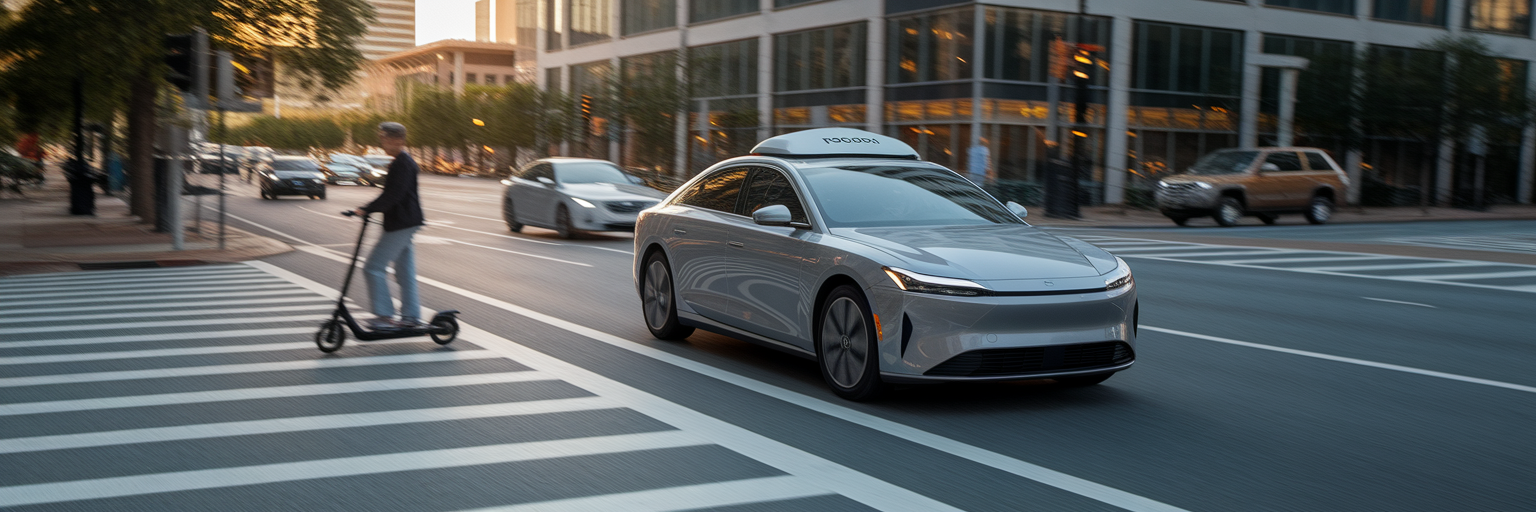
After years of development, what does autonomous driving look like right now? The reality in 2025 is one of impressive but limited deployment. We are seeing the first commercial applications of level 4 autonomous driving, where the vehicle handles all driving tasks within a specific area without needing a human to take over.
The most visible examples are the robotaxi services US cities like Phoenix and San Francisco now host. These services allow users to hail a driverless car through an app, but they operate within a geographically limited area known as a “geofence.” Outside this zone, the system won’t engage. A similar model is emerging in the trucking industry, where autonomous trucks handle long-haul highway routes, often with a human safety driver still present to manage complex situations at the beginning and end of the journey.
The primary challenge preventing wider adoption is the messy, unpredictable nature of mixed traffic. Integrating with human drivers, cyclists, and pedestrians who don’t always follow the rules remains a massive hurdle. The debate over the best approach is ongoing, with some companies pursuing camera-based systems while others insist on lidar, a key difference in strategy similar to the choices we explored in our comparison of the Toyota RAV4 and Tesla Model Y. According to the World Economic Forum, full integration with human-driven vehicles is a primary challenge that will likely extend into the 2030s. Key hurdles include:
- Handling unpredictable human behavior on the road.
- Safely navigating complex urban intersections and construction zones.
- Achieving cost-effective scalability for mass production.
- Establishing clear legal and liability frameworks for accidents.
The Road Ahead to Full Autonomy
The future of autonomous vehicles will be defined by solving the final, most difficult challenges. The path to full Level 5 autonomy—where a car can drive itself anywhere, anytime, without any human intervention—is paved with advancements in simulation, communication, and computing. Here are the key developments shaping that journey:
- Large-Scale Simulation: Developers are creating “digital twins” of entire cities. In these hyper-realistic virtual worlds, autonomous vehicles can drive billions of miles to master rare and dangerous scenarios, like a child running into the street, without any real-world risk. This allows for rapid, safe training on a massive scale.
- V2X Communication: The next step is a cooperative ecosystem where vehicles, infrastructure, and even pedestrians’ devices communicate in real time. This technology, known as Vehicle-to-Everything (V2X), allows a car to receive a warning about black ice from a vehicle ahead or know a traffic light is about to turn red, even if it’s around a blind corner.
- Advanced Onboard Computing: Cars are being equipped with powerful and efficient edge AI chips. These specialized processors allow the vehicle to perform all complex calculations onboard, reducing reliance on cloud connectivity and minimizing latency for critical decisions.
Most experts project that true Level 5 autonomy will become commercially viable in the mid-2030s, once these technological hurdles are cleared and global safety standards are established. This future is almost universally tied to electric powertrains, making the evolution of AVs a key part of the broader shift toward sustainable transportation. As we continue to cover on our electric vehicles page, the two technologies are advancing hand-in-hand, promising a cleaner, safer, and more efficient automotive future.