
Setting the Stage for Self-Driving Dominance
No company dominates the conversation around autonomous vehicles quite like Tesla. Its approach has been framed as both a revolutionary leap and a high-risk gamble. To understand this debate, we first need to clarify the terminology. Tesla offers Autopilot, Enhanced Autopilot, and Full Self-Driving (FSD), but it’s critical to recognize what these are in 2025: they are all advanced Level 2 autonomous driving systems. This means the driver must remain fully attentive and ready to take control at any moment.
The core of the controversy lies in Tesla’s strategic decision to pursue Tesla vision-only autonomy. While competitors build their systems with a suite of sensors including lidar and radar, Tesla has stripped them away, betting everything on cameras and a powerful neural network. This fundamental disagreement over hardware sets the stage for one of the most significant technological debates in the automotive industry. Is relying on cameras alone a stroke of genius or a dangerous oversimplification?
The Hardware and Software Driving the Vision
So, how does Tesla Autopilot work? The system is built on two core components: hardware and software. The latest hardware suite, HW4, uses a network of eight cameras to create a 360-degree view around the vehicle with a range of up to 250 meters. This visual data is the exclusive input for the car’s artificial intelligence. There is no radar or lidar to provide a secondary layer of information. The car sees the world, and the AI must interpret it.
This visual data is processed by a tiered software system, with capabilities expanding at each level:
- Standard Autopilot: This base system functions as a Level 2 ADAS, providing traffic-aware cruise control to match the speed of surrounding cars and autosteer to keep the vehicle centered in its lane.
- Enhanced Autopilot: This tier adds more convenience features, including automatic lane changes, Autopark for parallel and perpendicular parking, and Navigate on Autopilot, which guides the car from a highway on-ramp to off-ramp.
- Full Self-Driving (FSD) Beta: This is the most ambitious layer, designed to navigate complex urban environments, including intersections, traffic lights, and roundabouts. Its performance is meant to improve over time through over-the-air (OTA) software updates that refine the neural network based on data from millions of miles driven by the fleet. This reliance on software updates is becoming a standard in the world of modern electric vehicles.
A Reality Check on FSD Performance in 2025
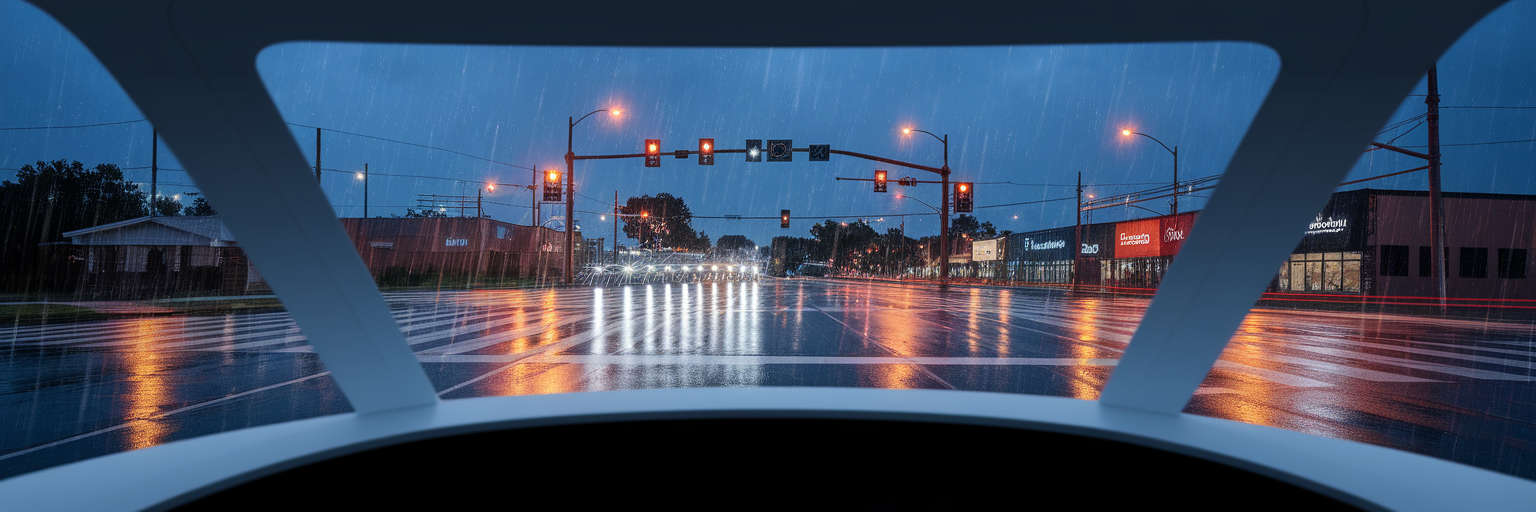
A proper Tesla Full Self-Driving review must move beyond marketing promises and look at real-world performance. As of 2025, even with the latest “Supervised” v14 software, the system remains firmly in the category of Level 2 autonomous driving systems. A recent analysis by Electrek in December 2025 noted that while the system shows incremental gains in smoothness, it still requires constant driver supervision.
This need for vigilance is reflected in how owners actually use the feature. Most confine FSD to predictable highway driving, suggesting a lack of confidence in its ability to handle the chaotic nature of city streets. The system is still prone to unnerving behaviors that erode trust. Key performance issues that persist include:
- Phantom braking, where the car brakes suddenly for no apparent reason.
- Hesitation at complex intersections, causing delays and frustrating other drivers.
- Degraded performance in adverse weather like heavy rain or direct sun glare.
Then there is the cost. At $12,000 upfront or a $199 monthly subscription, FSD is a significant investment. When you compare this to other major vehicle expenses, you have to ask if the value is there. For many drivers, paying a premium for a system that still requires their full attention feels like a steep price for a feature that is still a work in progress. It raises the question of whether the cost justifies the current capabilities, especially when you consider other high costs of car ownership.
The Great Divide: Vision-Only vs. Multi-Sensor Systems
The Tesla vs Waymo self-driving debate represents a fundamental schism in engineering philosophy. Tesla stands almost entirely alone in its vision-only approach, while nearly every other major player, from Waymo to Cruise, believes in a multi-sensor suite. This difference in strategy creates clear trade-offs in cost, performance, and scalability.
| Factor | Tesla (Vision-Only) | Competitors (Multi-Sensor) |
|---|---|---|
| Primary Sensors | Cameras, Neural Networks | Lidar, Radar, Cameras, HD Maps |
| Cost & Scalability | Lower hardware cost, easier to scale | Higher hardware cost, often reliant on pre-mapped areas |
| Redundancy | Relies on AI to interpret 2D data into 3D | Built-in redundancy; Lidar directly measures depth |
| Weather Performance | Vulnerable to rain, fog, snow, and direct sun | Radar provides robust performance in adverse conditions |
| Data Processing | Requires immense computational power for AI interpretation | Fused sensor data provides a more direct world model |
The argument for Tesla vision-only autonomy is compelling from a business perspective. Cameras are inexpensive and easy to install on every vehicle, creating a path to rapid scalability. By contrast, competitors’ systems are more complex. Lidar, which uses lasers to measure distance directly, provides an unambiguous 3D map of the world. Radar excels at seeing through rain, fog, and snow, conditions where cameras struggle. This sensor fusion creates built-in redundancy, a safety principle many experts consider non-negotiable for achieving true, unsupervised autonomy. While Tesla’s approach is elegant, it places an enormous burden on its AI to perfectly interpret a 2D world, a challenge that other high-performance systems, like the ones we’ve explored in our analysis of top fuel dragsters, solve with mechanical certainty.
Navigating a Maze of Legal and Regulatory Roadblocks
Beyond the technical debate, Tesla faces a growing wall of legal and regulatory challenges. The central issue is a disconnect between the company’s ambitious marketing and the system’s actual capabilities. This came to a head when, as reported by The Verge, a California judge ruled that the names “Autopilot” and “Full Self-Driving” were deceptive. This ruling is not just a slap on the wrist; it could force a complete rebranding of the features or even lead to a sales suspension in a key market.
This case highlights a broader problem for regulators. How do you certify the safety of an end-to-end neural network that operates like a “black box”? Unlike systems with transparent redundancy from multiple sensors, a vision-only AI’s decision-making process is difficult to validate. This ambiguity creates complex liability questions in the event of an accident. Who is at fault when a Level 2 system makes a mistake? These external hurdles are proving to be just as significant as any software bug, and they will affect every new vehicle trying to enter the market, including highly anticipated models like the upcoming 2026 Jeep Grand Cherokee.
The Path Forward: Robotaxis and the End Game
To understand Tesla’s unwavering commitment to its vision-only strategy, you have to look at its stated end game: a massive, company-owned robotaxi fleet. This ambition is the ultimate justification for its high-stakes bet. The goal is not just to sell cars with driver-assist features but to create a network of autonomous vehicles that generate recurring revenue. This vision for the future of autonomous driving is why Tesla has pursued vertical integration so aggressively, designing its own chips, cameras, and AI software in-house.
This control over the entire technology stack is intended to give Tesla a decisive edge in the race to Level 4 and 5 autonomy. While the company projects the launch of robotaxi trials, the path forward is littered with the immense technical, regulatory, and public trust hurdles we have discussed. The central question remains unanswered. Will Tesla’s bold vision redefine transportation, or will its all-or-nothing gamble fall short of the finish line? For more on what’s next in the automotive world, you can always find the latest news and trends on our homepage.