Two Icons Defining Modern Adventure
The American car market is experiencing a shift. Buyers are turning away from anonymous crossovers and toward vehicles with a clear sense of purpose and identity. We want something authentic, something capable. This has created the perfect stage for a fascinating conflict between two resurrected legends, each representing a completely different philosophy of adventure. This is the core of the Ford Bronco vs Toyota Land Cruiser debate: a choice between expressive freedom and uncompromising durability.
The Ford Bronco is the embodiment of the lifestyle adventurer. Its appeal is woven into the fabric of classic American ideals of freedom, open-air fun, and endless personalization. It’s the vehicle you see with the top off, cruising down a coastal highway on a sunny afternoon or parked at a trailhead, ready for a spontaneous hike. The Bronco is designed to be a statement piece, a versatile tool for weekend escapes that adapts to your mood. It’s less about conquering the ends of the earth and more about maximizing the enjoyment of the journey there.
In the other corner stands the Toyota Land Cruiser, the purpose-built explorer. Its reputation was not forged in marketing meetings but in the punishing deserts of Australia and the rugged mountains of South America. Its design philosophy is rooted in a single, unwavering principle: absolute reliability when you are hundreds of miles from help. This vehicle attracts a different kind of buyer, one who sees their SUV not as an accessory but as a critical piece of life-support equipment. For them, flashy features are secondary to the proven capability needed for self-reliant overland journeys.
In 2026, their market positions are clearer than ever. The Bronco is a highly visible, immensely popular choice that has captured the public’s imagination. The new Land Cruiser, having returned to the US market, is a more focused and premium off-road instrument. It has a specific mission: to serve those who demand the highest level of long-term dependability. This comparison isn’t just about specs; it’s about understanding which of these two distinct adventure philosophies truly aligns with your own.
Off-Road Hardware for Unpaved Paths
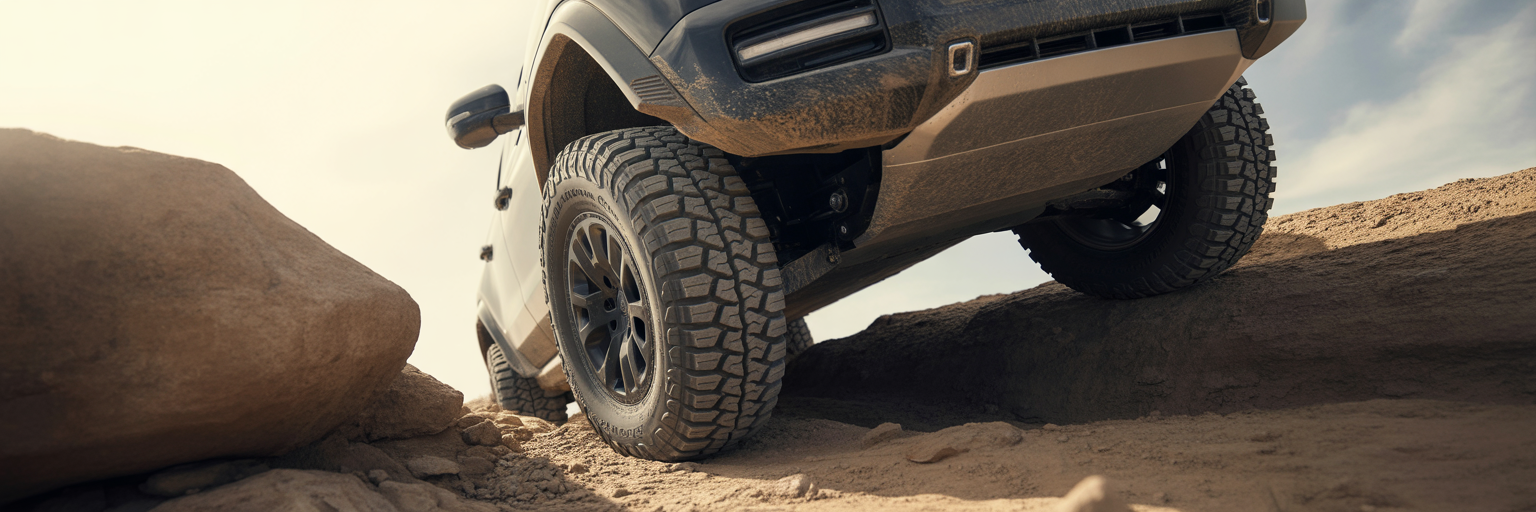
Beyond the brand stories lies the hardware that gives these SUVs their credibility. While both are immensely capable, their engineering approaches reveal their core priorities. This is where we move from the philosophical to the mechanical, examining the nuts and bolts that get you over the obstacle.
Fundamental 4WD Systems
The way these vehicles deliver power to the wheels is a fundamental difference. The Bronco offers an advanced part-time 4×4 system with an optional 4A (auto) mode. In most situations, you choose between 2H, 4H, and 4L. The 4A mode is a valuable addition, automatically engaging the front wheels when slip is detected, which is great for roads with patchy ice or rain. However, it still requires a conscious decision from the driver. The Land Cruiser, by contrast, comes standard with a full-time 4WD system. This is a set-it-and-forget-it solution that constantly manages traction across all four wheels without any driver intervention. It’s engineered for seamless performance in any condition, from a dry highway to a muddy trail, reflecting its go-anywhere, do-anything ethos.
Suspension Architecture and Trail Manners
Suspension design dictates how a vehicle behaves on rough terrain. The Bronco utilizes Ford’s High-Performance Off-Road Stability Suspension (HOSS), which features an independent front suspension. This setup is excellent for soaking up bumps at higher speeds on washboard roads and provides a more comfortable, car-like ride on pavement. It’s a design that balances daily comfort with impressive trail performance. The Land Cruiser sticks to a more traditional and robust formula: a tough body-on-frame platform with an independent double-wishbone front and a multi-link solid axle rear. This architecture is optimized for maximum wheel articulation, allowing the tires to stay in contact with the ground on uneven surfaces, and for extreme durability when carrying heavy loads over long distances.
Specialized Off-Road Packages: Sasquatch vs. Integrated Engineering
The Bronco Sasquatch vs Land Cruiser comparison highlights their different approaches to ultimate capability. The Sasquatch package is Ford’s factory-installed “hardcore” option. It bundles 35-inch tires, front and rear locking differentials, and position-sensitive Bilstein shocks into one potent package. It transforms the Bronco into a rock-crawling beast straight from the showroom. Toyota takes a more integrated approach. Features like CRAWL Control, which acts as a low-speed off-road cruise control, and Multi-Terrain Select, which adjusts vehicle settings for different surfaces like mud or sand, are baked into the Land Cruiser’s core engineering. It’s less of an optional package and more a part of the vehicle’s DNA, designed to make expert-level maneuvers more accessible and repeatable.
By the Numbers: Ground Clearance and Critical Angles
On paper, the specifications tell a clear story. A Bronco with the Sasquatch package boasts superior numbers for technical rock crawling. Its massive tires and suspension lift give it class-leading ground clearance and aggressive approach and departure angles, allowing it to climb over tall obstacles without scraping its bumpers. The Land Cruiser’s figures are more conservative, reflecting a design balanced for all-around capability rather than just extreme crawling. These numbers translate directly to the trail: the Bronco is better equipped to tackle the most challenging, slow-speed obstacles, while the Land Cruiser is designed to reliably traverse a wider variety of demanding terrains. A recent review from MotorTrend noted the Land Cruiser’s hybrid system produces a stout 465 lb-ft of torque, while the Bronco’s optional V6 offers 410 lb-ft, showcasing the different power delivery strategies.
| Specification | Ford Bronco (Sasquatch Package) | Toyota Land Cruiser (2026) |
|---|---|---|
| 4WD System | Part-Time 4×4 with 4A (Auto) Mode | Full-Time 4WD |
| Front Suspension | Independent (HOSS System) | Independent Double-Wishbone |
| Rear Suspension | Solid Axle with Coil Springs | Multi-Link with Coil Springs |
| Available Differentials | Front & Rear Locking | Center & Rear Locking |
| Max Ground Clearance | ~11.6 inches | ~8.7 inches |
| Approach Angle | ~43.2 degrees | ~31.0 degrees |
| Departure Angle | ~37.2 degrees | ~22.0 degrees |
Note: Figures are based on top-tier off-road trims for each model. The Bronco’s Sasquatch package provides superior clearance and angles for technical rock crawling, while the Land Cruiser’s full-time 4WD is engineered for all-condition traction and reliability.
From the Trailhead to the Trader Joe’s Run
An adventure vehicle spends most of its life on pavement. The true test for many buyers is how well it handles the mundane realities of daily life. Evaluating each as a daily driver off road vehicle reveals practical strengths and weaknesses that are just as important as approach angles.
Interior Design and Daily Practicality
Stepping inside, the two SUVs present starkly different environments. The Bronco’s cabin is utilitarian-chic. You’re greeted by prominent grab handles, a dashboard rail designed for mounting phones and cameras, and options for rubberized flooring with drain plugs. It feels like a piece of equipment, ready for mud and dust. The Land Cruiser’s interior, on the other hand, prioritizes conventional comfort. It’s quieter, more insulated, and feels more premium. The materials are less about hose-down durability and more about creating a serene space to escape the noise of the outside world. It’s the difference between a functional workspace and a comfortable office.
Cargo Flexibility for Errands and Gear
Both vehicles can haul plenty of gear, but they do so differently. The Bronco 4-door offers a versatile cargo area that feels open and accessible, especially with the top removed. Loading bulky items like bikes or furniture can be easier thanks to its boxy shape. The Land Cruiser provides a traditionally large and secure cargo hold, but it’s a more enclosed space. It’s perfect for neatly packing away luggage and supplies for a long trip, but might feel less flexible for the awkward shapes of everyday errands. The choice comes down to whether you prefer an open, adaptable bed or a secure, enclosed trunk.
Maneuverability in Urban Environments
Navigating tight city streets and crowded parking lots can be a challenge in any large SUV. The Bronco’s upright seating position and large windows can provide a commanding and clear view of your surroundings, making it feel surprisingly manageable. The Land Cruiser, with its larger overall footprint, can feel more substantial and requires a bit more care when parking. However, both vehicles are equipped with an array of modern driver aids, including high-resolution cameras and parking sensors, that significantly ease the stress of urban maneuvering.
The Daily Commute: Fuel Economy
For a vehicle that will see thousands of miles of commuting, fuel economy is a major consideration. Here, the Land Cruiser’s modern powertrain gives it a distinct edge. According to data compiled by TrueCar, the Toyota Land Cruiser demonstrates a notable advantage in fuel efficiency with an estimated 22 MPG in the city and 25 MPG on the highway. The Bronco, with its powerful but thirsty EcoBoost engines, typically falls in the 18-21 MPG range combined. Over the course of a year, that difference adds up at the pump, making the Land Cruiser the more economical choice for a daily commute. Exploring how different brands approach this balance of power and efficiency, as seen in a Lexus RX Hybrid vs. Toyota Highlander Hybrid comparison, shows this is a key differentiator across the market.
Built for a Decade or a Lifetime?
A vehicle’s purchase price is just the beginning of its story. How it holds up over years of use, what it costs to maintain, and how much it’s worth a decade from now are critical questions. This is where the legendary Toyota Land Cruiser reliability goes head-to-head with Ford’s modern manufacturing.
The Legend of Toyota Land Cruiser Reliability
There’s a reason why you see decades-old Land Cruisers still tackling the toughest terrain on earth. Toyota’s engineering philosophy for this vehicle is unique: components are famously over-engineered with a target service life of over 25 years. This isn’t just marketing; it’s a deeply ingrained practice that has built a global reputation for near-indestructible longevity. Buying a Land Cruiser is often seen as a long-term investment. Its ability to hold value is legendary, partly because owners know it’s built to last not just through its warranty period, but for a generation.
Ford’s Modern Approach to Durability
The Ford Bronco is a much more complex machine. With its removable roof panels, advanced electronics, and turbocharged engines, there are inherently more potential points of failure compared to the Land Cruiser’s simpler, time-tested approach. Ford has been diligent in addressing the well-documented issues from the Bronco’s first model years, and the current vehicles are solid and dependable. However, it’s a vehicle that will likely require more attention and potential repairs over a 15-year lifespan than the Toyota. It’s a reliable modern vehicle, but it isn’t engineered with the same lifetime-use philosophy.
Contrasting Powertrain Philosophies
The engines at the heart of these trucks reflect their core identities. The Land Cruiser’s i-FORCE MAX hybrid powertrain is designed for immense low-end torque and smooth, reliable power delivery. It’s a system that leverages Toyota’s decades of hybrid expertise for durability and efficiency under load. The Bronco’s EcoBoost V6 engines, on the other hand, prioritize thrilling, turbocharged power and acceleration. While proven and potent, forced induction systems inherently add complexity and stress on components over the long term. The choice is between a powertrain designed for sustained, heavy use and one designed for exciting performance. Buyers often track how manufacturers handle powertrain issues, such as the GM 6.2L engine recall, which underscores the importance of long-term factory support.
Total Cost of Ownership Beyond the Sticker
When you look beyond the initial purchase price, the financial picture can change. The Land Cruiser typically commands a higher upfront cost. However, that premium may be offset over a decade by lower maintenance and repair bills and a significantly higher resale value. The Bronco, while often more affordable initially, could present more unpredictable expenses once its factory warranty expires. The cost of replacing a complex electronic module or repairing a leaking roof mechanism are real-world considerations that factor into the total cost of ownership.
Comfort and Composure on the Long Haul
A weekend trip to the mountains is one thing; a 2,000-mile cross-country road trip is another. The experience of spending eight to ten hours a day in a vehicle separates the true long-haul champions from the sprinters. This is about more than just a smooth ride; it’s about reducing the physical and mental fatigue that accumulates over hundreds of miles on the interstate.
Highway Ride Quality and Wind Noise
On the highway, the Land Cruiser’s mission of refined durability becomes clear. It feels planted, composed, and exceptionally quiet. The cabin is an insulated sanctuary, shielding passengers from the drone of wind and tire noise. It’s engineered to make a 500-mile day feel effortless. The Bronco, especially with a soft top, offers a much more connected experience, for better or worse. The ride is firmer, and you hear more of the world around you. While this can be engaging on a backroad, the constant wind noise on a long highway stretch can become genuinely tiring. The hardtop is significantly quieter, but it still can’t match the bank-vault-like serenity of the Land Cruiser at 75 mph.
Seating Ergonomics for Extended Drives
After several hours behind the wheel, seat comfort becomes paramount. The Bronco’s seats are designed with durability in mind, with options like marine-grade vinyl that can withstand sun and moisture. They are supportive for shorter trips, but may lack the fine-tuned adjustability and plush cushioning needed for all-day comfort. The Land Cruiser’s seats are built for the long haul. With extensive power adjustments, quality materials, and ergonomic shaping, they are designed to reduce fatigue and pressure points over an eight-hour drive. It’s the difference between a sturdy work stool and a high-end office chair; both serve a purpose, but one is clearly better for sitting in all day.
Driver-Assist Systems for Reducing Fatigue
Modern driver-assist systems are a huge asset on long journeys. Both vehicles offer sophisticated suites that include adaptive cruise control and lane-keeping assist. The key difference often lies in the refinement of their operation. Toyota’s Safety Sense systems are known for their smooth, predictable inputs that feel natural and trustworthy, genuinely reducing the driver’s workload on long, monotonous stretches of highway. Ford’s Co-Pilot360 is also highly capable, but some drivers find its interventions can be more abrupt. A well-tuned system inspires confidence and allows the driver to relax, while a less refined one can keep you on edge, defeating the purpose.
The Open-Air Question: Roofs and Doors
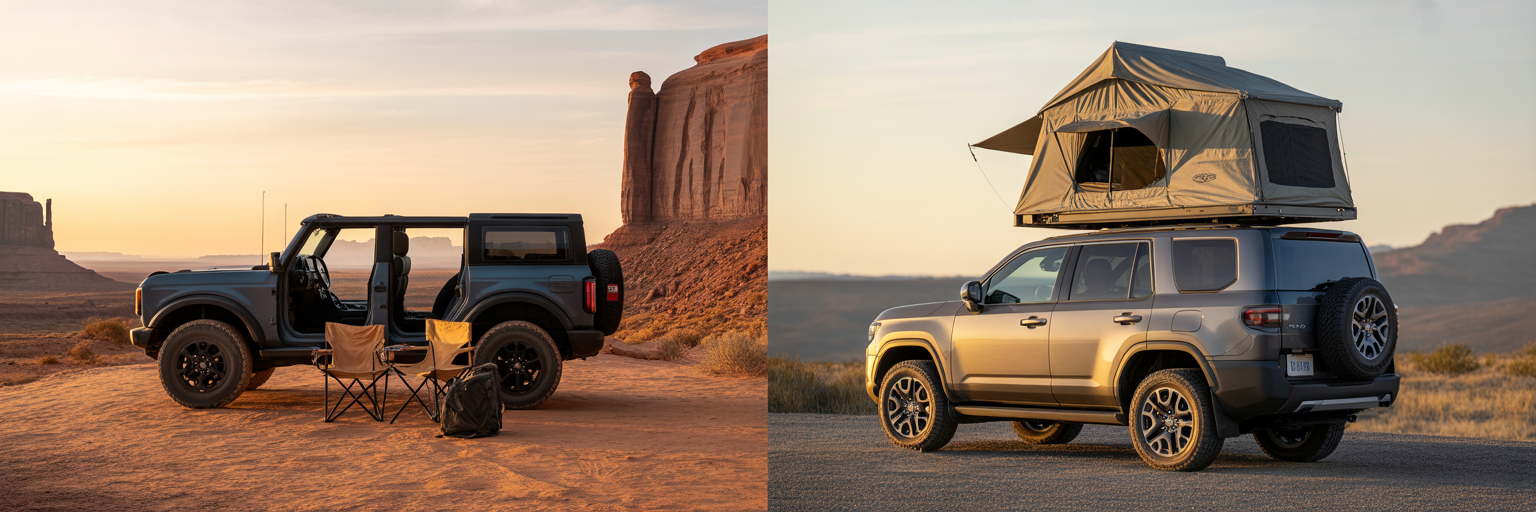
There is one feature that defines the Ford Bronco more than any other: its ability to shed its roof and doors. This single design choice creates an experience the Land Cruiser simply cannot offer, but it comes with a set of practical compromises that every potential buyer must consider.
The appeal is undeniable. With a few minutes of work, you can remove the roof panels and even the doors, transforming the Bronco into an open-air machine that delivers an unparalleled connection to the environment. Driving a doorless Bronco down a scenic trail is a sensory experience, immersing you in the sights, sounds, and smells of the outdoors. This is the core of the Bronco’s “fun” factor, and for many, it’s the primary reason to choose it. It’s a rolling embodiment of freedom.
However, this freedom comes with a list of real-world challenges. A balanced perspective requires acknowledging the downsides of this design:
- Storage: Once you remove four doors and three heavy roof panels, where do you put them? They are bulky and require significant garage space, making spontaneous removal a planned event.
- Weather: Even the best soft tops and panel seals are more susceptible to leaks than a fixed roof. Getting caught in an unexpected downpour can mean a very wet interior.
- Noise: The increase in wind and road noise is significant, even with the roof on. With it off, conversations at highway speeds become difficult.
- Security: A soft top or a topless vehicle offers virtually no security for items left inside. Parking in an urban area requires you to take everything with you.
In stark contrast, the Land Cruiser’s fixed roof offers a different kind of advantage: it’s a fortress. Its solid, one-piece construction provides superior insulation from extreme heat and cold, a much quieter cabin, and a secure environment for you and your belongings. The choice is fundamentally about what you want from your vehicle. Do you want the immersive, sensory experience of the Bronco, with all its associated compromises? Or do you prefer the safe, comfortable, and secure passage through any environment that the Land Cruiser guarantees?
In-Cabin Technology and User Interface
How you interact with your vehicle’s systems is a critical part of the ownership experience. The Bronco and Land Cruiser showcase two distinct philosophies on in-cabin technology, one prioritizing cutting-edge features and the other focusing on functional reliability.
Central Infotainment Screens
The centerpiece of the Bronco’s dash is its large, vertically-oriented touchscreen running Ford’s SYNC system. It’s known for being fast, intuitive, and packed with features like wireless Apple CarPlay and Android Auto. It feels like a modern tablet integrated into the vehicle. Toyota’s latest infotainment system, found in the Land Cruiser, is a massive improvement over its predecessors, with a clean interface and crisp graphics. Its focus is on reliability and clarity, including dedicated off-road displays that show critical information like vehicle pitch and roll. Ford’s system is flashier, while Toyota’s feels engineered to never fail you in the middle of nowhere.
Driver Instrument Clusters
Behind the steering wheel, the differences continue. The Bronco offers a highly customizable all-digital instrument cluster. You can configure it to show a vast amount of information, from navigation directions to detailed off-road data. It’s tech-forward and appeals to those who love personalization. The Land Cruiser opts for a more conservative blend of a central digital screen flanked by clear, analog-style gauges for the speedometer and tachometer. This design is based on the principle of at-a-glance readability, ensuring the most critical information is always visible and unambiguous, a key consideration in demanding driving situations.
Physical vs. Digital Controls
Here lies a surprisingly important distinction. The Bronco features a row of tactile, rubberized buttons and switches on the dashboard for critical functions like the differential lockers and climate control. They are designed to be easily located and operated by feel, even while wearing gloves. It’s a nod to practical, real-world use. The Land Cruiser also retains physical switchgear for key controls, but they are integrated into a more premium and conventional layout. It blends high-quality buttons with touchscreen menus. Ford’s approach prioritizes function in rough conditions, while Toyota’s balances modern design with proven ergonomics. As vehicles become more connected, the conversation around how this data is managed becomes critical. As many experts agree, robust data privacy is the bedrock of modern technology. The trends in both vehicles are part of a larger industry shift, which can be seen in a Hyundai Ioniq 5 vs. Kia EV6 review showcasing other cutting-edge interfaces.
Personalizing Your Rig: The Aftermarket Ecosystem
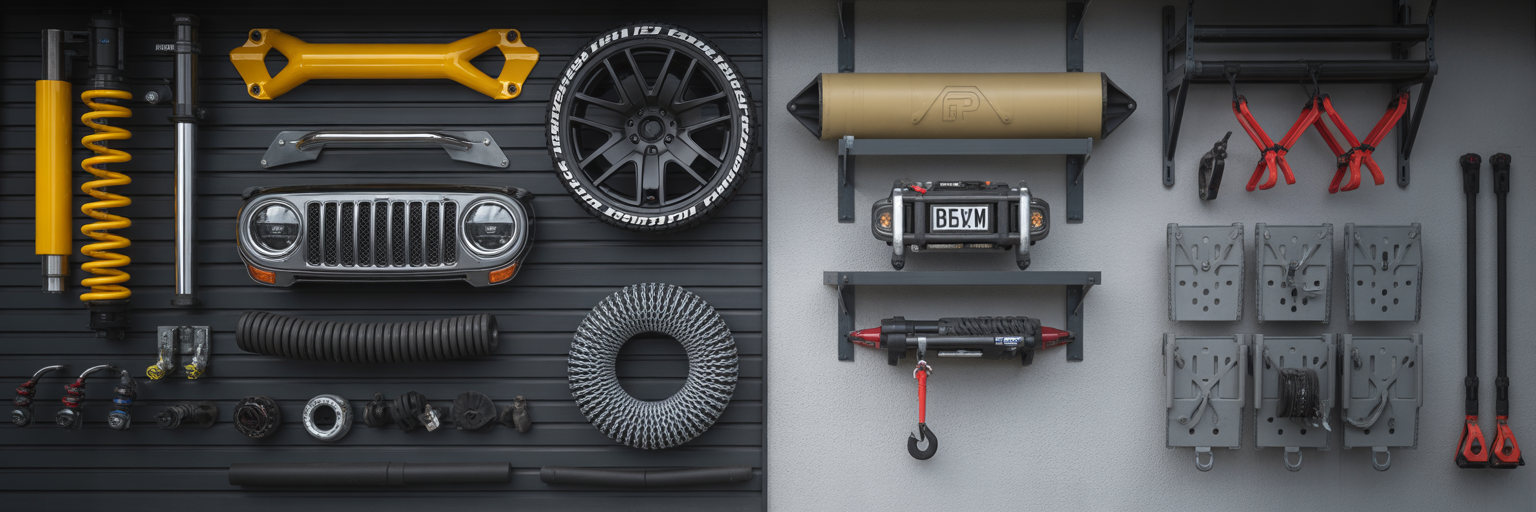
For many owners, buying the vehicle is just the first step. The ability to modify and personalize a 4×4 is a huge part of the culture, and this is an area where the two vehicles could not be more different. The world of Ford Bronco aftermarket parts is a universe unto itself.
From the moment the Bronco was launched, a massive and vibrant industry sprang up to support it. The sheer variety of available parts from both Ford Performance and countless third-party vendors is staggering. This aftermarket is largely focused on personal expression and tailoring the vehicle for specific recreational uses. You can change almost every aspect of the Bronco to fit your style. The Land Cruiser’s aftermarket, while robust and global, is more specialized and conservative. It is centered on professional-grade expedition equipment from respected brands known for their durability. The focus is less on style and more on function for serious, long-distance travel.
The different modification paths are clear:
- Ford Bronco: Lift kits for an aggressive stance, custom grilles with integrated LED lights, colorful beadlock rings to match paint, lightweight tube doors for trail days, and endless vinyl graphic packages.
- Toyota Land Cruiser: Heavy-duty suspension systems designed for increased load capacity, complex drawer systems for organizing gear, snorkels for deep water crossings, and long-range auxiliary fuel tanks to extend remote travel.
Ultimately, the Bronco’s aftermarket is a fast-moving, trend-driven marketplace that allows for infinite individual style. It’s about making the vehicle uniquely yours. The Land Cruiser’s aftermarket is a curated world of proven, functional solutions. It’s about equipping a tool for a specific, demanding job.
Making the Final Decision: Which Adventure Profile Fits You?
After comparing the hardware, daily livability, and long-term prospects, the choice between these two icons comes down to a simple question: What is your definition of adventure? The right answer depends entirely on the kind of owner you are.
We can define two distinct buyer profiles. First is the ‘Weekend Adventurer.’ This person values fun, flexibility, and making a statement. Their SUV is a daily driver that needs to transform into an excitement machine for weekend trips to the trail, beach, or mountains. For them, the Bronco’s thrilling open-air capability, modern technology, and vast aftermarket for personalization are the primary draws. The compromises in noise and security are a small price to pay for the unique experience it offers.
Second is the ‘Long-Term Overlander.’ This buyer’s priorities are absolute reliability, long-term value, and comfort during extended, self-reliant journeys into remote areas. For them, an SUV is a tool they must trust with their safety. The Land Cruiser’s legendary durability, quiet and composed ride, and over-engineered components are non-negotiable. They are willing to trade the Bronco’s playful character for the Land Cruiser’s unwavering peace of mind.
So, if your priority is a fun, highly customizable 4×4 that delivers an unmatched open-air experience, the Ford Bronco is the superior choice. It is arguably the best off road SUV 2026 for expressive, recreational adventure. Conversely, if your adventures involve betting your safety on a vehicle’s ability to get you home from anywhere for the next 200,000 miles, the Toyota Land Cruiser remains the undisputed benchmark. It is less of a toy and more of a lifelong tool. To continue your research, you can see how other legendary nameplates stack up in our Camaro SS vs. Mustang Mach 1 track showdown.