The New Era of Compact Trucks for City Life
The American automotive market has a funny way of reviving old ideas. For years, the compact pickup truck was a relic, a memory of simple, no-frills work vehicles from the 90s. But a new category has emerged, and it’s not about nostalgia. It’s about solving a modern problem. Many people find SUVs aren’t quite practical enough for their weekend projects, yet they see full-size trucks as oversized, thirsty, and a nightmare to park in a crowded city garage.
This is where the 2026 Ford Maverick Hybrid and the 2026 Hyundai Santa Cruz come in. They are the leading contenders defining this new segment, but they represent a clash of philosophies. This isn’t just a feature-for-feature battle. The Maverick embodies pragmatic utility. It’s a smart, efficient tool designed to solve everyday problems with minimal fuss and maximum savings. Think of it as the sensible, clever friend who always has the right tool for the job.
In the other corner, Hyundai markets the Santa Cruz as a “Sport Adventure Vehicle.” The name itself tells you its priority. It emphasizes style, crossover-like comfort, and a more premium, tech-forward experience. It’s less of a tool and more of a lifestyle accessory, designed for those who want the look of adventure with the feel of a modern SUV. This new breed of compact trucks offers a compelling alternative to both SUVs and their larger counterparts.
The core conflict for any potential buyer is clear. Is your priority the Maverick’s almost unbelievable fuel economy and brilliantly versatile bed? Or are you drawn to the Santa Cruz’s refined interior, muscular styling, and more powerful engine options? To help you decide, this detailed Ford Maverick vs Hyundai Santa Cruz comparison will break down exactly what each vehicle offers for daily life. We will examine:
- Powertrain performance and driving feel in traffic
- Real-world running costs and fuel efficiency
- Ride comfort and handling on city streets
- Bed utility and everyday practicality
- Interior design, technology, and safety
By the end, you’ll have a clear picture of which is the best compact pickup for city driving.
Powertrain and Performance Face-Off
What’s under the hood defines how a vehicle feels every single day, from the morning commute to a weekend getaway. Here, the Maverick and Santa Cruz take fundamentally different approaches.
The Maverick’s Hybrid Efficiency
The Ford Maverick Hybrid review 2026 starts with its standard powertrain, a 2.5-liter full-hybrid system. With a combined 191 horsepower, it’s not built to win drag races. Instead, it’s engineered for smoothness and responsiveness where it matters most: in the city. The electric motor provides instant torque from a standstill. That feeling of immediate, silent acceleration when a traffic light turns green makes the truck feel surprisingly nimble and light on its feet. In stop-and-go traffic, the powertrain operates with a quiet confidence that reduces the stress of a noisy commute.
The Santa Cruz’s Power Options
Hyundai offers a choice, which immediately sets it apart. The standard 2.5-liter four-cylinder engine produces around 191 horsepower, putting it in a direct statistical fight with the Maverick. However, the real story is the optional 2.5-liter turbocharged engine. Pushing out approximately 281 horsepower, this engine transforms the Santa Cruz into a much quicker and more assertive vehicle. It’s the clear choice for anyone who prioritizes acceleration and passing power, but that performance comes at a cost at the gas pump.
Driving Dynamics in Urban Traffic
The on-road experience is where their philosophies truly diverge. The Maverick Hybrid often pulls away from a stop in near silence, running on its battery. This creates a serene driving environment that feels calming in dense urban settings. The Santa Cruz, with its conventional gasoline engines and either a traditional automatic or a quick-shifting dual-clutch transmission (on the turbo model), feels more familiar and, with the turbo, decidedly more aggressive.
When it comes to utility, the numbers can be misleading. The Santa Cruz boasts a higher towing capacity, especially with the turbo engine. But how often does the typical urban dweller need to tow 5,000 pounds? The Maverick’s 1,500-pound payload and 2,000-pound towing capacity are more than enough for the tasks it’s designed for: a trip to the garden center, hauling a new piece of furniture, or taking a couple of bikes to a trailhead. While the Santa Cruz boasts higher numbers, it’s worth considering which 2026 trucks offer the best towing and fuel economy for real-world needs. The Maverick is optimized for efficiency, while the Santa Cruz gives you a choice that leans toward performance.
Fuel Efficiency and Real-World Running Costs
For most people living in a city, the total cost of ownership is a huge factor in any vehicle purchase. This is where the Maverick vs Santa Cruz comparison becomes incredibly one-sided. The Maverick Hybrid’s single most compelling advantage is its incredible fuel economy. According to data compiled by Car and Driver, the Maverick Hybrid achieves an EPA-estimated 37 mpg combined, whereas the Santa Cruz’s gasoline engines range from 20 to 25 mpg combined. That difference isn’t just a number on a spec sheet; it translates to significant savings over time.
To put this in perspective, let’s look at the real-world financial impact. The table below shows just how much you could save in fuel costs alone.
| Vehicle | Combined MPG (Est.) | Annual Miles | Projected Gas Price (per gallon) | Estimated Annual Fuel Cost |
|---|---|---|---|---|
| 2026 Ford Maverick Hybrid | 37 MPG | 12,000 | $3.80 | $1,232 |
| 2026 Hyundai Santa Cruz (Base Engine) | 23 MPG | 12,000 | $1,983 | $3.80 |
| 2026 Hyundai Santa Cruz (Turbo Engine) | 22 MPG | 12,000 | $3.80 | $2,073 |
Note: This calculation is an estimate based on a projected national average gas price and 12,000 miles driven per year. The significant difference in annual cost highlights the long-term savings provided by the Maverick’s hybrid system.
The savings are even more pronounced in city driving. The Maverick’s hybrid system uses regenerative braking to recapture energy every time you slow down, which then powers the electric motor. This is a scenario where a traditional gasoline engine, like the one in the Santa Cruz, is at its least efficient, burning fuel while sitting in traffic. Beyond fuel, the Maverick’s hybrid system can also lead to lower maintenance costs. Because regenerative braking does much of the work, the physical brake pads and rotors tend to last longer.
For any driver whose primary concern is minimizing running costs, the conclusion is unavoidable. The Maverick Hybrid is one of the best small trucks with good gas mileage, presenting a far more economical choice. The Maverick’s low running costs place it in a category of value typically reserved for some of the best hybrid SUVs under $35k.
Ride Comfort and Handling Dynamics
Both the Maverick and Santa Cruz share a secret that makes them so well-suited for city life: they are built on a unibody platform, just like a car or SUV. This is what separates them from traditional, rugged body-on-frame trucks and gives them a far superior ride quality. You won’t feel the jarring bumps and shudders common in larger pickups, making them an easy transition for someone coming from a sedan.
The Maverick’s ride is best described as compliant and composed. Ford’s engineers clearly tuned the suspension to soak up the imperfections of urban roads. Potholes, expansion joints, and rough pavement are handled with a softness that prioritizes passenger comfort. The standard front-wheel-drive hybrid model uses a twist-beam rear suspension that is simple, effective, and perfectly suited for the demands of a daily commute.
Pivoting to the Santa Cruz, its ride and handling feel more like a sporty compact SUV, which makes sense given its shared DNA with the Hyundai Tucson. The suspension is a bit firmer, which gives it a more planted and confident feel when you turn into a corner. However, this sportier tuning means you might feel more of the minor bumps and cracks in the road. Its more sophisticated multi-link rear suspension contributes to this controlled handling, giving it an edge for drivers who enjoy a more spirited feel.
In the tight quarters of a city, maneuverability is key. Both trucks are far easier to park and navigate through congested streets than any full-size truck. However, the Maverick’s slightly more upright seating position and its boxier, more defined corners can give some drivers a bit more confidence when squeezing into a tight parallel parking spot. The takeaway is simple: both are comfortable, but the Maverick prioritizes a softer, more absorbent ride, while the Santa Cruz offers sharper, more engaging handling.
Bed Utility and Everyday Practicality
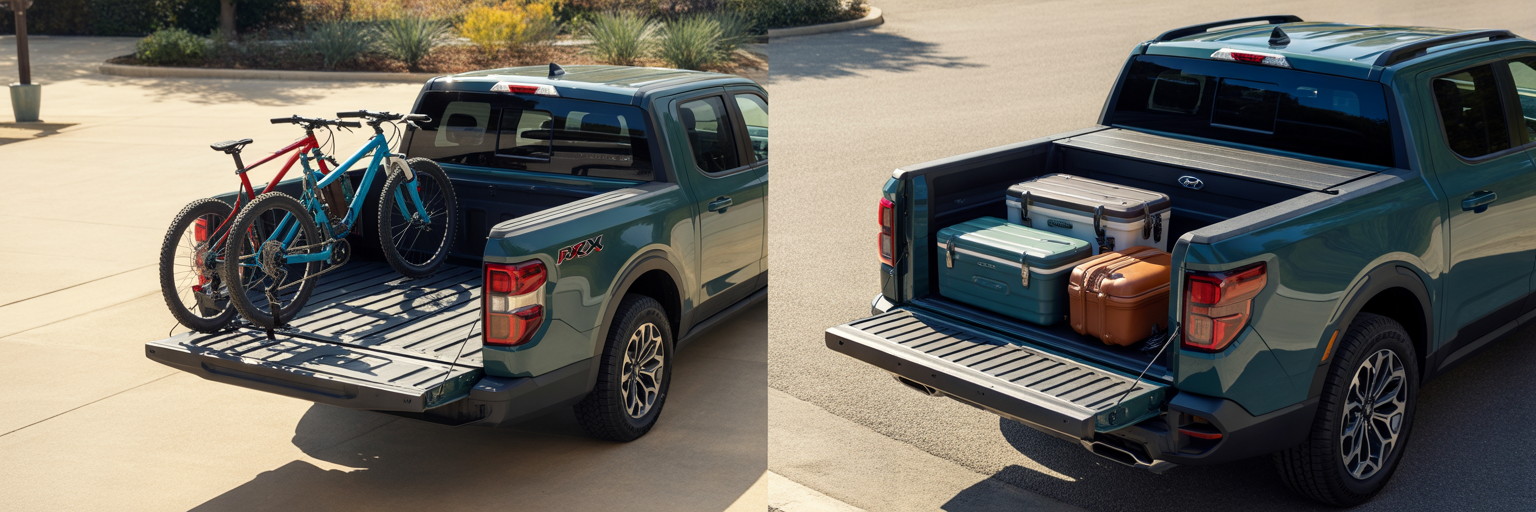
A truck is defined by its bed, and this is where the Maverick’s practical genius truly shines. The focus here isn’t on massive hauling capacity but on clever, real-world solutions for an urban owner. Ford’s “FlexBed” system is a masterclass in functional design.
- It features a 4.5-foot standard length that can be extended to accommodate 8-foot-long items by resting them on the multi-position tailgate.
- It is packed with numerous tie-downs and pre-wired 12V power sources for accessories.
- Its signature feature is the series of slots designed to fit standard 2x4s and 2x6s, allowing owners to easily create custom bike racks, storage dividers, or tiered shelving with a quick trip to the hardware store.
This DIY spirit is something we appreciate, whether it’s customizing your truck bed or learning how to clean headlights with toothpaste. The FlexBed isn’t a gimmick; it’s an open invitation to personalize your utility.
The Hyundai Santa Cruz utility takes a different approach. Its bed is shorter, at just over 4 feet, and its design is more stylized, flowing seamlessly from the cab. Its standout features are geared more toward lifestyle and security. The lockable, weatherproof in-bed trunk is a brilliant addition, perfect for securely stowing groceries, a gym bag, or laptops away from prying eyes. Many models also come with a sleek, factory-integrated roll-up tonneau cover, turning the bed into a secure trunk.
Let’s use a couple of real-world scenarios to draw the contrast. Imagine you just bought a bulky flat-pack bookshelf. In the Maverick, you can easily transport it by setting the tailgate to its mid-position. This would be a much bigger challenge in the Santa Cruz. Conversely, if you’re spending a day at the beach and want to store your valuables securely while you’re in the water, the Santa Cruz’s in-bed trunk is the perfect solution. Ultimately, the Santa Cruz’s bed is a secure gear locker for adventure, while the Maverick’s bed is the clear winner for hands-on practicality and maximum hauling flexibility.
Interior Design and Cabin Comfort
For a vehicle that serves as a daily driver, the interior experience is just as important as what it can haul. Inside, the Maverick and Santa Cruz present two completely different worlds. The Maverick’s cabin is best described as clever, durable, and unapologetically functional. Ford used an interesting mix of plastics and textures that are designed to be hard-wearing and easy to clean. It’s an interior built to be used, not just admired.
The smart storage solutions are a highlight. The door panels are specifically molded to hold a large 1-liter water bottle upright, a small detail that you’ll appreciate every day. Ford also wisely retained simple, tactile physical knobs and buttons for the climate and audio controls, making them easy to adjust without taking your eyes off the road. It feels honest and well-thought-out.
In contrast, the Santa Cruz’s interior is modern, stylish, and feels a class above. It closely mirrors the design of Hyundai’s current lineup of SUVs, with a wraparound dashboard, an available large, fully digital instrument cluster, and a more generous use of soft-touch materials. The gloss-black trim and sleek lines create a premium, car-like ambiance that is designed to impress. It feels less like a truck and more like a well-appointed crossover.
Both are four-door vehicles with seating for five, and passenger space is comparable in both, though some may find the Maverick’s more upright cabin offers a greater sense of airiness. This Maverick vs Santa Cruz comparison of their interiors comes down to a subjective choice. Do you prefer the rugged, built-to-last practicality of the Maverick, or the polished, tech-centric experience of the Santa Cruz? It’s a choice between a durable tool and a stylish accessory.
Technology, Infotainment, and Audio
In 2026, the screen in the dashboard is as important as the engine under the hood. Both the Maverick and Santa Cruz establish a solid baseline, coming standard with a functional 8-inch touchscreen that includes Apple CarPlay and Android Auto. This means that even on the base models, you get essential connectivity for navigation, music, and communication.
The user experience, however, reveals their different priorities. The Maverick’s SYNC system is praised for its simplicity. Crucially, it retains physical volume and tuning knobs. We can all relate to the frustration of trying to adjust volume on a bumpy road using a touch-sensitive slider. Ford’s decision to keep these physical controls is a win for everyday usability.
The Santa Cruz, especially on higher trims, offers a more dazzling tech showcase. The available 10.25-inch screen is visually impressive and packed with features. However, this system relies more heavily on capacitive touch controls for many functions, which can be less intuitive and more distracting to use while driving. It looks futuristic, but is it better? That’s debatable.
Both vehicles offer a suite of available tech upgrades, including fully digital instrument clusters, wireless charging pads, and premium branded sound systems (B&O for Ford, Bose for Hyundai). But the conclusion here should be framed around value. While the Santa Cruz can be optioned into a rolling tech hub, the Maverick’s standard package provides all the essential functionality most people actually need. It delivers a great user experience without forcing buyers into expensive upper trims, making its tech offering practical and highly cost-effective.
Safety Features and Reliability Outlook
When you’re buying a new vehicle, peace of mind is priceless. Both Ford and Hyundai have equipped their compact trucks with a strong foundation of safety technology. The standard safety suites, Ford Co-Pilot360 and Hyundai SmartSense, include the most important features right out of the box.
- Automatic Emergency Braking
- Pedestrian Detection
- Automatic High Beams
This means both vehicles are actively working to prevent an accident before it happens. More advanced driver-assistance systems, like adaptive cruise control with stop-and-go and lane-centering assist, are available on both trucks, typically as part of optional packages or on higher trim levels. In terms of available safety tech, they are very evenly matched.
The conversation around reliability is more nuanced. Here, Hyundai plays its trump card: its industry-leading 10-year/100,000-mile powertrain warranty. This is a massive confidence booster and a tangible benefit that provides long-term security against major repair bills. It’s one of the most compelling reasons to choose any Hyundai.
Ford, on the other hand, leans on its legacy. It has been building trucks for over a century, and that reputation carries significant weight. Furthermore, the Maverick’s hybrid system isn’t some unproven experiment; its core components are shared with other reliable Ford models like the Escape Hybrid, which has a solid track record. While both vehicles are expected to receive high safety ratings from the IIHS and NHTSA, the choice on reliability comes down to what you value more: Hyundai’s explicit, long-term written promise or Ford’s established truck-building heritage.
The Final Verdict for the Urban Buyer
After breaking down every aspect of this Ford Maverick vs Hyundai Santa Cruz matchup, a clear picture emerges. These are two excellent vehicles, but they are designed for two different buyers. The Ford Maverick Hybrid is the undisputed champion of efficiency, low running costs, and no-nonsense utility. It’s a brilliantly designed tool for modern life. The Hyundai Santa Cruz is the stylish, powerful, and tech-forward choice that feels more like an SUV with a bed, prioritizing form and feel over pure function.
So, for the target urban or suburban buyer who needs a vehicle for commuting, errands, and light-duty hauling, which is the better choice? The verdict goes to the Ford Maverick Hybrid. Its justification is built on the key points of this review. Its game-changing 37 MPG is perfectly suited for expensive gas prices and stop-and-go city traffic. Its FlexBed is more versatile for the occasional bulky item from a hardware or furniture store. And its lower starting price and significantly lower running costs make it the financially smarter decision for the vast majority of people.
However, this doesn’t mean the Santa Cruz is without merit. It’s an excellent alternative for a specific buyer: someone who prioritizes a premium interior, powerful acceleration, and head-turning style. It’s for the person who is willing to sacrifice some fuel efficiency and raw utility to get a vehicle that feels more special and looks more aggressive. It’s the “want” choice versus the Maverick’s “need” choice.
Ultimately, the Maverick wins the contest for the most practical and intelligent urban utility vehicle. It simply solves more of the real-world problems that city dwellers face, and it does so while saving them money every single day. If you enjoyed this detailed breakdown, check out our other head-to-head vehicle comparisons.