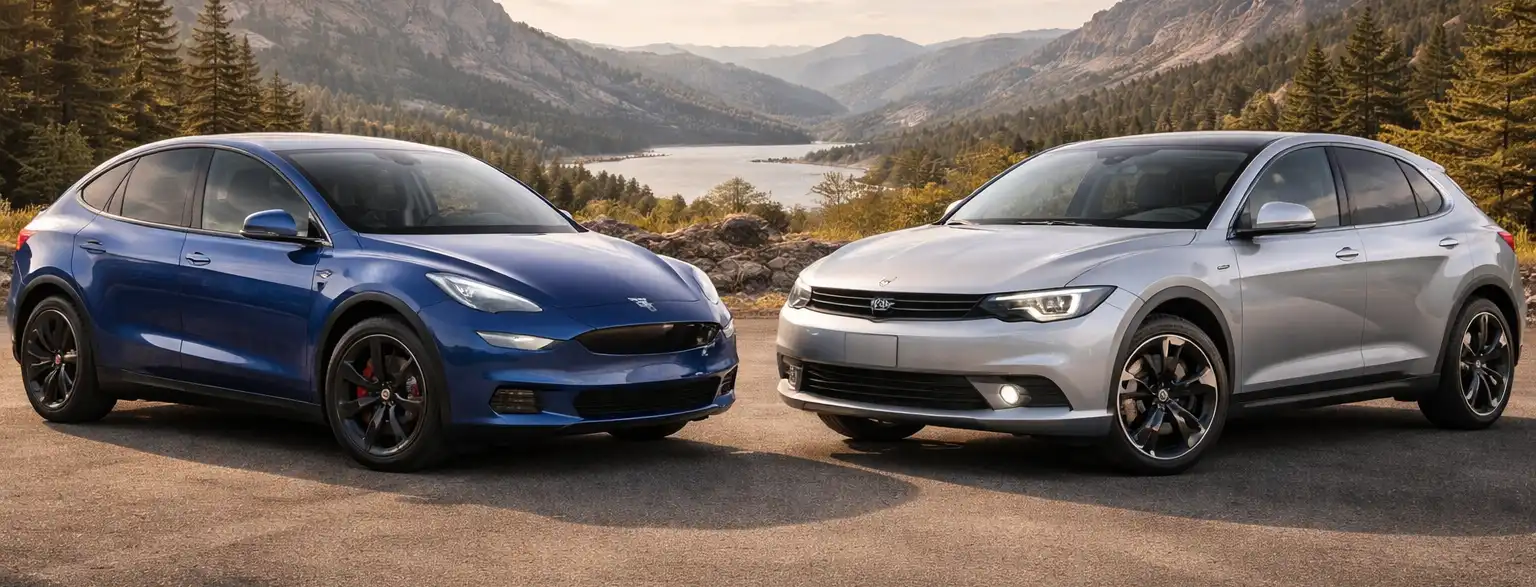
By 2026, the electric vehicle conversation in America has moved past the early adopter phase. The question for most families is no longer *if* they should get an EV, but *which* one truly fits their daily lives. In the crowded electric family SUV segment, two vehicles consistently rise to the top: the Tesla Model Y and the Hyundai Ioniq 5. They represent two distinct philosophies on what a modern car should be, making for a fascinating head-to-head matchup.
The Tesla Model Y stands as the established pioneer, a vehicle born from a tech company that redefined the automotive industry. It’s known for its startling performance, minimalist interior, and the deeply integrated ecosystem of its software and charging network. On the other side is the Hyundai Ioniq 5, an ambitious challenger from a legacy automaker that has fully embraced the electric future. It has earned praise for its bold, retro-futuristic design, user-centric features, and compelling overall value.
Choosing between them involves weighing these different approaches. Is your priority the seamless, software-driven experience and raw power of the Model Y? Or does the Ioniq 5’s thoughtful design, charging flexibility, and financial practicality appeal more? This electric SUV comparison 2026 will break down the decision into four key areas: driving dynamics, range and charging, interior functionality, and the total cost of ownership. Our goal isn’t to crown a single winner. Instead, this guide provides a clear framework to help you decide which of these exceptional vehicles aligns with your personal priorities.
Behind the Wheel: A Tale of Two Driving Philosophies
The moment you press the accelerator, the fundamental differences between the Model Y and Ioniq 5 become clear. One feels like a sports sedan in disguise, while the other prioritizes a calm, collected journey. Their distinct personalities on the road are shaped by opposing philosophies on what makes a great driving experience.
Raw Acceleration: The Instant Torque Divide
The Tesla Model Y Long Range delivers an almost startling surge of power. Its 0-60 mph time of under 4.5 seconds isn’t just a number on a spec sheet; it’s a physical sensation. The power delivery is immediate and silent, a seamless wave of torque that pushes you back into your seat without any drama or hesitation. As noted in a recent Car and Driver comparison, this thrilling acceleration remains a key differentiator. It’s the kind of performance that makes merging onto a busy highway feel effortless and confident.
The Hyundai Ioniq 5 is no slouch, either. It’s impressively quick and more than capable of handling any daily driving scenario with ease. However, its acceleration feels more controlled and progressive. It’s a powerful push rather than a sudden shove, engineered to be smooth and reassuring. For many drivers, this is preferable, as it makes for a less jarring experience for passengers while still providing ample power on demand.
Handling Dynamics: Sporty vs. Serene
The Model Y performance vs Ioniq 5 debate extends directly to handling. The Model Y drives with a firmness that connects you directly to the road. Its steering is quick and responsive, giving the SUV an agile, almost athletic feel through corners. This setup appeals to those who enjoy an engaging drive and want precise feedback from their vehicle. It’s a car that feels smaller and more nimble than its size suggests, a characteristic that makes it a compelling choice in our other comparisons as well.
In contrast, the Ioniq 5 is tuned for comfort. Its suspension is softer, designed to absorb road imperfections and isolate occupants from bumps and vibrations. The result is a quieter, more serene ride that glides over pavement. While its handling is secure and predictable, it prioritizes relaxation over sporty engagement. It’s the vehicle you’d choose for a long, comfortable road trip where the journey is just as important as the destination.
One-Pedal Driving: A Matter of Preference
Both vehicles offer excellent one-pedal driving through regenerative braking, but they approach it differently. Tesla’s system is highly intuitive and aggressive, allowing you to come to a complete stop simply by lifting your foot off the accelerator. It’s a core part of the Tesla driving experience and quickly becomes second nature.
Hyundai’s i-Pedal system, however, offers more customization. Using paddles on the steering wheel, drivers can choose from several levels of regeneration, from an aggressive one-pedal mode to a setting that allows the car to coast like a traditional gasoline vehicle. This flexibility is a significant advantage for drivers who want more control over their driving experience or are transitioning from a non-electric car.
Powering Your Journey: Range and Charging Realities
For any EV owner, the questions of “how far can I go?” and “how quickly can I recharge?” are paramount. While both the Model Y and Ioniq 5 offer more than enough range for daily driving, their capabilities on a long road trip reveal important differences. Exploring these practicalities of EV ownership is key to making the right choice.
EPA Range vs. Real-World Miles
On paper, the Tesla Model Y Long Range often boasts a slightly higher EPA-estimated range than a comparable Ioniq 5. However, in real-world American highway driving, this small advantage can become negligible. Factors like cold weather, high speeds, and even tire choice have a much greater impact on your actual mileage. For most drivers, the practical range difference between these two vehicles on a day-to-day basis is minimal.
The Supercharger Network Advantage
For years, Tesla’s Supercharger network was its undeniable trump card. It remains a gold standard for reliability, ease of use, and sheer number of locations. The “plug and charge” experience, where the car communicates directly with the charger for seamless billing, is incredibly convenient. For anyone who frequently travels long distances to areas with sparse charging infrastructure, the proven dependability of the Supercharger network is a powerful reason to choose a Tesla.
Hyundai’s 800-Volt Architecture and NACS Flexibility
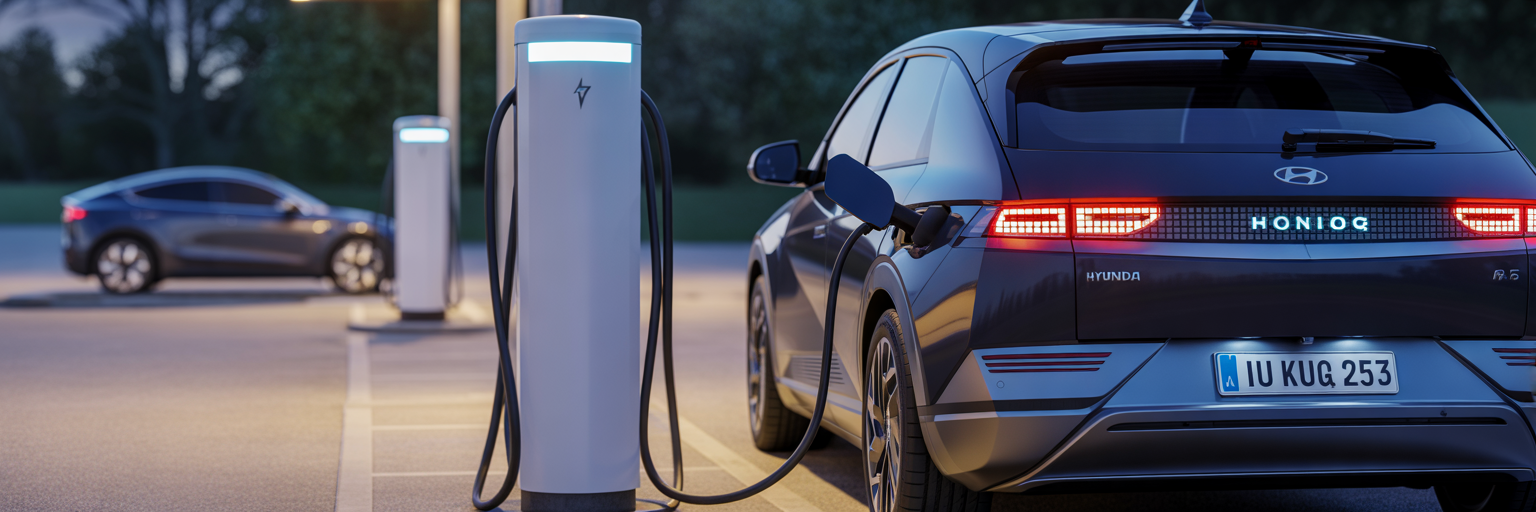
This is where the Ioniq 5 truly shines. Its advanced 800-volt electrical architecture allows it to take advantage of the fastest 350kW DC fast chargers. This superior Ioniq 5 charging speed means it can go from 10% to 80% battery in as little as 18 minutes under ideal conditions. That’s a coffee break, not a lunch stop. Crucially, by 2026, the Ioniq 5 comes equipped with a NACS port, giving it access to Tesla’s Supercharger network in addition to other networks like Electrify America. This dual-network access makes the Ioniq 5 one of the most flexible and convenient EVs to charge on the road, effectively neutralizing one of Tesla’s biggest historical advantages.
| Charging Scenario | Tesla Model Y Long Range | Hyundai Ioniq 5 Limited AWD | Key Takeaway |
|---|---|---|---|
| Level 2 Home Charging (240V) | ~10-11 hours (0-100%) | ~7-8 hours (0-100%) | Both fully charge overnight, making daily use identical. |
| 350kW DC Fast Charger (10-80%) | ~25-30 minutes | ~18 minutes | Ioniq 5’s 800V architecture provides a clear time advantage. |
| Miles Added in 15 Mins (DC Fast Charger) | ~169 miles | ~178 miles | A small but meaningful difference on a road trip stop. |
Cabin Comfort, Technology, and Utility
An electric SUV needs to be more than just a powertrain; it has to be a comfortable, practical, and intuitive space for you and your family. The Model Y and Ioniq 5 present two very different visions for the modern car interior, each with distinct advantages and trade-offs.
Interior Design: Minimalism Meets User-Friendliness
The Model Y’s cabin is a study in stark minimalism. Nearly every vehicle function is controlled through a single, massive central touchscreen. The dashboard is a clean, uninterrupted slab, creating an open and airy feel. While this aesthetic is undeniably futuristic, it comes at a cost. Simple actions like adjusting the mirrors or wipers require navigating through screen menus, which can be distracting while driving.
The Ioniq 5, by contrast, blends modern technology with familiar usability. It features dual screens for the driver display and infotainment but retains physical buttons and switches for essential functions like climate control and volume. This approach feels immediately intuitive. You don’t need to hunt through menus to turn on the heated seats. The result is a cabin that feels both high-tech and user-friendly.
Infotainment: Tesla OS vs. Apple CarPlay & Android Auto
Tesla’s native operating system is fast, responsive, and packed with features like integrated streaming apps, video games, and a web browser. It’s a powerful, self-contained ecosystem. However, its biggest drawback for many American buyers is the lack of support for Apple CarPlay and Android Auto. If your digital life revolves around these platforms, you’ll have to rely on Bluetooth for audio and Tesla’s own navigation system.
This is a major win for the Ioniq 5. Its standard inclusion of Apple CarPlay and Android Auto means seamless access to your phone’s apps, music, and navigation on the car’s large screen. For many, this familiar interface is non-negotiable and makes the Ioniq 5’s system far more practical for daily use.
Driver Assistance: Autopilot vs. Highway Driving Assist 2
Tesla’s Autopilot is one of the most ambitious driver-assistance systems on the market, constantly evolving with over-the-air software updates. It excels at lane-keeping and adaptive cruise control. Hyundai’s Highway Driving Assist 2 (HDA2) is less ambitious but exceptionally reliable and predictable. It smoothly handles lane centering, speed adjustments, and even assists with lane changes. For drivers who want a dependable co-pilot for highway driving without the beta-testing feel, HDA2 is a standout system.
Cargo and Passenger Space
When it comes to pure cargo volume, the Model Y has an edge thanks to its deep sub-trunk and a usable front trunk (frunk). However, the Ioniq 5’s clever design makes it a strong contender for the best electric family SUV. Its completely flat floor and boxy shape make it incredibly practical for carrying bulky items. The sliding center console creates a more open and flexible front passenger area, and the rear seats offer generous legroom, enhancing overall passenger comfort.
- Central Control: Model Y uses a single 15.4-inch touchscreen for nearly all functions; Ioniq 5 uses dual 12.3-inch screens plus physical buttons.
- Smartphone Integration: Ioniq 5 offers standard Apple CarPlay and Android Auto; Model Y relies on its native system with Bluetooth.
- Interior Flexibility: Ioniq 5 features a sliding center console and a more open, flat-floor design.
- Glass Roof: Model Y comes standard with a large, single-pane glass roof; Ioniq 5 offers an optional panoramic sunroof.
- Vehicle-to-Load (V2L): Ioniq 5 includes V2L capability, allowing it to power external devices, a feature absent on the Model Y.
The Financial Equation: Cost, Warranty, and Long-Term Value
The purchase price is just the beginning of the story. A true understanding of the Tesla vs Hyundai cost of ownership requires looking at warranty coverage, resale value, and the service experience. These factors can significantly influence your satisfaction and financial outlay over years of ownership, and it’s an area where the two brands have very different strengths.
The most immediate difference is the initial cost. The Hyundai Ioniq 5 typically holds a significant price advantage over a comparably equipped Tesla Model Y. This upfront saving can be a primary decision-making factor for many families, freeing up budget for other priorities.
Perhaps the most compelling financial argument for the Ioniq 5 is its warranty. As highlighted by sources like Kelley Blue Book, Hyundai’s industry-leading 10-year/100,000-mile powertrain and battery warranty is a standout feature. This provides a decade of protection against major repair costs, offering a level of long-term peace of mind that Tesla’s 8-year/120,000-mile battery and drive unit warranty doesn’t quite match. This robust coverage translates directly into more predictable ownership costs.
Historically, Tesla has been the leader in resale value, with its vehicles holding their worth exceptionally well. However, as the EV market matures and competitors like the Ioniq 5 build a strong reputation for reliability and desirability, that gap is narrowing. While the Model Y may still hold a slight edge, the Ioniq 5 is proving to be a competitive asset in the long run.
Finally, consider the service experience. Hyundai has a vast, established network of dealerships across the country, making it easy to find a location for routine maintenance or repairs. Tesla’s service model relies on a smaller number of dedicated service centers, which can lead to longer wait times and less convenience depending on where you live. For owners outside of major metropolitan areas, Hyundai’s network is a clear practical advantage.
- Initial Price: The Ioniq 5 typically holds a significant price advantage over a comparably equipped Model Y.
- Warranty: Hyundai’s 10-year/100,000-mile powertrain warranty is a standout feature, offering greater long-term protection than Tesla’s.
- Resale Value: Tesla has historically maintained higher resale values, though the gap is narrowing as competitors mature.
- Service Network: Hyundai offers a vast network of dealerships for service, while Tesla’s service center availability can be more limited depending on location.
Which Electric SUV Fits Your Life?
After comparing performance, charging, interiors, and costs, it’s clear there is no single “better” vehicle. The right choice depends entirely on what you value most. The fierce competition between these two has produced a fantastic outcome for consumers: two excellent but fundamentally different electric SUVs. The informed buyer is the true winner.
The case for the Tesla Model Y is clear. It is for the driver who prioritizes raw, exhilarating performance and a tech-forward, minimalist experience. If you love the idea of a car that feels like a gadget, constantly improving through software updates, and you frequently take long road trips where the reliability of the Supercharger network is paramount, the Model Y is likely your ideal match. It’s an athlete in an SUV’s body, built around a powerful and cohesive ecosystem.
The case for the Hyundai Ioniq 5 is equally strong. It is for the buyer who values everyday comfort, practical design, and financial peace of mind. If you prefer a quiet, serene ride, an intuitive interior with physical buttons, and the flexibility of Apple CarPlay, the Ioniq 5 delivers. Its faster charging speeds at top-tier stations and unbeatable warranty make it a pragmatic and deeply satisfying choice for family life.
To find your answer, ask yourself a few direct questions:
- Is the thrill of instant acceleration more important than a quiet, comfortable ride?
- Do you prefer a single screen for all controls or a mix of a touchscreen and physical buttons?
- Is having Apple CarPlay or Android Auto a must-have feature for you?
- Does a 10-year warranty provide more value to you than potentially higher resale value?
By weighing your answers, you can confidently choose the electric SUV that not only meets your needs but also complements your lifestyle. For more reviews and automotive news, you can always explore what we have to offer on our homepage.