Two Visions of Italian Performance
The rivalry between Ferrari and Lamborghini has never been just about speed. It’s a clash of ideologies born in the hills of Emilia-Romagna, a debate between elegance and aggression that continues to define the supercar world. For 2026, that debate is reignited by two new titans: the Ferrari Amalfi and the Lamborghini Temerario. This deep dive follows our tradition of pitting industry titans against each other, offering readers a clear look at their strengths and weaknesses in our VS series.
The Ferrari Amalfi arrives as the latest evolution of the front-mid-engine grand tourer. It’s a direct descendant of a lineage that believes breathtaking performance should not come at the expense of cross-continental comfort. The Amalfi is designed to be as exhilarating on a tight mountain pass as it is composed on a long highway journey, a machine that marries a powerful heart with a sophisticated soul. It represents Ferrari’s conviction that a supercar can be a daily thrill, not just a weekend weapon.
In the other corner stands the Lamborghini Temerario, the successor to the legendary Huracán. This is not a car concerned with subtlety. The Temerario is Lamborghini’s bold statement on the future of hybrid performance, a machine engineered to dominate the track and capture every ounce of attention. It prioritizes raw, unadulterated power and technological supremacy. We’ve all seen cars that look fast standing still, but the Temerario looks like it’s breaking the sound barrier while parked.
The core conflict in the Ferrari Amalfi vs Lamborghini Temerario showdown is clear. Do you choose the refined, muscular experience of the Amalfi’s pure twin-turbo V8, a masterpiece of internal combustion engineering? Or do you embrace the Temerario’s technologically advanced, high-revving hybrid fury, a glimpse into the next era of performance? This isn’t just a choice between two cars. It’s a choice between two philosophies. Which vision of Italian excellence will define the future?
Form and Function in Aerodynamic Design
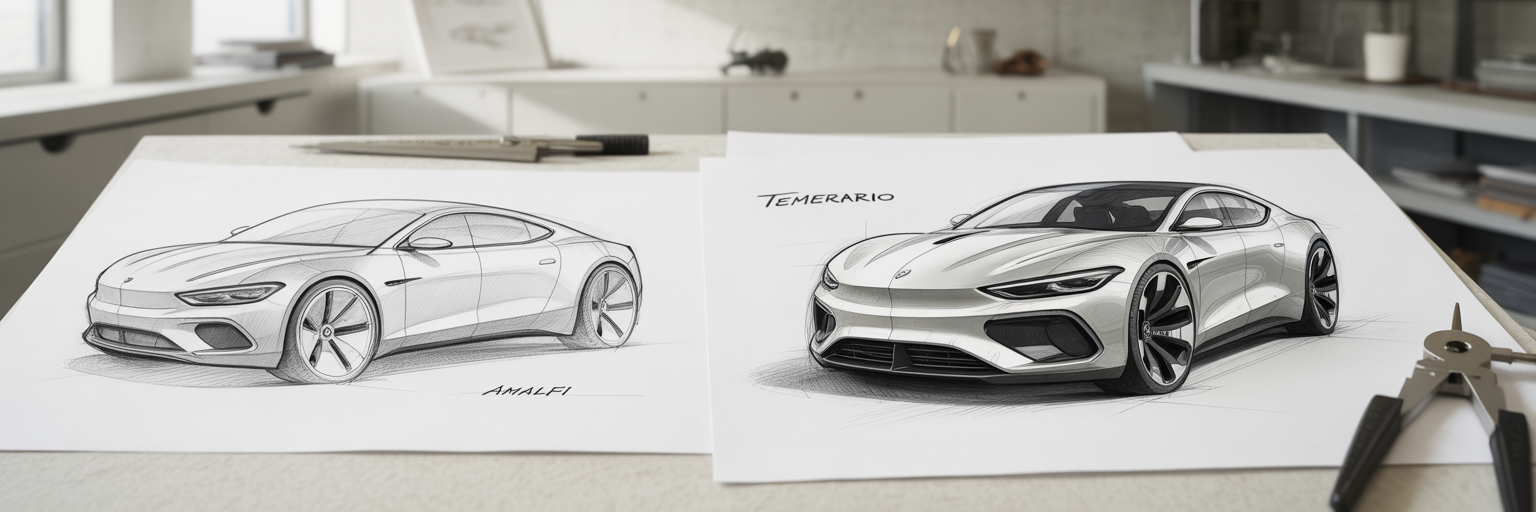
A supercar’s shape is its first promise to the driver, a visual contract of the performance within. With the Amalfi and Temerario, Ferrari and Lamborghini have penned two very different agreements, one written in flowing curves and the other in aggressive, hard-edged lines.
The Amalfi: Sculpted by the Wind
The Ferrari Amalfi is a sleek coupé, its form dictated by the pursuit of aerodynamic efficiency without sacrificing beauty. Its lines are long and sculptural, flowing from the pronounced front fenders over the cabin and down to a taut rear. This is the shape of a high performance grand tourer comparison, where elegance is a critical performance metric. You won’t find massive, tacked-on wings here. Instead, the Amalfi’s aerodynamic elements are masterfully integrated. Active flaps in the front and a subtle deployable spoiler at the rear work in concert with a smooth underbody, managing airflow to create stability at speed while remaining nearly invisible when cruising. It’s a design that whispers its capabilities rather than shouting them.
The Temerario: Forged for Downforce
If the Amalfi is sculpted by the wind, the Temerario is forged to conquer it. Its design language is pure, unapologetic aggression. Every angle, vent, and surface serves a single purpose: to generate downforce and keep the car glued to the asphalt. The styling is dominated by sharp, hexagonal motifs, a signature of modern Lamborghini design. A prominent fixed rear wing, an aggressive front splitter that juts out with intent, and a massive rear diffuser leave no doubt about its track-focused mission. This is a car designed to look and feel like a race car for the road, where every piece of bodywork is a functional weapon in the fight against lift.
A Tale of Two Philosophies
Comparing their designs side-by-side reveals their fundamentally different purposes. The visual distinction is immediate and speaks volumes about what each brand values most.
- Amalfi: Features integrated active aero that adapts to speed, a smooth underbody to reduce drag, and an elegant, flowing silhouette that prioritizes a clean, classic GT profile.
- Temerario: Employs a large fixed rear wing for constant downforce, an aggressive front splitter for maximum front-end grip, and sharp, hexagonal design motifs that scream performance.
This philosophical divide extends to the use of materials. The Amalfi uses carbon fiber strategically for key components and interior accents, reducing weight where it matters most while preserving a sense of handcrafted luxury. The Temerario, by contrast, makes extensive use of lightweight composites throughout its structure. Its optional ‘Alleggerita’ package takes this even further, swapping more panels for carbon fiber to underscore its unwavering commitment to shaving every possible gram in the pursuit of raw performance metrics.
The Heart of the Matter: Powertrain Philosophies
Beneath the sculpted bodywork lies the heart of each machine, and here the philosophical chasm between Ferrari and Lamborghini widens into a canyon. One perfects a proven formula, while the other unleashes a technological storm. Understanding the engineering behind these powerplants provides a deeper appreciation for their performance, a topic we explore across many different vehicles in our informative articles.
Ferrari’s V8: The Evolution of an Icon
The Ferrari Amalfi engine is a testament to the art of internal combustion. It’s a 3.9-liter twin-turbocharged V8, an evolution of the award-winning F154 family. Producing a formidable 640 horsepower, its genius lies not just in the peak number but in its delivery. Ferrari’s engineers have tuned this engine for a broad, linear torque curve. Thanks to Variable Boost Management, which adjusts torque delivery for each gear, the engine feels responsive and naturally aspirated, pulling strongly from low revs all the way to its redline. It’s an engine designed for spirited road driving, providing immense, usable power that is both thrilling and surprisingly manageable for a long-distance journey.
Lamborghini’s Hybrid Fury: A New Era of Power
The Lamborghini Temerario specs read like a fantasy wish list for a performance engineer. It pairs a bespoke twin-turbo 4.0-liter V8 with a trio of electric motors, creating a powertrain that redefines what 2026 hybrid supercars can be. According to a detailed analysis by Car and Driver, the Temerario’s hybrid system achieves a staggering total output of 907 horsepower. Perhaps even more impressive is its 10,000 rpm redline, a feat almost unheard of for a turbocharged engine. The axial-flux electric motors serve a critical role, providing instantaneous torque-fill to completely eliminate turbo lag. The moment you touch the throttle, electric power surges to fill the gap before the turbos spool, delivering a relentless, seamless wave of acceleration.
| Feature | Ferrari Amalfi | Lamborghini Temerario |
|---|---|---|
| Engine Type | Twin-Turbocharged V8 | Twin-Turbocharged V8 + Hybrid System |
| Displacement | 3.9 Liters | 4.0 Liters |
| Electric Motors | None | Three (Axial-Flux) |
| Total Horsepower | 640 hp | 907 hp |
| Maximum RPM | ~8,000 rpm (estimated) | 10,000 rpm |
| Key Technology | Variable Boost Management | Electric Torque-Fill, Torque Vectoring |
| Primary Focus | Broad Torque Curve, Responsiveness | Peak Power, Instant Acceleration |
The Sound of Speed
The auditory experience of these two cars is as different as their engineering. The Amalfi delivers the classic, soul-stirring symphony of a flat-plane crank Ferrari V8. It’s a high-pitched, operatic crescendo that builds with revs, a sound that has defined Italian performance for generations. The Temerario, on the other hand, offers a futuristic, multi-layered soundtrack. You get the deep, guttural roar of the high-revving V8, but it’s overlaid with the silent, urgent surge of electric power. It’s less of a classic song and more of a complex, technological roar that signals a new kind of speed.
Harnessing Power: Drivetrain and Transmission
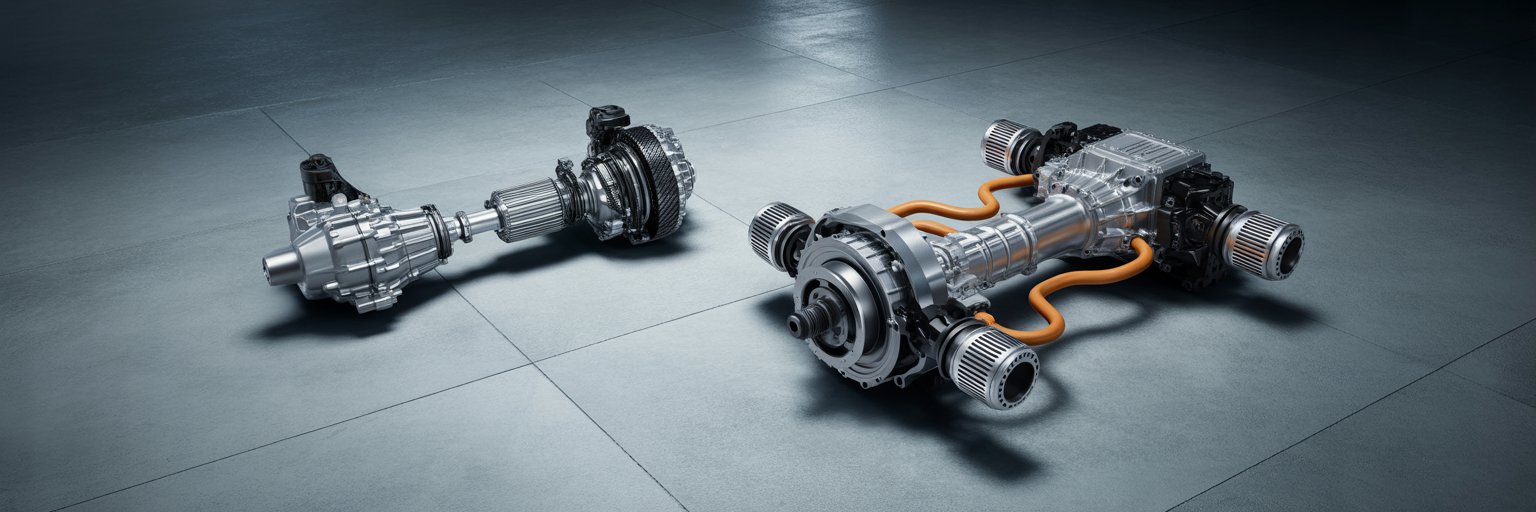
Having immense power is one thing; delivering it to the road effectively is another challenge entirely. The drivetrain layout and transmission are the unsung heroes of performance, and in the Amalfi and Temerario, they are tailored perfectly to each car’s mission. Both Ferrari and Lamborghini have a rich history of engineering marvels, and you can explore more about these iconic brands and their legendary models on our site.
Amalfi: The Classic Front-Mid-Engine Balance
The Amalfi adheres to the classic grand tourer layout with a front-mid-engine configuration. By placing the V8 entirely behind the front axle, Ferrari achieves a near-perfect 50/50 weight distribution. This balance is the key to the Amalfi’s handling character. It provides a natural sense of agility and predictability, allowing the driver to feel connected to the car’s behavior through the steering wheel and seat. This layout not only enhances handling but also preserves the timeless, elegant proportions of a long hood and a cabin set further back, reinforcing its GT identity.
Temerario: Mid-Engine Agility
The Temerario follows Lamborghini’s mid-engine tradition, placing its complex V8 and hybrid system directly behind the driver. This concentrates the heaviest components at the car’s center, resulting in a very low polar moment of inertia. Think of it like an ice skater pulling their arms in to spin faster. This layout enables the Temerario to change direction with incredible speed and immediacy. The turn-in is razor-sharp, and the car feels like it rotates around the driver, a characteristic prized for setting blistering lap times on a racetrack.
Shifting Gears: A Tale of Two Transmissions
Both cars utilize a state-of-the-art dual-clutch transmission (DCT), but they are tuned for different priorities. The Amalfi’s eight-speed DCT is a masterpiece of refinement and speed. In automatic mode, it can be smooth and almost imperceptible, perfect for relaxed cruising. But when you pull the carbon-fiber paddles, it delivers lightning-fast shifts that never upset the car’s balance. The Temerario’s DCT, also an eight-speed, has a tougher job. It’s engineered to withstand the colossal and instantaneous torque from the hybrid powertrain. Its priority is brutal, uncompromising shift speed to ensure no momentum is lost during flat-out acceleration. While it can handle city driving, its true nature is revealed on the track, where each upshift feels like a percussive event.
The real-world result is two distinct driving experiences. The rear-wheel-drive Amalfi offers a thrilling yet predictable GT feel, a car you can dance with on a winding road. The Temerario, with its mid-engine layout and hybrid-assisted all-wheel-drive system, delivers savage, all-weather acceleration and a handling character that feels closer to a dedicated race car.
The Command Center: Interior and Infotainment
Stepping inside these supercars reveals two vastly different interpretations of the driver’s environment. This part of the Temerario vs Amalfi review is crucial, as it’s where the driver connects with the machine. One is a luxurious sanctuary, the other a high-tech cockpit.
Inside the Amalfi: A Driver’s Sanctuary
The Amalfi’s cabin is a masterclass in driver-centric luxury. Ferrari’s “hands on the wheel, eyes on the road” philosophy is on full display. Most critical controls, from the turn signals to the drive mode selector (the Manettino), are mounted directly on the steering wheel. The dashboard is minimalist and elegant, flowing around the driver and passenger. Surfaces are swathed in fine materials like Poltrona Frau leather and matte carbon fiber, creating an environment that feels both sporty and incredibly special. The seats are supportive for spirited driving but designed with enough comfort to make a five-hour journey feel effortless. It’s a space that invites you to drive, not just for the thrill, but for the sheer pleasure of the journey.
Inside the Temerario: The Fighter Jet Cockpit
Opening the scissor door of the Temerario reveals an interior that is pure theater. The design is heavily inspired by aviation, with a low-slung driving position and a cabin that envelops the driver. We’ve all seen that iconic red flip cover protecting the start/stop button, and it’s here, adding a sense of occasion to every startup. The instrument cluster is a fully digital, gamified display that prioritizes performance data like G-forces, lap times, and hybrid system status. Hexagonal design motifs are everywhere, from the air vents to the stitching, reinforcing the car’s aggressive, futuristic character. It feels less like a car interior and more like the command center of a stealth fighter.
User Interface and Practicality
The infotainment approaches reflect each car’s mission. The Amalfi features a crisp 10.25-inch central display that is accessible to the passenger, suggesting a more traditional, shared experience. It balances performance functions with navigation and media in a clean, intuitive interface. The Temerario’s system, in contrast, is almost entirely focused on the driver. The main screen is a digital instrument cluster, with a smaller secondary screen on the center console for auxiliary controls. The focus is on telemetry and performance settings, not on passenger entertainment.
When it comes to practicality, the difference is clear. The Amalfi’s design, with its more upright seating and better all-around visibility, is inherently more suited for grand touring and daily use. The Temerario’s deeply bolstered bucket seats lock you in place for high-G cornering, but they prioritize driver connection far above everyday convenience. Getting in and out is an event in itself, and visibility is compromised for the sake of its dramatic styling.
Contact Patch: Chassis, Suspension, and Tires

The most advanced powertrain in the world is useless without a chassis that can handle it. The suspension, chassis, and tires are the critical link between the driver’s inputs and the road surface. Here, the Amalfi’s duality clashes with the Temerario’s singular focus.
Chassis Tuning: Duality vs. Uncompromising Focus
The Amalfi’s chassis is engineered for a dual purpose. It needs to be rigid enough to provide sharp, responsive handling on a challenging road, yet compliant enough to absorb the imperfections of a real-world highway. The key to this is a sophisticated adaptive damper system. With distinct modes ranging from Comfort to Race, the suspension can transform the car’s character at the touch of a button. In its softer settings, it glides over bumps; in its firmest, it hunkers down for maximum control. It’s a chassis that refuses to compromise, offering both comfort and performance.
The Temerario’s chassis, by contrast, is uncompromisingly tuned for the track. The primary goal is maximum structural stiffness to provide a stable platform for the extreme aerodynamic forces and powertrain output. Body roll is virtually nonexistent. While it likely features adaptive dampers, the range between its softest and firmest settings is much narrower. The default state is firm, and it only gets firmer from there. This setup provides incredible feedback and control at the limit but means the driver will feel much more of the road surface, a trade-off Lamborghini is happy to make for ultimate performance.
The Critical Role of Tires
The final piece of the handling puzzle is the rubber that meets the road, and the tire choices for these two cars tell a story in themselves. The sheer power of the Temerario necessitates an extreme tire setup. As reported by Car and Driver, its tire specifications are a clear indicator of its performance intent.
- Ferrari Amalfi: It wears high-performance tires on forged wheels, likely Michelin Pilot Sport 4S or a similar compound. The setup is optimized for a superb balance of dry and wet grip, road manners, and progressive feedback, allowing the driver to explore the limits confidently.
- Lamborghini Temerario: It is shod with specialized, massive rubber. It wears massive 255/35ZR-20 tires at the front and colossal 325/30ZR-21s at the rear. These are likely a track-focused compound like a Pirelli P Zero Corsa or Trofeo R.
This difference is absolutely critical. The Temerario’s ultra-wide rear tires are essential for transferring its 907 horsepower and immense electric torque to the pavement without being overwhelmed. This extreme tire package provides phenomenal levels of grip but can also be more demanding to drive at the limit, with a sharper breakaway characteristic. The Amalfi’s setup, while still incredibly capable, is designed to offer a more progressive and communicative feel, making its performance more accessible across a wider range of conditions.
The Final Verdict: The Grand Tourer or The Track Weapon
After dissecting the engineering, design, and philosophy behind these two Italian masterpieces, the choice becomes less about which car is “better” and more about which experience you crave. There is no single winner here; there are two different answers to the question of what a supercar should be in 2026.
The Amalfi Experience: The Quintessential All-Rounder
The Ferrari Amalfi is the ultimate expression of the all-rounder supercar. It is a car that delivers a spine-tingling thrill on a winding road like California’s Pacific Coast Highway, with its responsive V8 singing and its balanced chassis dancing through the corners. Yet, it is also a machine you could comfortably drive from Los Angeles to San Francisco without a second thought. It’s an experience defined by balance, elegance, and versatility. The Amalfi doesn’t demand compromises. It offers blistering performance wrapped in a package of usability and timeless beauty, making every drive an occasion, whether it’s a trip to the grocery store or a lap around a circuit.
The Temerario Experience: An Adrenaline-Fueled Event
Driving the Lamborghini Temerario is not a journey; it is a pure, visceral event. The experience is utterly dominated by the explosive, relentless thrust of its hybrid powertrain and the razor-sharp responses of its track-honed chassis. This is a specialized instrument designed to deliver maximum adrenaline, a car that feels most at home on a circuit like Laguna Seca or Circuit of the Americas. Every moment, from flipping the starter cover to feeling the G-forces build in a high-speed corner, is an assault on the senses. It’s a car that makes you feel like a hero, demanding your full attention and rewarding it with a level of performance that borders on overwhelming.
Who Is It For?
So, which car reigns supreme? The answer lies in the driver’s soul. The Amalfi is for the connoisseur, the driver who values heritage, dynamic finesse, and the versatility to enjoy their supercar in any situation. It’s for the person who believes performance and elegance are two sides of the same coin.
The Temerario is for the thrill-seeker, the technology enthusiast who craves the bleeding edge of performance and the raw, unfiltered G-forces that come with it. It’s for the driver who sees a supercar as a weapon for weekend battles on the track and the street.
Ultimately, the Ferrari Amalfi vs Lamborghini Temerario debate is a fantastic problem to have. The Amalfi perfects the high-performance grand touring formula with breathtaking style, while the Temerario redefines the modern supercar with hybrid fury. The choice is yours: refined, versatile excitement or raw, visceral power? Whether your preference is for elegant grand tourers or aggressive track weapons, Carphanatics is your home for in-depth automotive analysis and news.