For decades, the American luxury sedan market operated on a simple premise: if you wanted sophisticated comfort and proven engineering, you bought a German car. An Audi, specifically, was the default choice for those who valued quiet competence and understated prestige. That established order, however, is no longer the only story being told on the road. The central conflict in today’s compact luxury segment is a fascinating one, pitting legacy against ambition.
The 2026 Audi A4 and Genesis G70 are more than just cars; they represent competing philosophies. The A4 is the product of careful evolution, a testament to refined comfort and the quiet confidence of a legacy brand. In the other corner, the G70 embodies disruptive ambition, offering superior standard performance and a value proposition that forces a complete re-evaluation of what a luxury sedan should deliver. This Genesis G70 vs Audi A4 comparison isn’t just about features, it’s about priorities.
So, where is true luxury found? Is it in the established badge and serene daily commute, or in the thrilling performance and financial intelligence offered by a challenger? We will analyze the key battlegrounds: the character of their engines, the feel of their handling in the real world, the quality of their interiors, their onboard technology, and the often-overlooked but critical aspects of long-term ownership. This analysis moves beyond brand bias to help you decide which sedan truly aligns with your definition of modern luxury.
Engine Performance and Power Delivery
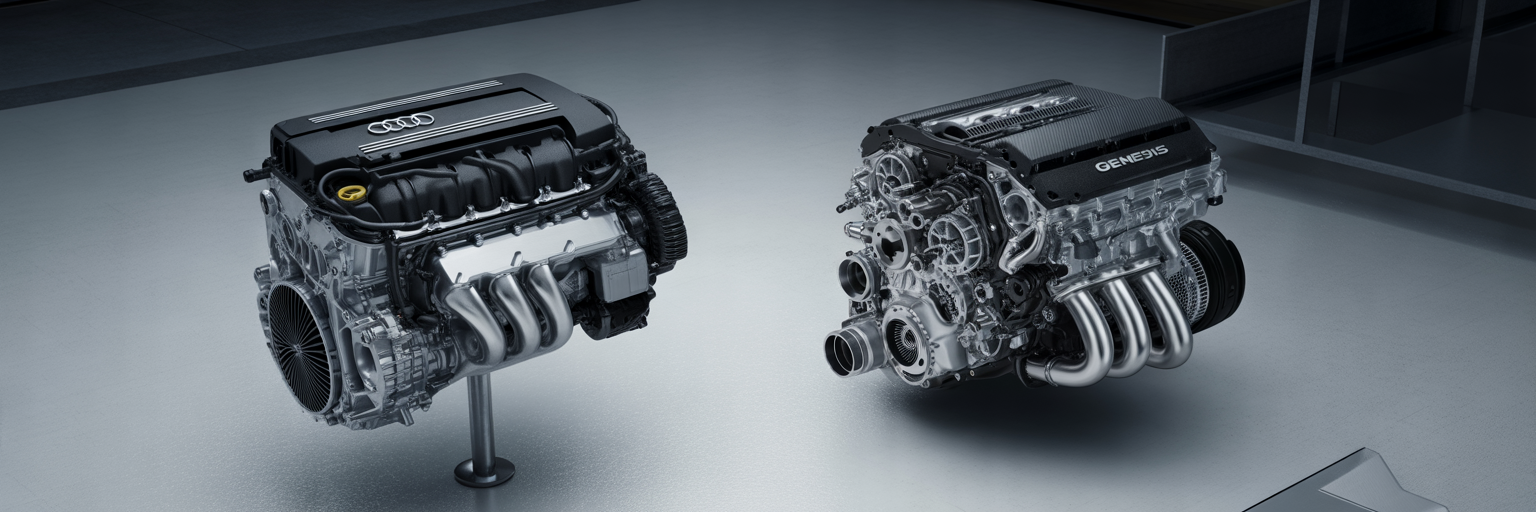
The conversation about these two sedans begins under the hood, where their differing philosophies are most apparent. One prioritizes accessible power from the start, while the other focuses on progressive refinement. This isn’t just about numbers on a spec sheet; it’s about how that power feels when you press the accelerator on a highway on-ramp or pull away from a stoplight.
The Standard Powertrain Advantage
Right out of the gate, the Genesis G70 establishes a commanding lead. Its standard 2.5-liter turbocharged four-cylinder engine produces a robust 300 horsepower. This isn’t just an on-paper victory. It translates to an immediate, confident surge of acceleration that makes daily driving feel effortless and engaging. In contrast, the entry-level Audi A4 40 TFSI comes with a 2.0-liter turbocharged engine delivering 201 horsepower. While perfectly adequate for city commuting, it lacks the G70’s sense of urgency. For buyers who want performance without ticking a single option box, the G70 is the undeniable choice.
Optional Upgrades: Raw Power vs. Refined Speed
When you step up to the optional engines, the character differences become even more pronounced. The G70 3.3T vs Audi S4 (the A4’s direct performance variant) showcases this perfectly. The G70’s 3.3-liter twin-turbo V6 is all about visceral excitement. It delivers its power with a muscular, slightly raw character that enthusiasts crave, accompanied by a satisfying engine note. The Audi S4’s turbocharged V6, on the other hand, is a model of relentless efficiency. Its power delivery is incredibly smooth and linear, creating a feeling of effortless, almost silent, velocity. It’s a choice between the thrill of the G70’s raw power and the sheer, unflappable competence of the Audi.
Transmissions and Drivetrain Response
A great engine needs a great partner, and both sedans feature excellent transmissions tuned to their respective missions. The G70 uses a traditional 8-speed automatic that has been programmed for sporty, decisive shifts, especially in its sportier drive modes. It holds gears willingly and responds quickly to paddle shifter inputs. The A4 employs a 7-speed S tronic dual-clutch transmission (DCT). This technology provides nearly instantaneous and seamless gear changes, contributing to the car’s polished and uninterrupted feel. The DCT is a marvel of engineering, but the G70’s automatic can feel more traditionally engaging during spirited driving.
Audi’s Mild-Hybrid System: A Focus on Efficiency
It’s important to note that the Audi A4’s powertrain includes a mild-hybrid system. However, its purpose is not to boost peak performance. Instead, this system is engineered to improve fuel economy and smooth out the engine’s start-stop function, making it nearly imperceptible in traffic. This technology reinforces Audi’s core philosophy of refinement and efficiency, even if it means ceding the raw horsepower crown to Genesis. This approach is similar to what we’ve seen in other segments, like in our analysis of the Toyota RAV4 vs Tesla Model Y, where differing philosophies on performance and efficiency define the vehicles.
Handling Dynamics and Ride Comfort
Moving beyond how these cars accelerate, we arrive at how they feel through the steering wheel and the seat of your pants. The previous section focused on straight-line power, but this is about the connection between driver, car, and road. Here, the G70 and A4 offer two distinct experiences, one aimed at engagement and the other at isolation.
Drivetrain Philosophy: RWD Agility vs. AWD Security
The most fundamental difference in their handling is the drivetrain layout. The Genesis G70 is built on a standard rear-wheel-drive (RWD) platform, the classic formula for a sport sedan. This provides a natural sense of balance and agility, allowing the front wheels to focus on steering while the rear wheels handle propulsion. You can feel the car pivot around you in a corner, a sensation prized by driving enthusiasts. The Audi A4, conversely, is defined by its front-wheel-drive-based Quattro all-wheel-drive (AWD) system. The result is unshakable stability and a secure, planted feel in all weather conditions. The Audi A4 Quattro performance is less about playful agility and more about confident, all-weather grip that inspires security on any road surface.
Suspension Tuning: A Tale of Two Rides
This drivetrain difference is amplified by their suspension tuning. The G70, especially in its Sport trims, offers a firmer, more communicative ride. You feel more of the road’s texture, which creates a stronger connection for the driver but can be less forgiving over broken pavement. The A4 is engineered for sophisticated comfort. Its suspension excels at absorbing road imperfections, creating a serene cabin environment that isolates you from the harshness of the outside world. Both brands offer adaptive suspensions as an option, attempting to bridge this gap, but their baseline characters remain distinct: the G70 connects you to the road, while the A4 protects you from it.
Steering Feel and Driver Connection
That connection is further defined by the steering. The G70’s steering is weighted to be heavier and more direct, providing more granular feedback from the front tires. It requires a bit more effort, but it rewards the driver with a clearer sense of what the car is doing. The A4’s steering is lighter and more insulated. While precise and easy to use in daily driving and parking maneuvers, it filters out much of the road feel in the name of comfort. It’s a choice between communication and ease of use, a theme that runs through many of our head-to-head vehicle comparisons.
Braking Systems: Confidence for the Canyon Road
A final, telling detail is the braking hardware. The Genesis G70 offers high-performance Brembo brakes on its sport-oriented models. These powerful brakes provide exceptional stopping power and superior resistance to fade during repeated hard use, underscoring the car’s sporting credentials. The A4’s standard brakes are more than competent for any daily driving scenario, but they are not designed with the same high-performance ceiling in mind.
- Genesis G70: RWD-based agility, communicative ride, direct steering, available Brembo brakes.
- Audi A4: AWD-based security, composed comfort, light steering, competent daily-use brakes.
Interior Quality, Design, and Practicality
The cabin is where you spend all your time, and both Audi and Genesis have created beautiful, high-quality environments. Yet, just like their driving dynamics, their interior designs follow contrasting philosophies. One is a study in cool, technological minimalism, while the other embraces a warmer, more driver-focused opulence.
Contrasting Design Philosophies: Opulent vs. Minimalist
Stepping into the 2026 Audi A4 is like entering a modern design museum. The cabin is a masterclass in tech-forward minimalism, defined by clean, horizontal lines that emphasize width and space. The large, integrated screens and the expansive Virtual Cockpit create an atmosphere of understated, almost clinical elegance. The Genesis G70, by contrast, feels more like a tailored cockpit. The design wraps around the driver, with a prominent center console and a satisfying array of physical buttons and knobs for key functions like climate and audio. It’s a more traditional approach to luxury, prioritizing tactile control and a sense of occasion with details like available quilted Nappa leather.
A Deep Dive into Materials and Craftsmanship
Both cars use premium materials, but they impress in different ways. Audi remains a benchmark for fit and finish. Every button and dial delivers a satisfying, tactile click, and the precision of the panel gaps is second to none. It feels engineered to perfection. Genesis, however, impresses with the sheer quality and generous application of its materials. You’ll find soft-touch surfaces and real metal trim in places where some competitors, including Audi, might use high-quality plastic. The G70’s focus is on delivering a rich, tactile experience throughout the cabin, making it feel more expensive than it is. Both approaches reflect the premium nature of these luxury and mainstream manufacturers we cover.
Passenger Accommodations and Cargo Space
From a practical standpoint, there are trade-offs. The G70 often provides more generous and deeply bolstered front seats, reinforcing its driver-centric mission. However, this can come at the expense of rear-seat legroom, which can be tighter than in the A4. The Audi generally offers a more conventionally shaped and usable rear passenger area and a trunk that is slightly more accommodating for bulky items. When it comes to daily usability, the G70’s physical controls for common tasks can be easier to use on the move. The A4’s reliance on its touchscreen for some functions, while sleek, can require more attention. For pure practicality, the A4 has a slight edge, but the G70’s focus on the driver’s immediate needs is compelling.
Onboard Technology and Sound Systems

In 2026, in-car technology is as much a part of the luxury experience as leather and wood. The infotainment screen and digital cluster are the primary points of interaction, and both Audi and Genesis have invested heavily here. However, they prioritize different aspects of the user experience, creating a choice between deep functionality and straightforward intuition.
Central Infotainment: Intuitive vs. Feature-Rich
Audi’s MMI touch display is a powerful, feature-rich system with crisp graphics and quick responses. It’s deeply integrated with the car’s systems and offers a high degree of customization. However, its menu structure can sometimes feel complex. We all know that moment when you just want to find a simple setting and end up three menus deep. The Genesis infotainment system, while also featuring a large and responsive touchscreen, is widely praised for its simplicity. Its logical layout and clear graphics make it one of the most intuitive systems on the market. For users who value ease of use over endless configuration options, the Genesis interface is a significant advantage.
Digital Instrument Clusters: The Virtual Cockpit Benchmark
When it comes to the screen behind the steering wheel, the Audi Virtual Cockpit remains the industry benchmark. Its ability to display a full-screen, high-resolution navigation map is a standout feature that transforms how you follow directions. The level of customization it offers is unparalleled. The Genesis G70’s digital instrument cluster is no slouch, offering its own compelling features like incredibly sharp graphics and an available 3D effect that adds a sense of depth. It presents driving information clearly and attractively, but it doesn’t offer the same level of deep data configuration and full-screen map integration as the Audi.
Premium Audio Systems: Bang & Olufsen vs. Lexicon
For audiophiles, the choice of premium sound system is critical. The Audi A4 offers an available Bang & Olufsen system known for its crisp, precise, and almost clinical sound reproduction. It’s like listening with studio monitor headphones, revealing every detail in the music with stunning accuracy. The Genesis G70 counters with a Lexicon premium audio system. Lexicon systems are often tuned to provide a warmer, more immersive surround-sound experience. The soundstage feels wider, creating a concert-hall ambiance that fills the cabin. It’s a choice between analytical clarity and immersive warmth.
- Connectivity: Both vehicles offer seamless Apple CarPlay and Android Auto integration, typically with wireless capability.
- Head-Up Display: Both offer bright, clear head-up displays, but Audi’s can often integrate more detailed navigation and driver-assist information.
- Wireless Charging: A conveniently located wireless charging pad is available in both, though the G70’s design is often cited as being more accommodating for larger phones.
Advanced Safety Features and Driver Assistance
Safety is non-negotiable in a modern luxury car, and both the G70 and A4 are equipped with an impressive array of technologies designed to prevent accidents and protect occupants. While both provide a high level of security, Genesis again pushes the value proposition by making more of its advanced systems standard across the lineup.
Standard Active Safety Suites
You can rest assured that both sedans come equipped with a comprehensive suite of active safety features. Core technologies like automatic emergency braking with pedestrian detection, blind-spot monitoring, and lane-keeping assist are readily available on most trims. The key difference, however, is that Genesis often includes its more advanced “Highway Driving Assist” features as standard equipment on more trim levels. This means buyers get a more complete semi-autonomous driving package without having to climb to the most expensive models, representing a better out-of-the-box value.
Unique and Advanced Safety Technologies
Digging deeper reveals unique safety innovations from each brand. The Genesis G70, for instance, comes standard with a front center airbag. This important feature, located between the driver and front passenger, is designed to prevent occupants from colliding with each other during a side-impact crash. Audi, meanwhile, shows its attention to detail with features like the inclusion of pretensioners for the rear outboard seat belts, a technology that tightens the belts in the initial moments of a crash to better secure backseat passengers. These distinct features show how both brands are pushing safety forward, a topic we take seriously when covering industry news like the recent GM 6.2L engine recall.
Semi-Autonomous Driving Systems in the Real World
On the highway, the real-world performance of these systems matters most. Audi’s Adaptive Cruise Assist with Traffic Jam Assist is exceptionally smooth, managing speed and lane centering with a polished competence that feels very natural. Genesis’s Highway Driving Assist II is equally capable and adds features like machine-learning for the smart cruise control and lane-change assistance. From the driver’s perspective, both systems inspire confidence and reduce fatigue on long journeys. The choice often comes down to personal preference, as both are among the best in the segment. Ultimately, with strong safety ratings typically earned from both the IIHS and NHTSA, buyers can be confident in the fundamental passive safety of either car.
Pricing, Warranty, and Long-Term Value

This is where the debate shifts from the emotional to the rational, and where the Genesis G70 builds its most compelling case. A luxury car purchase is a significant financial decision, and understanding the total cost of ownership is critical. The G70’s advantage in this area is not just a minor detail; it’s a core part of its identity.
Starting Price vs. Standard Equipment
At first glance, the starting MSRPs for the G70 and A4 appear competitive. However, this surface-level view is misleading. As we discussed earlier, the G70’s base price includes a 300-horsepower engine, offering nearly 100 more horsepower than the base 201-hp A4. To get comparable performance from an Audi, you would need to spend significantly more. This immediately frames the G70 as the performance-per-dollar leader and a superior value from the moment you start building your car.
The Critical Warranty Advantage
The most significant factor in this luxury car value comparison is the warranty. The difference is stark and has major implications for long-term peace of mind and potential out-of-pocket costs. The Genesis G70 reliability and warranty package is the best in the luxury class, period. It provides a 10-year/100,000-mile powertrain warranty, more than double Audi’s coverage. This isn’t just a marketing point; it’s a statement of confidence in the vehicle’s long-term durability, protecting owners from expensive powertrain repair bills for a full decade.
| Metric | 2026 Genesis G70 | 2026 Audi A4 |
|---|---|---|
| Basic (Bumper-to-Bumper) Warranty | 5 years / 60,000 miles | 4 years / 50,000 miles |
| Powertrain Warranty | 10 years / 100,000 miles | 4 years / 50,000 miles |
| Projected 5-Year Depreciation | 44.4% | 50.2% |
| Standard Base Engine Horsepower | 300 hp | 201 hp |
Note: Warranty data reflects standard manufacturer coverage in the United States. Depreciation data is based on projections from automotive industry analysts like iSeeCars.com for comparable models, highlighting the total cost of ownership over a typical ownership period.
Resale Value and Total Cost of Ownership
For years, a common assumption was that German luxury cars held their value best. That is no longer a given. According to analysis from industry experts like iSeeCars.com, the data tells a different story. The Audi A4 is projected to lose 50.2% of its value over five years, while the Genesis G70 is expected to lose only 44.4%. This stronger value retention means G70 owners will get more of their initial investment back when it’s time to sell or trade in. When you combine a lower depreciation rate with a vastly superior warranty that minimizes repair costs, the G70 emerges as the clear winner in total cost of ownership, making it a financially smarter decision over the long run.
The Final Verdict: Which Sedan Earns Your Money?
After analyzing everything from engine character to long-term cost, a clear picture emerges. The choice between the 2026 Audi A4 and Genesis G70 is a choice between two different definitions of luxury. The Audi A4 is the embodiment of sophisticated, understated German engineering. It is the ideal sedan for the buyer who prioritizes brand heritage, a supremely serene and comfortable ride, a high-tech minimalist interior, and the all-weather security of the legendary Quattro system. It is an excellent, highly polished machine that executes its mission of quiet competence flawlessly.
However, the Genesis G70 presents a more powerful argument for the modern buyer. It is the car for both the driving enthusiast and the financially savvy consumer. It delivers superior standard performance, a more engaging RWD-based chassis that speaks to those who love to drive, and an unbeatable long-term value proposition. The G70 proves that you don’t have to compromise on premium features or thrilling dynamics to make a smart purchase. Its industry-leading warranty and stronger resale value are not just numbers on a chart; they represent real-world financial benefits and peace of mind.
While the Audi A4 remains a formidable and desirable luxury sedan, the 2026 Genesis G70 offers a more compelling overall package. For buyers seeking more power for their money, more dynamic handling, and significantly better long-term value, the G70 stands out as the smarter and more exciting choice. It challenges the old guard not just on price, but on performance and principle, arguably making it the best luxury sport sedan in this comparison. To continue exploring the automotive world, you can find all our latest news, reviews, and guides on the CarPhanatics homepage.