
The compact SUV market is filled with practical choices, yet the allure of luxury remains strong. This creates a classic conflict for buyers considering two of the most popular hybrids from the same automotive family. The central question in the Lexus NX 350h vs Toyota RAV4 Hybrid debate is whether the premium price of the Lexus is justified by tangible, real-world benefits over its exceptionally competent Toyota counterpart. While both vehicles are built around a shared 2.5-liter hybrid powertrain, their engineering philosophies diverge significantly.
The Toyota RAV4 Hybrid is designed from the ground up for maximum value, utility, and efficiency. It’s the sensible, do-it-all choice for a huge segment of the population. The Lexus NX 350h, on the other hand, is engineered for refinement, quietness, and a premium ownership experience. They are not simply rebadged versions of one another but distinct vehicles aimed at different buyers with different priorities. This type of head-to-head matchup is a core focus for us, and for readers interested in other detailed analyses, Car Phanatics offers a dedicated section for vehicle comparisons.
To determine if the upgrade is worth it, we will examine several key areas. We will start with the purchase price and standard features, then move to driving dynamics and refinement. From there, we will explore interior quality and comfort, everyday practicality, and the crucial long-term ownership costs that are often overlooked. There is no single winner here. The right choice depends entirely on your personal priorities, whether that is financial prudence, daily comfort, or the prestige associated with a luxury brand.
A Tale of Two Hybrids: Lexus NX 350h vs Toyota RAV4 Hybrid
The compact SUV market is filled with practical choices, yet the allure of luxury remains strong. This creates a classic conflict for buyers considering two of the most popular hybrids from the same automotive family. The central question in the Lexus NX 350h vs Toyota RAV4 Hybrid debate is whether the premium price of the Lexus is justified by tangible, real-world benefits over its exceptionally competent Toyota counterpart. While both vehicles are built around a shared 2.5-liter hybrid powertrain, their engineering philosophies diverge significantly.
The Toyota RAV4 Hybrid is designed from the ground up for maximum value, utility, and efficiency. It’s the sensible, do-it-all choice for a huge segment of the population. The Lexus NX 350h, on the other hand, is engineered for refinement, quietness, and a premium ownership experience. They are not simply rebadged versions of one another but distinct vehicles aimed at different buyers with different priorities. This type of head-to-head matchup is a core focus for us, and for readers interested in other detailed analyses, Car Phanatics offers a dedicated section for vehicle comparisons.
To determine if the upgrade is worth it, we will examine several key areas. We will start with the purchase price and standard features, then move to driving dynamics and refinement. From there, we will explore interior quality and comfort, everyday practicality, and the crucial long-term ownership costs that are often overlooked. There is no single winner here. The right choice depends entirely on your personal priorities, whether that is financial prudence, daily comfort, or the prestige associated with a luxury brand.
Analyzing the Price and Feature Divide

The financial aspect of this comparison is the most straightforward and often the deciding factor for many buyers. The price difference isn’t just a small step up; it represents a significant leap into another vehicle class. Understanding what that extra money buys you in terms of standard and optional equipment is essential to making an informed decision.
The Initial Price Gap: A Five-Figure Difference
The conversation begins with the manufacturer’s suggested retail price (MSRP). For the 2026 model year, a new Toyota RAV4 Hybrid starts under $35,000 for a well-equipped trim. In contrast, the Lexus NX 350h begins its pricing over $45,000. This immediate five-figure difference of more than $10,000 is the primary hurdle for anyone cross-shopping these two vehicles. That initial cost sets the stage for every other comparison, as it’s the price you pay for the promise of a more premium experience.
Standard Equipment: What Your Money Buys at the Base Level
That $10,000-plus gap does translate into a noticeable difference in standard features. A base model RAV4 Hybrid comes with durable cloth seats, an 8-inch infotainment screen, and a functional interior that prioritizes usability over aesthetics. It’s comfortable and well-built, but the materials are chosen for longevity and cost-effectiveness.
Stepping up to the base NX 350h, that extra investment immediately becomes apparent. Standard equipment includes NuLuxe synthetic leather upholstery, which feels substantially more upscale than cloth. The standard infotainment screen is larger at 9.8 inches, and the entire cabin is appointed with higher-grade, soft-touch materials on the dashboard and door panels. Features like multi-zone climate control and more sophisticated ambient lighting are also part of the standard package, creating a more inviting and luxurious atmosphere from the moment you get in.
The World of Options: How Costs Escalate
The price divide widens considerably once you enter the world of optional packages. Toyota offers packages that add features like a larger screen, a sunroof, and SofTex seats, but the options list is relatively contained. Lexus, however, offers a suite of high-cost, exclusive options that can quickly push the NX 350h’s price well past $55,000.
These include the stunning 17-speaker Mark Levinson premium audio system, a true audiophile-grade experience that costs several thousand dollars. Other Lexus-exclusive options include a massive 14-inch infotainment display, a panoramic glass roof, and advanced driver aids like a 360-degree camera system with a transparent under-vehicle view. These features are simply not available on the RAV4 at any price, and they represent a significant part of the luxury proposition.
Value Analysis: Loaded RAV4 vs. Base NX
This brings up a critical question of value. A fully loaded RAV4 Hybrid can be equipped with features like a premium JBL audio system, a 10.5-inch screen, heated and ventilated front seats, and a digital rearview mirror, with a final price that lands near the starting price of a base NX 350h. This creates a compelling dilemma. Is your money better spent on the top-tier version of a mainstream vehicle or the entry-level version of a luxury one? The loaded RAV4 offers more features for the money, but it can never replicate the fundamental refinement, quietness, and material quality of the Lexus. This is where the Toyota RAV4 Hybrid value shines, offering a near-luxury level of equipment without the associated brand premium.
Performance, Efficiency, and Driving Dynamics
While the price and features are easy to compare on paper, the driving experience is where the distinct engineering philosophies of Toyota and Lexus truly come to life. Despite sharing a powertrain, the way these two SUVs translate power to the road and shield their occupants from the outside world is fundamentally different.
The Shared Heart: A Common Powertrain
At the core of both vehicles is Toyota’s highly regarded A25A-FXS engine, a 2.5-liter four-cylinder paired with electric motors and an electronically controlled continuously variable transmission (eCVT). In both applications, the system produces a similar combined horsepower figure. However, to assume they perform identically would be a mistake. The engine management, transmission calibration, and power delivery have been tuned to meet very different goals.
On-Road Feel: Smoothness vs. Utility
When comparing the RAV4 Hybrid vs Lexus NX 350h in everyday driving, the differences are immediately noticeable. When you press the accelerator to merge onto a highway, the RAV4 Hybrid responds with adequate power, but the gasoline engine can become quite audible as it works to get the vehicle up to speed. The experience is perfectly acceptable and efficient, but it’s not designed to be particularly serene.
The Lexus NX 350h, by contrast, is engineered for smoothness. The transition between electric and gasoline power is nearly imperceptible. Under hard acceleration, the engine noise is much more subdued, thanks to different engine mounts, more sound insulation, and specific tuning aimed at keeping the cabin quiet. The power feels just as accessible, but it’s delivered in a more refined, linear fashion that befits a luxury vehicle.
The Fuel Factor: Premium vs. Regular
A critical and often overlooked difference is the type of fuel required. The Toyota RAV4 Hybrid is designed to run on less expensive 87-octane regular unleaded gasoline. The Lexus NX 350h, however, requires more expensive 91-octane premium unleaded fuel to achieve its optimal performance and efficiency. For an American driver covering 15,000 miles per year, with a typical price difference of 50 to 80 cents per gallon between regular and premium, this can add up to an extra $200 to $350 in fuel costs annually. It’s a recurring expense that contributes to the higher cost of ownership for the Lexus.
Ride and Refinement: The Sound of Silence
The most significant difference in the driving experience is ride quality and cabin noise. The RAV4 Hybrid offers a competent and comfortable ride that handles bumps and imperfect roads without issue. However, a noticeable amount of road noise from the tires and wind noise from around the mirrors and windows makes its way into the cabin, especially at highway speeds.
This is where the Lexus truly justifies its premium positioning. It employs a host of noise-reduction measures, including acoustic laminated glass for the windshield and front side windows, extensive sound-deadening material throughout the body, and a suspension tuned specifically to isolate occupants from road imperfections. The result is a remarkably quiet and serene cabin. As noted in a detailed comparison by Driving.ca, while the core components are related, the execution results in two very different driving experiences. The Lexus glides over bumps that you would feel and hear more distinctly in the RAV4, creating a far more relaxing environment for both daily commutes and long road trips.
A Deep Dive into Cabin Quality and Comfort
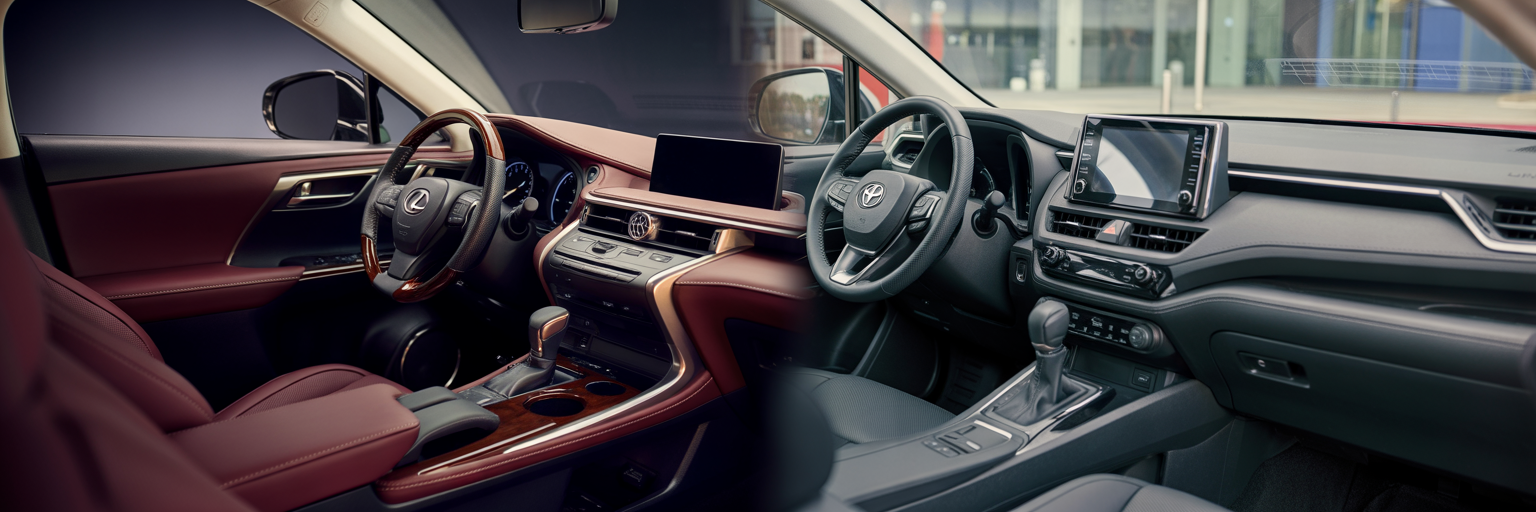
Beyond the driving dynamics, the interior is where you live with a vehicle day in and day out. It’s where the promise of luxury is either fulfilled or falls short. Here, the differences between the NX 350h and RAV4 Hybrid are not just about features, but about the subjective feelings of quality, comfort, and thoughtful design.
Materials and Tactility: A Touch of Class
Your sense of touch immediately tells the story. In the RAV4 Hybrid, the interior is a landscape of durable, hard-wearing materials. The plastics are sturdy, the cloth or available SofTex upholstery is built to last, and the switchgear is functional. It’s a well-assembled and practical space, but it rarely invites you to reach out and touch a surface for the sake of it.
The Lexus NX 350h is a different world. The dashboard, center console, and door panels are covered in soft-touch materials with elegant stitching. The standard NuLuxe synthetic leather feels supple and premium, and the available real wood or textured metal trims add a layer of authentic craftsmanship. Every button and knob clicks with a satisfying, damped precision. This focus on tactile quality is a hallmark of a luxury vehicle and a key differentiator from its mainstream counterpart. For those considering a long-term investment in a premium car, our guide to the best used luxury SUVs that wont destroy you on repairs offers more context on how these materials hold up over time.
Ergonomics and Infotainment: The User Experience
Both vehicles feature modern touchscreen infotainment systems, but their execution differs. The Toyota Audio Multimedia system in the RAV4 is straightforward and easy to use, with responsive menus and standard wireless Apple CarPlay and Android Auto. It gets the job done efficiently, but the graphics and overall presentation are basic.
The Lexus Interface, available in 9.8-inch or massive 14-inch versions, is a significant step up in visual appeal and processing power. The graphics are sharper, the maps are more detailed, and the overall user experience feels more sophisticated. The system’s voice assistant is also more advanced, able to understand natural language commands for climate, audio, and navigation. While both systems are a huge improvement over their predecessors, the Lexus system simply looks and feels more modern and integrated.
Seating and Support: Long-Haul Comfort
For anyone who spends significant time on the highway, seat comfort is paramount. The RAV4’s seats are supportive and perfectly adequate for daily driving and moderate trips. They provide a good driving position and sufficient comfort for most people.
However, the seats in the NX 350h are engineered for superior long-haul comfort. They offer a greater range of power adjustments, including multi-way lumbar support, allowing drivers to fine-tune their seating position to perfection. The cushioning is more complex, designed to reduce pressure points and fatigue over many hours of driving. This is a tangible benefit that you will appreciate at the end of a long road trip.
The Intangibles: Defining the ‘Premium Feel’
So, is Lexus NX better than RAV4 when it comes to the daily driving environment? The answer lies in the intangibles. It’s the solid, reassuring “thunk” the Lexus doors make when they close. It’s the whisper-quiet operation of the power windows. It’s the artfully designed ambient lighting that creates a calming atmosphere at night. It’s the tight, consistent panel gaps and the complete absence of squeaks or rattles. These small details combine to create an overall sense of quality and refinement that elevates the entire experience of being in the vehicle.
Practicality, Space, and Daily Usability
While the Lexus excels in refinement and luxury, the Toyota RAV4 Hybrid reclaims a significant advantage in the realm of everyday practicality. For many buyers, especially those with families or active lifestyles, this section may be the most important. The physical dimensions and clever packaging of a vehicle have a direct impact on its daily usability.
The Cargo Conundrum: A Clear Winner
There is no ambiguity here: the Toyota RAV4 Hybrid is vastly more practical for carrying cargo. Behind the rear seats, the RAV4 offers a generous 37.8 cubic feet of space. The Lexus NX 350h, with its sleeker, more stylized rear end, provides only 22.7 cubic feet. This nearly 15-cubic-foot difference is substantial and has real-world consequences.
To put this into perspective, consider these common scenarios:
- Family Vacations: The RAV4 can easily accommodate several large suitcases and carry-on bags, while the NX would require much more strategic packing or the use of a rooftop carrier.
- Big Box Store Runs: Fitting bulky items from stores like Costco or Home Depot is significantly easier in the Toyota’s wide, tall cargo area.
- Sports Equipment: Multiple golf bags, hockey gear, or camping equipment will fit far more comfortably in the RAV4’s larger hold.
For those planning their next adventure, the RAV4’s superior space makes it a more flexible companion. For more ideas on capable haulers, our list of the best family road trip vehicles that are not boring offers other great options.
Rear-Seat Reality: Room for Adults?
The practicality advantage for the RAV4 continues in the back seat. While both vehicles can comfortably seat two adults, the Toyota’s boxier shape provides more generous headroom and shoulder room. Taller passengers will find their heads closer to the headliner in the Lexus, a direct result of its sloping, coupe-like roofline. The RAV4’s larger rear windows also create a more open and airy feeling for back-seat occupants, reducing the potential for claustrophobia on longer journeys.
Navigating the Urban Jungle: Parking and Maneuverability
In terms of navigating tight urban environments, the two vehicles are more closely matched. They have similar overall footprints and turning radii, making them both relatively easy to park and maneuver in crowded mall parking garages or on narrow city streets. The Lexus does offer more advanced parking aids, such as the 360-degree Panoramic View Monitor and Advanced Park assist, which can automate parking maneuvers. However, in terms of pure physical maneuverability, neither holds a significant advantage over the other. The RAV4’s better outward visibility, thanks to its larger windows and less dramatic styling, can make it feel slightly easier to place in tight spots for some drivers.
Comparing Onboard Technology and Safety Assists

Modern vehicles are as much about their software and electronic systems as they are about their mechanical components. In this luxury compact SUV comparison, both Toyota and Lexus equip their vehicles with an impressive suite of standard safety and convenience technologies, but the Lexus offers a higher level of refinement and a few exclusive features.
Standard Safety Suites: Lexus Safety System+ vs. Toyota Safety Sense
Both the NX 350h and the RAV4 Hybrid come standard with their respective brand’s latest safety suites: Lexus Safety System+ 3.0 and Toyota Safety Sense 3.0. These packages share a common foundation, offering critical features like a Pre-Collision System with Pedestrian Detection, Lane Departure Alert with Steering Assist, and Full-Speed Range Dynamic Radar Cruise Control. The core functionality is the same, providing a robust safety net for the driver.
The key difference lies in the tuning and operation. The Lexus systems are generally calibrated for smoother, less intrusive interventions. For example, the Lane Tracing Assist in the NX feels more subtle in its steering corrections, guiding the car with a gentle touch, whereas the Toyota system can sometimes feel more assertive. This refinement contributes to a more relaxing and less fatiguing driving experience, especially on long highway trips.
Exclusive Tech: The Lexus Advantage
Lexus reserves some of its most advanced technology for its own models. A prime example is the standard Digital Latch with Safe Exit Assist on the NX. This clever feature uses the blind-spot monitoring sensors to detect approaching vehicles or cyclists from the rear. If it determines that opening a door could cause a collision, it will prevent the door from unlatching. This is a tangible safety upgrade that can prevent common and dangerous “dooring” accidents, and it’s a feature not available on the RAV4.
Convenience and Infotainment Upgrades
Beyond safety, the Lexus offers more sophisticated convenience technology. The available Heads-Up Display (HUD) in the NX is larger and more feature-rich, projecting a wider range of information directly onto the windshield. The optional Advanced Park system on the Lexus can handle both parallel and perpendicular parking maneuvers with minimal driver input, a step beyond the simpler parking sensors and rear cross-traffic alert systems on the Toyota.
Ultimately, while both vehicles are exceptionally safe, the Lexus offers a more polished and technologically advanced experience. The question for the buyer is whether these smoother systems and exclusive features provide a meaningful improvement in daily driving. For a tech-savvy driver who values the latest innovations and the most seamless operation, the Lexus holds a clear edge. For others, the excellent standard suite in the RAV4 may be more than sufficient.
Calculating the True Cost of Long-Term Ownership
The sticker price is only the beginning of a car’s financial story. To make a truly informed decision, it’s crucial to look at the Lexus NX 350h ownership costs over several years. Factors like depreciation, maintenance, fuel, and insurance can dramatically alter the total financial picture, often revealing the mainstream option to be the more prudent long-term choice.
Depreciation is the single largest and most overlooked cost of owning a new car. It’s the amount of value the vehicle loses over time. While both Toyota and Lexus products are known for holding their value well, the RAV4 Hybrid has a distinct advantage. Industry projections for 2026 models suggest the RAV4 Hybrid will lose approximately 30.1% of its value over five years. The more expensive Lexus NX 350h is projected to lose around 40.7% in the same period. On a $50,000 Lexus, that’s a loss of over $20,000, compared to about $11,000 on a $37,000 Toyota. This difference in retained value is a significant financial win for the RAV4 owner. Understanding why some high mileage cars age better than others can provide more insight into these depreciation patterns.
When it comes to maintenance, Toyota offers a more generous complimentary plan with ToyotaCare, which covers normal factory-scheduled maintenance for two years or 25,000 miles. Lexus provides a shorter plan, covering the first complimentary maintenance service at one year or 10,000 miles. However, Lexus counters with a longer powertrain warranty of 72 months or 70,000 miles, compared to Toyota’s 60 months or 60,000 miles. The dealership experience also plays a role. Lexus service centers are renowned for their comfortable lounges, complimentary loaner cars, and high level of customer service, which is a valuable intangible for many owners. Toyota service is efficient and professional but typically more transactional and high-volume.
The following table summarizes these key long-term financial factors:
| Ownership Factor | Lexus NX 350h | Toyota RAV4 Hybrid |
|---|---|---|
| Projected 5-Year Depreciation | ~40.7% Loss of Value | ~30.1% Loss of Value |
| Fuel Requirement | Premium Unleaded | Regular Unleaded |
| Complimentary Maintenance | 1 Year / 10,000 Miles | 2 Years / 25,000 Miles |
| Powertrain Warranty | 72 Months / 70,000 Miles | 60 Months / 60,000 Miles |
| Estimated Insurance Cost | Higher Premiums | Lower Premiums |
| Typical Replacement Tire Cost | Higher (Larger Wheels) | Lower (Smaller Wheels) |
Note: Depreciation figures are based on industry projections for 2026 models. Insurance and tire costs are estimates and can vary based on location, driving habits, and specific trim level. This table summarizes key financial considerations that impact the total cost of ownership beyond the initial purchase price.
Other costs add up as well. The Lexus will almost certainly command higher insurance premiums due to its higher value and repair costs. It also typically comes with larger wheels and more specialized tires, which are more expensive to replace than the common tire sizes found on the RAV4. Finally, the potential cost of repairing complex, luxury-specific electronics like the Mark Levinson audio system or advanced parking aids out of warranty is a financial risk that RAV4 owners largely avoid.
Final Verdicts for Every Type of Buyer
After analyzing everything from sticker price to long-term running costs, it’s clear that the Lexus NX 350h and Toyota RAV4 Hybrid, despite their shared heritage, are built for very different customers. The “better” vehicle depends entirely on what you value most. Here are our definitive verdicts for every type of buyer.
For the Value-Focused Buyer
The Toyota RAV4 Hybrid is the undeniable winner. It has a significantly lower purchase price, a much slower rate of depreciation, and lower running costs thanks to its use of regular fuel and less expensive tires. When you add its superior cargo capacity, the RAV4 Hybrid delivers an unbeatable combination of efficiency, practicality, and financial sensibility. It offers 90% of the capability for a fraction of the long-term cost.
For the Comfort and Quiet Seeker
The Lexus NX 350h is the clear choice. The extra money you spend directly translates into a tangible, measurable improvement in daily comfort. The serene, quiet cabin, plush ride quality that isolates you from the road, and more supportive seats make every journey more relaxing. For those who prioritize a peaceful driving environment above all else, the NX 350h delivers an experience the RAV4 cannot match.
For the Buyer Focused on Long-Term Costs
Again, the Toyota RAV4 Hybrid is the more financially sound decision over a 5-to-10-year ownership period. The combination of its lower depreciation, better complimentary maintenance plan, and savings on fuel and insurance creates a total cost of ownership that is substantially lower than the Lexus. The RAV4 is the smarter long-term financial asset.
For the Status-Conscious Buyer and Tech Enthusiast
The Lexus NX 350h holds a distinct advantage. The prestige of the Lexus badge, the premium dealership and service experience, and access to exclusive technologies like the Mark Levinson audio system and Safe Exit Assist have a subjective but real value. For buyers who want the latest features and appreciate the social currency of a luxury brand, the NX 350h is the more desirable option.
The Definitive Answer
So, is the luxury upgrade worth it? The answer is yes, but only for a specific type of buyer. The upgrade to the Lexus NX 350h is worth the significant financial and practical trade-offs if, and only if, your primary goal is to have the quietest, most comfortable, and most serene driving experience possible in a compact SUV. The refinement is real and noticeable every time you drive. For every other buyer—the one focused on value, practicality, family utility, or long-term financial wisdom—the Toyota RAV4 Hybrid remains the smarter, more logical, and overwhelmingly competent choice.