The Heart of the Machine: Powertrain and Performance
The first electric motors appeared in the 1830s, but it took nearly two centuries for them to challenge the combustion engine’s dominance in performance cars. Today, the debate isn’t about if EVs are fast, but how they deliver their speed. The Tesla Model 3 vs BMW i4 comparison begins here, with two profoundly different approaches to electric power.
Dueling Philosophies in Electric Propulsion
Tesla’s approach is rooted in a vertically integrated, efficiency-first mindset. Their motors, batteries, and software are developed in-house to work in perfect harmony, squeezing every possible mile from each kilowatt-hour. It’s a philosophy born from Silicon Valley, where system-wide optimization is paramount.
BMW, on the other hand, carries its century-long performance heritage into the electric era. The i4 uses externally excited synchronous motors, a deliberate choice that avoids the use of rare-earth magnets. More importantly for the driver, this technology allows BMW to shape the power curve with incredible precision, creating a signature feel that is distinctly their own.
Acceleration By The Numbers: A Tale of Two Trims
On paper, the performance is breathtakingly close. According to tests by Car and Driver, the Tesla Model 3 Performance hits 60 mph in about 3.1 seconds. The BMW i4 M50 is just a fraction behind at around 3.3 seconds. This razor-thin margin at the top end showcases the intense competition. Further down the line, the base rear-wheel-drive Model 3 is noticeably quicker than the entry i4 eDrive35, demonstrating Tesla’s performance focus across its entire range.
The Subjective Feel of Instant Torque
Numbers only tell part of the story. The Model 3’s acceleration is a sudden, almost shocking punch. It’s a digital-feeling surge that pins you to your seat without warning, a raw display of instant electric torque. It’s thrilling and relentlessly effective.
The i4 M50’s power delivery feels entirely different. It’s a powerful, controlled swell of force that builds progressively. It mimics the refined, muscular feel of a large-displacement combustion engine, delivering its speed with a sense of composure and sophistication. It’s less of a gut punch and more of a powerful, sustained push that feels engineered and deliberate.
Horsepower vs. System-Wide Efficiency
A quick look at the spec sheet shows the BMW i4 M50 boasts higher peak horsepower. So why isn’t it definitively faster? The answer lies in system efficiency. Tesla’s holistic design, from its battery management software to its motor controllers, is exceptionally effective at converting stored energy into forward motion. This proves a crucial point in modern performance: peak horsepower is no longer the only metric that matters. True performance comes from how efficiently the entire system works together.
Going the Distance: Range and Charging Capabilities
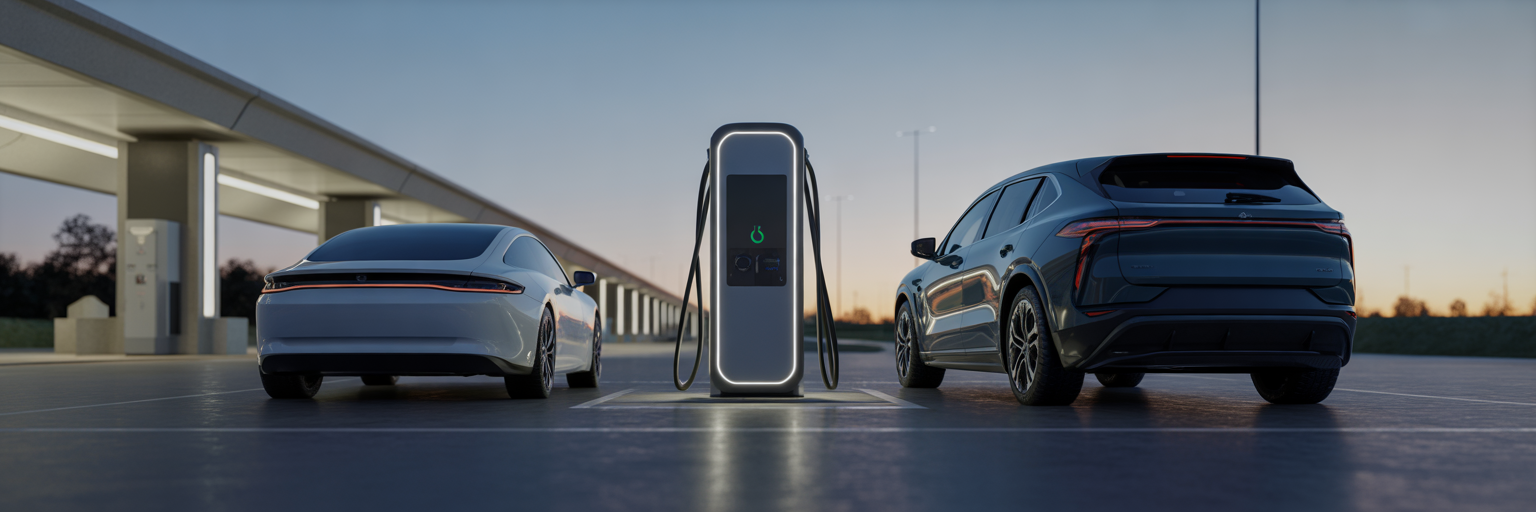
The powertrain’s performance is exhilarating, but for daily life in the United States, range and refueling convenience are what truly matter. This detailed electric sedan analysis now shifts to the practical logistics of living with these vehicles, addressing the core concern of range anxiety and the realities of charging on the go.
The EPA Range Showdown: Miles on Paper
Official figures provide a clear starting point. The Tesla Model 3 Long Range boasts an impressive EPA-estimated range of up to 341 miles, a figure that provides significant peace of mind for long American road trips. The Tesla Model 3 Performance range is slightly lower but still highly competitive. In contrast, the most efficient BMW i4, the eDrive40, offers a range of around 300 miles. While still very usable, that on-paper difference is a tangible factor for buyers who frequently travel long distances.
Real-World Range: The Impact of Weather and Driving Style
EPA estimates are a benchmark, not a guarantee. Real-world mileage is affected by everything from cold American winters that reduce battery efficiency to aggressive driving habits and hilly terrain. One of Tesla’s unsung strengths is its highly accurate range prediction software. The miles displayed on the screen are remarkably trustworthy, which builds immense driver confidence and reduces the mental calculus of planning a journey.
The Tesla Supercharger Network: A Decisive Advantage
This is arguably Tesla’s most compelling advantage. The Supercharger network vs Electrify America debate is a critical one for any EV buyer. Tesla’s network in the US is vast, reliable, and incredibly simple to use. The experience is seamless: you pull up, plug in, and the car handles the authentication and payment automatically. This “plug-and-charge” simplicity removes a major friction point of EV ownership.
BMW’s Approach: Navigating Public Charging Networks
The BMW i4 uses the common CCS standard, giving it access to a wide array of third-party charging networks like Electrify America and EVgo. The advantage is an open standard, but the reality can be frustrating. Drivers often face inconsistent reliability, with chargers that are frequently broken or offline. The payment process can also be clunky, sometimes requiring multiple apps or RFID fobs. While the industry is slowly moving toward adopting Tesla’s NACS connector, for now, the public charging experience for BMW owners remains less predictable than Tesla’s walled garden.
| Feature | Tesla Supercharger Network | Public CCS Networks (e.g., Electrify America) |
|---|---|---|
| Network Size (US) | Over 2,000 stations, 25,000+ connectors | Varies by provider; Electrify America has ~900 stations |
| Reliability & Uptime | Generally high; vertically integrated system | Inconsistent; frequent reports of broken or offline chargers |
| User Experience | Seamless ‘Plug & Charge’; automated payment | Often requires multiple apps, credit card swipes, or RFID fobs |
| Peak Charging Speed | Up to 250 kW | Up to 350 kW (vehicle dependent, often not sustained) |
| Cost Structure | Consistent pricing, visible in-car | Highly variable by network, location, and time of day |
Note: This table summarizes the user experience and infrastructure differences as of early 2026. The charging landscape is evolving, particularly with other automakers adopting Tesla’s NACS connector.
The Driver’s Connection: Handling and Ride Comfort
With range and charging practicalities understood, the focus returns to the driving experience itself. This isn’t about straight-line speed but the tactile sensations of steering, cornering, and suspension. This electric car handling comparison explores how each car connects the driver to the road, revealing two distinct personalities shaped by their manufacturers’ core values.
BMW’s Legacy of Driving Dynamics
The i4 is proof that BMW’s “Ultimate Driving Machine” ethos translates beautifully to the electric age. The steering provides superior feedback and weight, communicating what the front tires are doing with a clarity that inspires confidence. The chassis is impeccably balanced, and the optional adaptive M suspension masterfully blends comfort with control. In a corner, the i4 feels composed, predictable, and deeply satisfying to guide.
Tesla’s Agile and Direct Approach
The Model 3’s handling is defined by its agility. Thanks to a low center of gravity and incredibly quick steering, the car feels eager to change direction, almost like a go-kart. It darts into corners with an immediacy that can be thrilling. The trade-off, however, is that the steering can feel digital and somewhat detached. It’s responsive but lacks the nuanced communication you get from the BMW, making it feel more like a very precise input device than a direct mechanical connection.
The Comfort Compromise: Daily Driving on American Roads
When it comes to ride quality, there is a clear winner. The BMW i4 is significantly more comfortable. Its suspension is expertly tuned to absorb the bumps, potholes, and expansion joints common on American roads, delivering a serene and composed ride. The Model 3, especially the Performance trim with its larger wheels, has a much firmer setup. While sporty, it can feel jittery and harsh over imperfect pavement, which can become tiring on a daily commute.
Weight and Balance as Unseen Factors
The physics of each car contributes to their distinct feel. The heavier i4 feels more planted and stable, especially at highway speeds, giving it a substantial, long-legged character. The lighter Model 3, by contrast, feels more nimble and playful, always ready to pivot. Neither is inherently better, but they cater to different driving preferences.
- BMW i4: Superior steering feedback, better ride comfort, more stable and planted feel.
- Tesla Model 3: Quicker steering response, more agile and nimble feel, firmer and sportier ride.
The Cabin Experience: Interior Design and Quality
The way a car feels to drive is matched in importance by how it feels to sit in. The physical interior—what you see, touch, and interact with—sets the tone for every journey. Here, the Model 3 and i4 present two opposing visions of a modern car cabin. These differing interior designs reflect the core identities of the automotive brands themselves.
Minimalism Versus Traditional Luxury
The Tesla Model 3’s interior is an exercise in radical minimalism. A single, large touchscreen dominates a spartan dashboard devoid of traditional buttons or gauges. It’s clean, open, and feels like a piece of modern architecture. The BMW i4, conversely, creates a driver-focused cockpit. It blends a stunning curved display with familiar luxury elements, including physical buttons for climate control, an iDrive controller, and rich trim materials. It feels like an evolution of a classic luxury car, not a complete reinvention.
A Matter of Materials and Craftsmanship
Both cars utilize high-quality vegan leather, but the overall sense of quality differs. The BMW i4 feels solid, with tight panel gaps and substantial-feeling materials that give it a “bank-vault” sense of security. It’s a cabin built with meticulous attention to detail. The Model 3, while much improved over the years, can still exhibit inconsistencies in panel gaps and uses materials that feel less premium to the touch. The craftsmanship in the BMW is simply a step above.
Ergonomics and Daily Usability
We all want futuristic design, yet we also just want to adjust the wipers without looking away from the road. The Model 3’s reliance on its touchscreen for nearly every function introduces a learning curve and can be distracting. Simple tasks require navigating menus. The i4’s approach is more pragmatic. By retaining an iDrive rotary controller and physical shortcut buttons, it allows for eyes-free operation of key functions, relying on muscle memory that makes daily driving safer and less stressful.
Passenger Space and Practicality
While the i4 excels in perceived quality, the Model 3 wins on practical space. Its minimalist design and flat floor create a more open and airy feeling for passengers. More importantly, the Model 3 offers significant storage advantages that the i4, which is based on a shared platform, cannot match. The Tesla includes a useful front trunk (or “frunk”) and a large under-floor storage area in the rear, both of which are absent in the BMW.
The Digital Cockpit: Infotainment and Sound Systems
Moving from the physical cabin to the digital interface, the philosophical divide between Tesla and BMW becomes even more apparent. This section focuses on the car’s digital brain: the software, screen performance, and audio systems that define the user experience. For more deep dives into automotive technology and features, explore our collection of informative articles.
Tesla’s Central Command Center
The Model 3’s 15-inch touchscreen is the undisputed heart of the car. Its user interface is incredibly responsive and intuitive, feeling more like an iPad than a traditional car infotainment system. This is the “iPhone on wheels” experience. It seamlessly integrates unique features you won’t find elsewhere, like Tesla Arcade for gaming, a built-in Netflix viewer, Sentry Mode for security, and an integrated Dashcam. It’s a connected entertainment hub, not just a control screen.
BMW’s iDrive Evolution
The BMW i4 features a beautiful curved display running the latest version of iDrive. While the screen itself is gorgeous, its two biggest advantages are practical. First, the retention of the physical iDrive rotary controller allows for safer, tactile operation while driving. Second, and for many buyers this is a deal-breaker, it offers seamless integration of Apple CarPlay and Android Auto. Tesla’s refusal to support these platforms remains a significant omission, forcing users to rely entirely on its native system.
The Power of Over-The-Air Updates
Tesla pioneered and still leads in delivering frequent, substantial over-the-air (OTA) updates. These are not just minor bug fixes; they often include major new features, performance improvements, and UI redesigns that can make a three-year-old car feel new again. BMW also offers OTA updates, but they are typically more conservative, focusing on smaller fixes and map updates rather than transformative feature drops.
Comparing the Soundscapes
The audio experience in both cars is excellent but tailored to different tastes. The Model 3’s unbranded premium sound system is immersive, with powerful, deep bass that appeals to fans of modern, electronic, and hip-hop music. The optional Harman Kardon system in the i4 is praised for its exceptional clarity, balance, and detail. It offers a more traditional audiophile experience, excelling with acoustic, classical, and vocal-centric tracks.
- Tesla Model 3: Faster UI, integrated entertainment (Netflix, games), no Apple CarPlay/Android Auto.
- BMW i4: Apple CarPlay/Android Auto support, physical iDrive controller for safer use, more traditional menu structure.
The Co-Pilot: Driver Assistance and Safety Tech
The conversation now shifts from features that entertain to technologies that actively assist the driver. The approach to driver assistance is a core part of each brand’s identity, reflecting different philosophies on the relationship between human and machine. Tesla’s Autopilot system is a key feature not only in this comparison but also when evaluating it against other popular vehicles like in our Toyota RAV4 vs Tesla Model Y analysis.
Tesla Autopilot and Full Self-Driving (FSD)
It’s important to separate the two. Standard Autopilot, included on every Tesla, is an excellent adaptive cruise control and lane-keeping system that is among the best on the market for highway driving. The optional Full Self-Driving (FSD) package is an ambitious, perpetually-in-beta software suite that aims to handle city street driving. Its capabilities are impressive but its behavior can be inconsistent, and it remains a source of regulatory debate in the US.
BMW’s Driving Assistant Professional
BMW’s system is framed as a sophisticated co-pilot designed to reduce driver fatigue, not replace the driver. Its standout feature is the Extended Traffic Jam Assistant, which allows for hands-free driving at low speeds on mapped highways. The system’s philosophy is built around predictable, confidence-inspiring assistance. It operates smoothly and communicates its intentions clearly, making it easy for the driver to trust.
Real-World Performance and Driver Confidence
In practice, Tesla’s Autopilot and FSD feel more assertive. They will attempt to navigate more complex scenarios and can feel more capable when they work perfectly. However, this assertiveness comes with a tendency for “phantom braking,” where the car brakes suddenly for no apparent reason, which can be unnerving. BMW’s system is more conservative. It may disengage earlier in confusing situations, but its actions are smoother and more predictable, which many drivers find more reassuring for daily use.
Fundamental Safety Ratings and Structure
Beyond the driver-assist software, it’s crucial to remember that both cars are fundamentally very safe. Both the Model 3 and i4 have received top crash-test ratings from US agencies like the IIHS and NHTSA. Their modern, EV-native designs, with low centers of gravity and large crumple zones where an engine would normally be, contribute to their inherent structural safety, providing excellent protection for occupants in a collision.
Long-Term Ownership: Reliability and Cost
The driving experience is only one part of the equation. The practical, financial realities of owning one of these cars over several years are just as important. This section moves beyond the test drive to explore total cost, maintenance, and the service experience, which are critical but often overlooked factors in the decision-making process.
Projected Reliability and Build Quality Concerns
BMW has worked hard to shed its past reputation for high maintenance costs, and its recent models have shown improved reliability. The i4 benefits from this, feeling robustly built from the start. Tesla, conversely, has a mixed reputation. While its core EV components—the battery and motors—have proven to be very reliable, the brand is still known for initial build quality issues like inconsistent panel gaps. You are less likely to have a powertrain problem with a Tesla, but more likely to need a service visit for a cosmetic flaw.
The Purchase Price Breakdown
Comparing sticker prices requires careful attention. Tesla’s pricing is simple and transparent, with very few options. BMW follows a traditional luxury model, with a lower base price that can quickly inflate as you add desirable packages and options. It is essential to compare similarly equipped cars. Furthermore, the availability of US federal and state EV tax credits can change, significantly impacting the final purchase price for eligible buyers.
Warranty Coverage and Service Experience
The service models are night and day. BMW relies on its extensive traditional dealership network, offering a familiar if sometimes bureaucratic experience. Tesla uses a combination of dedicated service centers and mobile “Rangers” who can perform many repairs at your home or office. For an American owner, the convenience of mobile service can be a huge plus, but appointment availability at physical service centers can be a challenge in some regions.
Calculating the Total Cost of Ownership
The sticker price is just the beginning. Total cost of ownership includes depreciation, insurance, maintenance, and energy costs. While Teslas historically have had strong resale value, their insurance premiums are often higher. The table below provides an estimated comparison, but these figures can vary widely based on your location and personal circumstances.
| Cost Factor | Tesla Model 3 Long Range (Example) | BMW i4 eDrive40 (Example) |
|---|---|---|
| Base MSRP | ~$47,000 | ~$57,000 |
| Estimated 5-Year Depreciation | ~$21,000 (45%) | ~$29,000 (51%) |
| Estimated 5-Year Fuel (Charging) | ~$4,500 | ~$5,100 |
| Estimated 5-Year Insurance | ~$12,500 | ~$9,500 |
| Estimated 5-Year Maintenance | ~$1,500 | ~$2,500 |
| Estimated 5-Year Total Cost | ~$85,500 | ~$103,100 |
Note: These figures are estimates based on 15,000 miles driven per year, an average US electricity cost of $0.17/kWh, and national insurance averages. Depreciation, insurance, and final purchase price can vary significantly by location and individual circumstances.
The Final Verdict: Tech Innovator or Refined Performer
After comparing everything from powertrain philosophy to long-term cost, the Tesla Model 3 vs BMW i4 debate crystallizes into a choice between two distinct identities. This isn’t about which car is better, but which car is better for you. The final decision rests on what you value most in a modern vehicle.
The Case for the Tesla Model 3: The Tech-Forward Choice
The Model 3 is the clear choice for the tech enthusiast and early adopter. It’s for the driver who prioritizes raw, instant acceleration, cutting-edge software, and the unmatched convenience of the Supercharger network. Its minimalist interior and tablet-like interface represent a fundamental rethinking of what a car should be. If you see your car as the ultimate gadget, an “iPhone on wheels” that constantly improves through software updates, the Model 3 is your answer.
The Case for the BMW i4: The Luxury EV Evolved
The i4 is the ideal EV for the traditional luxury car buyer transitioning to electric. It’s for the driver who values superior ride comfort, impeccable interior craftsmanship, and an engaging, communicative driving experience. It masterfully blends next-generation technology with the familiar comforts of a driver-focused cockpit, making it a strong contender for the best electric luxury sedan. The i4 feels like a premium BMW first and an electric vehicle second, offering a seamless and reassuring entry into the world of EVs.
Making Your Personal Decision
So, which is it? Do you crave the disruptive innovation and blistering efficiency of the Model 3, or the refined performance and timeless luxury of the i4? We can share specs and driving impressions all day, but the profound experiential differences can only be truly understood from behind the wheel. We strongly recommend you test-drive both. Ultimately, the best car is the one that fits your life, and for more guides and reviews to help you on your automotive journey, visit CarPhanatics.com.