
You just left the tire shop. The ride feels smooth on your new rubber, and you’re feeling good about the investment in your vehicle’s safety and performance. Then, a few blocks down the road, it happens. A collection of amber and red icons suddenly illuminates your dashboard, turning your moment of satisfaction into one of immediate confusion and frustration. It’s a surprisingly common experience, and your first thought is likely, “What did they break?”
Before you jump to conclusions, it’s important to understand that modern vehicles are more than just mechanical assemblies. They are intricate electronic networks. These systems, which manage everything from your brakes to your fuel economy, depend on a constant flow of precise data from sensors located at every corner of your car. Even a routine service like a tire rotation or replacement can temporarily disrupt this delicate conversation between components. The appearance of dashboard lights after tire rotation is often a sign of a communication breakdown, not necessarily a mechanical failure.
Your car’s main computer is constantly juggling data from dozens of sensors, a task not unlike how a modern registration and ticketing platform must process thousands of simultaneous inputs to function correctly. When a wheel is moved or a sensor is disturbed, the system can get confused, triggering a warning as a precaution. This article will break down exactly why this happens. We will look at each specific light, explain the technical reasons they activate, help you assess the safety risk, and provide a clear, step-by-step process to troubleshoot the issue.
Understanding the Post-Service Light-Up
You leave the tire shop with a seemingly simple service completed, only to be greeted by a dashboard full of new, unexplained warning lights. It’s a frustrating moment that can make you question the quality of the work performed. The good news is that this is a frequent occurrence in the age of computer-controlled vehicles, and it rarely signals a major disaster.
Modern cars are not just mechanical machines; they are sophisticated electronic networks. These systems manage everything from engine performance to critical safety features, and they rely on a constant stream of data from sensors located throughout the vehicle. A tire rotation, wheel balancing, or tire replacement, while mechanically straightforward, can easily interrupt this data flow. The computers that control your Anti-lock Braking System (ABS), Traction Control System (TCS), and Tire Pressure Monitoring System (TPMS) are all expecting specific information from specific locations.
When a technician moves a wheel from the front-left to the rear-right, the car’s computer doesn’t automatically know the change occurred. It may still be listening for the front-left sensor’s signal at its old location, leading to a perceived fault. Similarly, the process of mounting and dismounting tires can sometimes disturb the delicate sensors and wiring located near the wheel hub. This isn’t always a sign of carelessness; these components can become brittle over time, and the normal process of a tire service can be enough to cause a pre-existing weakness to fail.
This article is designed to demystify the situation. We will provide a clear breakdown of each specific light you might see, explain the technical reasons they activate, offer a guide to assess the immediate safety risk, and walk you through a practical troubleshooting process. Understanding the “why” behind the warning lights transforms the problem from a catastrophic failure into a logical, solvable issue.
Decoding the Tire Pressure Monitoring System (TPMS) Light

Of all the warnings that can appear, the TPMS light is by far the most common culprit after a tire service. This symbol, typically an exclamation point inside a cross-section of a tire, is your car’s way of telling you there’s an issue with tire pressure or the monitoring system itself. While its appearance is alarming, the cause is often simple to resolve.
Direct vs. Indirect TPMS: Understanding Your System
To diagnose the problem, you first need to know which type of TPMS your vehicle uses. There are two main technologies, and they work in fundamentally different ways.
Direct TPMS (dTPMS) is the more advanced system. It uses a small, battery-powered sensor mounted inside each wheel, either on the valve stem or banded to the rim. Each sensor reads the exact air pressure and temperature of its tire and wirelessly transmits that data to the car’s central computer. This allows for precise, real-time pressure readings for each individual tire. It’s like having a dedicated thermometer in every room of your house.
Indirect TPMS (iTPMS) is a simpler, software-based solution. It does not use any pressure sensors inside the wheels. Instead, it cleverly uses the existing ABS wheel speed sensors. The system’s logic is based on a simple principle: a tire with low air pressure has a slightly smaller diameter, causing it to spin faster than the other tires to cover the same distance. The iTPMS monitors the rotational speed of all four wheels, and if it detects one is consistently spinning faster, it assumes that tire is underinflated and triggers the warning light. It’s less precise and can’t tell you which tire is low, but it’s a cost-effective way to meet safety requirements.
Common Causes: From Lost Positions to Damaged Sensors
When the TPMS light on after new tires or a rotation appears, the cause depends heavily on your system type. For vehicles with dTPMS, the most frequent issue is positional confusion. The car’s computer associates each unique sensor ID with a specific corner of the car (e.g., front-left). When tires are rotated, the computer is suddenly receiving the “front-left” signal from the “rear-right” position. This mismatch makes the system think there’s a fault. This positional confusion is a well-documented issue, as confirmed by resources like A-Premium, which note that many systems need to be manually told where each sensor is now located. Other common causes include:
- Incorrect Pressure: The technician may have inflated the tires to the pressure listed on the tire’s sidewall instead of the vehicle-specific pressure on the door jamb sticker.
- Sensor Damage: The sensor is a delicate electronic component. It can be accidentally damaged by tire mounting equipment if the technician is not careful.
- Dead Battery: TPMS sensors have sealed, non-replaceable batteries that last 5-10 years. It’s possible for a battery to fail coincidentally at the same time as your service.
For vehicles with iTPMS, the cause is almost always a failure to reset the system. After the tires are rotated and pressures are correctly adjusted, the system needs to be recalibrated. This reset procedure tells the computer to forget the old rotational speed values and establish a new baseline with the correctly inflated tires.
The ‘Relearn’ Procedure: Your First Line of Defense
For both system types, the first step is often to perform a TPMS reset or “relearn” procedure. This process tells the system to recognize the current state of the tires as the new normal. The exact steps on how to reset TPMS light vary widely between manufacturers and even models.
For some cars, it’s as simple as pressing and holding a dedicated TPMS reset button, often located in the glove box or under the dashboard. For others, it involves a specific sequence of actions through the vehicle’s infotainment screen or instrument cluster menus. Some iTPMS systems require you to drive for a certain distance (e.g., 20 minutes above 30 mph) for the system to recalibrate itself. For dTPMS systems that have lost their sensor positions, a specialized electronic tool may be required to tell the car’s computer the new location of each sensor ID. Your owner’s manual is the absolute best source of truth for your vehicle’s specific procedure. Following it precisely is the quickest way to resolve a simple TPMS light issue.
The Connection Between ABS, Traction, and Stability Control Lights
Seeing the ABS, Traction Control (TCS), and Electronic Stability Control (ESC/VSC) lights illuminate, often all at once, can be more unsettling than a simple TPMS warning. These are your vehicle’s primary active safety systems, and their deactivation is a serious matter. The reason they often appear together is that they are all part of a single, interconnected system that relies on one critical set of components: the wheel speed sensors.
The Role of Wheel Speed Sensors
At the heart of your car’s braking and stability systems are four wheel speed sensors, one located at each wheel hub. These sensors constantly monitor how fast each wheel is rotating and report this data hundreds of times per second to a central control module. This information is vital for several functions:
- ABS (Anti-lock Braking System): Prevents wheels from locking up during hard braking, allowing you to maintain steering control. It does this by rapidly pulsing the brakes on any wheel it detects is about to skid.
- TCS (Traction Control System): Prevents wheelspin during acceleration on slippery surfaces. If it detects a wheel spinning faster than the others, it can reduce engine power or apply the brake to that wheel to regain traction.
- ESC (Electronic Stability Control): Helps prevent skids and loss of control during cornering or evasive maneuvers. It compares your steering input with the vehicle’s actual direction of travel and can brake individual wheels to keep the car on your intended path.
Because all three systems use the same data, a fault in a single wheel speed sensor or its wiring will typically disable all of them as a safety precaution, causing all three warning lights to come on.
How Tire Service Can Disrupt the System
The most common reason for an ABS light after tire change is a problem with one of these wheel speed sensors. The sensor itself is a small, often plastic component located very close to the brake and suspension parts that a technician may be working around. During a tire service, several things can happen:
- Accidental Impact: A tool or even a hand can bump the sensor, cracking its plastic housing. These sensors can become brittle with age, making them susceptible to damage.
- Damaged Wiring: The wire leading from the sensor to the car’s main harness is thin and delicate. It can be easily snagged, stretched, or pinched during the service, causing an internal break that isn’t visible.
- Loose Connector: The technician may have disconnected the sensor to get better access and simply forgot to plug it back in securely. A loose connection can work its way free after a few miles of driving.
The Problem with Mismatched Tires
Another significant cause is the installation of incorrectly sized tires. The stability control module is programmed to expect all four wheels to rotate at nearly identical speeds when driving in a straight line. If a tire of a different diameter is installed, or if a vehicle with a staggered setup (different size tires front and rear) has its tires rotated incorrectly, the system will detect a persistent speed mismatch between the axles.
The computer cannot distinguish this mismatch from a genuine fault like a slipping tire. To prevent the system from making incorrect and potentially dangerous interventions, it disables itself and illuminates the warning lights. This is particularly critical in off-road capable vehicles where stability systems are finely tuned for specific tire dimensions, a factor to consider when comparing models like the ones in our Jeep Gladiator vs. Toyota Tacoma analysis. Finally, it’s also possible that an aging sensor was already on the verge of failure, and the minor jostling from the tire service was simply the final event that caused it to stop working.
The Red Brake Warning Light: A Non-Negotiable Stop Sign

While amber warning lights like TPMS or ABS indicate a problem with a secondary or safety-assist system, the red brake warning light is in a different category entirely. This light, often shown as the word “BRAKE” or an exclamation point inside a circle, signals a potential issue with your car’s core hydraulic braking system. It is not a suggestion; it is a command from your vehicle that demands your immediate and full attention.
Why This Light is Different
Unlike the other lights we’ve discussed, which are triggered by sensor data and computer logic, the primary function of the red brake light is to warn of a physical or hydraulic failure. It is most commonly tied to the brake fluid level sensor in the master cylinder reservoir. If the fluid level drops below a safe minimum, the light comes on. A drop in fluid level almost always indicates a leak somewhere in the brake lines, calipers, or wheel cylinders. A leak means a loss of hydraulic pressure, which directly translates to a loss of stopping power.
Potential Causes During Tire Service
It is rare for a standard tire service to cause a major brake system failure, but it is not impossible. A technician working in the confined space of the wheel well could, in theory, cause a problem. For example, a brake line, which can become corroded and weak over time, might be accidentally bent or stressed, causing a small crack that begins to leak under pressure. In other cases, if a brake caliper was moved to access another component, it might not have been re-secured properly. While these scenarios are unlikely with a professional technician, they are within the realm of possibility and highlight why this particular light must be taken so seriously.
Symptoms That Demand Immediate Action
The red brake light on its own is cause for concern, but when paired with any physical symptoms, it becomes a critical emergency. If you see the red brake light and experience any of the following, your vehicle is unsafe to drive:
- A Soft or Spongy Brake Pedal: If your brake pedal feels mushy or sinks further to the floor than usual, it’s a classic sign of air in the hydraulic lines, likely from a fluid leak.
- Grinding or Scraping Noises: This could indicate that your brake pads are completely worn away, or that a component like a caliper is loose and making contact with the wheel.
- Car Pulling During Braking: A sudden car pulling after tire rotation specifically when you apply the brakes can signal a failure in one of the calipers, causing uneven braking force.
If you experience any of these symptoms, do not try to “limp home.” Pull over to a safe location as soon as you possibly can, put your hazard lights on, and call for a tow truck. Before you panic, however, perform one simple check: ensure your parking brake is fully disengaged. On many cars, the same red light is used to indicate that the parking brake is on. Firmly release it and see if the light goes out. If it stays on, assume a serious fault.
Why Some Warnings Wait Until You’re Moving
One of the most confusing parts of this experience is when the dashboard is perfectly clear as you drive away from the shop, only to light up like a Christmas tree a few minutes later. This delay isn’t a sign of a new problem; it’s a feature of how your car’s diagnostic systems are designed to work. They need real-world data to confirm everything is operating correctly.
Think of it this way: the car’s safety computer is like a quality control manager who can’t spot a flaw on an assembly line until it starts moving. When you first start the car, the ABS and stability control modules perform a basic electronic self-check to ensure all the sensors are powered and communicating. If this check passes, the lights stay off.
However, the system can’t truly verify its own functionality while the car is stationary. It needs to see the wheels turning to analyze the data. Once your vehicle reaches a certain speed, typically around 15-20 mph, the control module begins its next phase of testing. It actively compares the signals from all four wheel speed sensors in real-time. It’s looking for consistency. Are all four wheels reporting similar speeds? Are the signals clean and uninterrupted?
If one sensor’s signal is missing because a wire is broken, erratic because the sensor is damaged, or consistently different from the others because of a mismatched tire size, the module immediately flags an inconsistency. It can’t trust the data it’s receiving, so to prevent making a dangerous error—like applying a brake at the wrong time—it takes the safest course of action. It disables the ABS, traction, and stability control systems, and then it turns on the corresponding warning lights to inform you that those safety nets are no longer active. This same logic applies to indirect TPMS, which also needs a period of driving to establish a baseline of normal wheel speeds before it can detect the deviation caused by a deflating tire.
Safe to Drive? A Triage Guide for Dashboard Warnings

With a dashboard full of new lights, the most pressing question is: “Is my car safe to drive?” The answer depends entirely on which light is on and whether it’s accompanied by any physical symptoms. This guide will help you categorize the warning by risk level and make a safe, informed decision.
Category 1: Likely Harmless (Address Soon)
This category almost exclusively applies to a solid, non-flashing TPMS light that appears with no other warnings or symptoms. If the car drives, brakes, and steers normally, the issue is almost certainly related to incorrect tire pressure or a system that needs to be reset. The vehicle is safe for normal, cautious driving. Your immediate action should be to find a reliable pressure gauge, check all four tires, and adjust them to the pressures listed on your driver’s door jamb sticker. Then, attempt the TPMS reset procedure found in your owner’s manual.
Category 2: Return to the Shop (Drive with Caution)
This category includes the amber ABS, Traction Control, and Stability Control lights. When these lights are on, it means those specific safety-assist systems are offline. Your primary hydraulic brakes will still function normally, but you have lost the anti-lock and stability-enhancing features. So, is it safe to drive with ABS light on? Yes, but with significant caveats. The car will be more prone to skidding during a panic stop and less stable in an emergency maneuver or on wet or icy roads. The recommended action is to avoid high speeds and aggressive driving, leave extra following distance, and drive cautiously back to the tire shop or your trusted mechanic for diagnosis.
Category 3: Do Not Drive (Critical Safety Risk)
This is the most serious category and is reserved for the red BRAKE warning light or any other warning light that is accompanied by a noticeable physical problem. If you feel a spongy or sinking brake pedal, hear grinding or scraping noises when braking, or feel the car pulling severely to one side, the vehicle is mechanically compromised. The instruction here is absolute: pull over as soon as it is safe to do so and call for a tow. Attempting to drive further risks a complete loss of braking ability. Understanding these warnings is a crucial part of driver safety, a topic we feel is especially important, as we covered in our guide to used cars for teen drivers.
| Warning Light | Common Cause After Tire Service | Risk Level | Recommended Action |
|---|---|---|---|
| Solid TPMS Light | Incorrect pressure or system needs relearn | Low | Check tire pressures. Attempt owner’s manual reset. Safe for cautious driving. |
| ABS / Traction / Stability Light | Damaged wheel speed sensor or mismatched tire size | Medium | Safety systems are disabled. Avoid hard braking or high speeds. Drive cautiously to the shop for diagnosis. |
| Red ‘BRAKE’ Light | Low brake fluid, hydraulic leak, or mechanical failure | High / Critical | Do not drive. Pull over safely as soon as possible and call for a tow truck. |
| Any Light + Physical Symptom (Grinding, Spongy Pedal, Pulling) | Potential mechanical failure of brakes or steering | High / Critical | Do not drive. The vehicle is mechanically compromised. Pull over immediately and call for a tow. |
A Practical Troubleshooting Sequence for Car Owners
If your dashboard lights up after a tire service, you don’t have to be a master mechanic to perform some initial checks. Following a logical sequence can often help you either solve the problem yourself or gather valuable information for the technician. This process empowers you to take control of the situation. Following these diagnostic steps is a great habit, much like the regular checks we detail in our guide on how to keep your car’s engine running for years.
-
Check the Fundamentals: Pressure and Size
Before you do anything else, verify the basics. Grab a reliable tire pressure gauge—not the cheap pencil-style one rattling in your glove box—and check the pressure in all four tires, plus the spare if it has a sensor. Compare your readings to the recommended pressures listed on the sticker inside your driver’s door jamb, not the maximum pressure molded into the tire’s sidewall. While you’re at each wheel, take a moment to read the tire size on the sidewall and confirm that all four tires are the same brand, model, and size designation (unless your vehicle has a staggered setup from the factory). -
Perform a Visual Inspection
Next, perform a careful visual check around each wheel. For the front wheels, turn the steering all the way to one side to get a clear view of the area behind the brake rotor. Look for anything that seems out of place. Do you see any dangling wires, loose electrical connectors, or obvious signs of damage to the wiring harness near the wheel hub? Look for fresh scrapes or cracks on the plastic body of the wheel speed sensor. This simple inspection can often reveal a snagged wire or an unplugged connector that is easy to fix. -
Attempt the TPMS Reset
If the only light on is for the TPMS, your next move is to perform the system reset. This is the most common fix. Consult your owner’s manual for the vehicle-specific “relearn” procedure and follow the instructions meticulously. This might involve pressing a button, navigating a menu on your infotainment screen, or driving for a specific period. Be patient, as some systems take time to recalibrate. -
Seek a Professional Scan
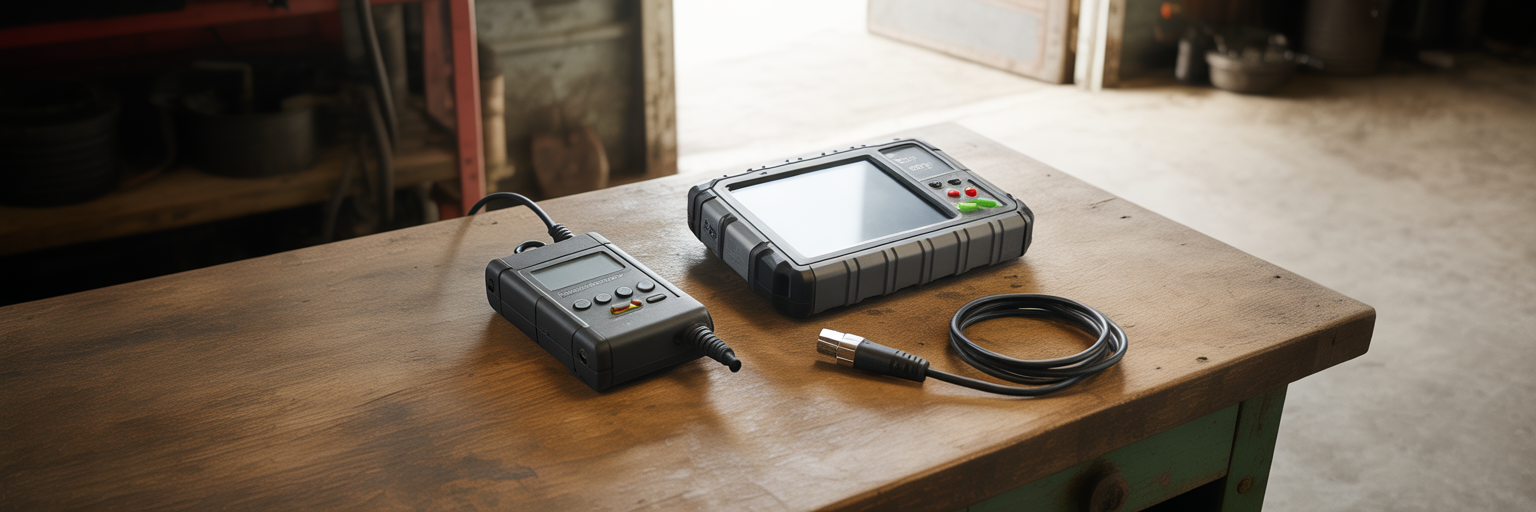
If the lights persist, especially the ABS and stability control warnings, the next step is a diagnostic scan. This is where it’s crucial to understand that not all scanners are created equal. A basic, inexpensive engine code reader will likely show “No Codes Found” because it can only communicate with the Powertrain Control Module (PCM). The ABS, TPMS, and stability systems are controlled by a separate Brake Control Module (BCM). You need a more advanced OBD-II scanner that can read codes from the BCM and other modules. Many auto parts stores in the US offer this service for free. Otherwise, it’s time to head back to the shop that performed the service or to your trusted mechanic.
Common Diagnostic Myths and Misconceptions
When faced with mysterious warning lights, many drivers turn to internet forums for advice. While sometimes helpful, these forums are also filled with common myths and incorrect information that can waste your time or even cause more problems. Let’s debunk two of the most common pieces of bad advice.
The ‘Disconnect the Battery’ Fallacy
You’ve probably seen it on a forum: “Just disconnect the negative battery terminal for 15 minutes. That will reset everything.” While it’s true that disconnecting the battery will cut power to the vehicle’s control modules and likely turn the warning lights off temporarily, it is not a fix. It’s like taking the batteries out of a smoke detector to stop the beeping without putting out the fire.
The moment you reconnect the battery and the car’s systems complete their self-tests, the original fault—the broken wire, the damaged sensor, the mismatched tire size—will be detected again, and the light will come right back on. Furthermore, disconnecting the battery can have negative side effects. It erases the memory for your radio presets, clock, and, more importantly, the adaptive learning values for your engine and transmission. This can result in poor engine performance and rough shifting until the car has had time to relearn your driving habits.
Why Your Basic Code Reader Can’t See the Problem
Another source of immense frustration is plugging in a basic OBD-II code reader and having it display the message “No Codes Found,” even with multiple warning lights staring you in the face. This leads many to believe there is no problem, or that the scanner is broken. The issue is a matter of jurisdiction.
Your vehicle has multiple onboard computers, or modules, each responsible for a different area. The ubiquitous “Check Engine” light is controlled by the Powertrain Control Module (PCM). The cheap, widely available code readers are designed to talk only to this module. However, the ABS, TPMS, and stability control lights are governed by a completely separate computer, typically the Brake Control Module (BCM). A basic scanner doesn’t have the software to communicate with the BCM, so it can’t see the fault codes that are stored there. It’s like trying to diagnose a heart problem with a thermometer. You need the right tool for the job: a more advanced scan tool that can access the specific module that has detected a fault.
Frequently Asked Questions
Here are quick answers to some of the most pressing questions drivers have when their dashboard lights up after a tire rotation.
Can a tire rotation actually damage a sensor?
Yes, it is possible. While a careful and professional technician will take precautions, accidents can happen. The delicate wiring for a wheel speed sensor can be snagged or stretched, or the sensor itself can be bumped and cracked. Similarly, a TPMS sensor, especially an older one with a brittle valve stem, can be broken during the process of mounting or dismounting a tire from a wheel.
Will the dashboard lights just reset themselves?
Sometimes, but you shouldn’t rely on it. A TPMS light caused by a minor pressure change might go off by itself after you drive for a while, especially if the ambient temperature changes. However, a “hard fault”—like a broken sensor, disconnected wire, or a major tire size mismatch—will not resolve itself. The light will stay on until the underlying physical problem is repaired.
Is it safe to drive with these lights on?
This depends entirely on which light is on. As outlined in our triage guide, a standalone TPMS light is a low-risk issue. The amber ABS, traction, and stability control lights indicate a medium risk; the car is drivable, but its key safety systems are offline. The red brake warning light, especially with other symptoms, indicates a high-risk, stop-driving situation.
Should the tire shop be responsible for diagnosing and fixing the problem?
Generally, yes. If the dashboard lights after tire rotation appeared immediately after you left the shop, your first call should be to them. A reputable shop values its customers and will want to ensure their work didn’t cause an issue. They should inspect their work and perform a diagnostic scan to determine the cause. If the fault was directly caused by their service (e.g., a damaged wire), they should cover the repair. If the failure is found to be coincidental (like a TPMS sensor battery that died of old age), you may be responsible for the cost of the part, but the initial diagnosis should be part of the shop’s commitment to customer service.
For more helpful articles and in-depth vehicle information, explore the full range of topics on Car Phanatics.