
We’ve all been there. You drive off the lot in a new or new-to-you car, impressed by the fuel economy number on the window sticker. A few months later, you’re standing at the gas pump, looking at your receipts and wondering why your real-world results feel like a distant dream. It’s a common frustration that leads many drivers to ask, why is my MPG so low? The good news is that your car probably isn’t broken, and the manufacturer isn’t trying to deceive you. The difference between the sticker and the pump comes down to a misunderstanding of what that EPA number truly represents.
Decoding the EPA Fuel Economy Sticker
The fuel economy rating you see on a vehicle’s window sticker is born in a highly controlled laboratory, not on the open road. To create these estimates, the U.S. Environmental Protection Agency uses a machine called a dynamometer, which is essentially a treadmill for cars. This setup allows for perfectly repeatable tests by eliminating real-world variables like traffic, weather, and driver behavior. As the EPA outlines on their website, these procedures are designed to ensure every vehicle is tested under the exact same conditions.
During these tests, a vehicle is run through standardized “city” and “highway” driving cycles that simulate specific patterns of acceleration, cruising, and braking. The city cycle involves more stops and starts, while the highway cycle features higher, more sustained speeds. The results from these controlled simulations are then used to calculate the MPG numbers you see advertised.
Think of the EPA sticker like the nutrition label on a box of cereal. It provides a standardized benchmark that is incredibly useful for one specific purpose: making an apples-to-apples comparison between different vehicles. It tells you that, under identical conditions, a car rated at 35 MPG is more efficient than one rated at 25 MPG. It does not, however, guarantee you will achieve 35 MPG in your daily commute.
Your actual mileage is influenced by a host of factors the lab can’t account for. The reason your car getting worse gas mileage than EPA estimates almost always comes down to three things: your personal driving habits, the environment you drive in, and the mechanical health of your vehicle. Understanding these variables is the first step toward closing the gap between the sticker and your reality.
How Your Driving Style Drains the Fuel Tank

Before you start worrying about complex mechanical problems, it’s worth looking at the biggest variable in the fuel economy equation: the person behind the wheel. Your habits and decisions on the road have a direct and significant impact on how often you visit the gas station. Many of the primary causes of poor fuel economy are directly within your control.
The Cost of Aggressive Driving
Imagine the gas pedal is a faucet. Stomping on it from a stop is like opening the tap all the way, demanding a huge rush of fuel to get the car’s mass moving. Hard braking then wastes all that forward momentum you just paid for. Aggressive driving, characterized by rapid acceleration and sudden stops, is the single biggest driver-related factor in poor fuel economy. Smooth, predictive driving—looking ahead, anticipating stops, and accelerating gently—uses momentum to your advantage and keeps that fuel faucet at a steady, efficient flow.
Why Short Trips Are Fuel Guzzlers
A cold engine is an inefficient engine. When you first start your car, the engine runs on a “rich” fuel mixture, meaning it uses more gasoline than normal to ensure smooth operation until it warms up. On trips shorter than about five miles, your engine may never reach its optimal operating temperature. This means you’re completing your entire journey in the least efficient phase of the engine’s operation, which is a major reason why is my MPG so low on city errands.
The Hidden Drain of Idling and Traffic
We can all picture that moment: you’re stuck in bumper-to-bumper traffic, watching the minutes tick by. What you might not realize is that you’re also watching your fuel disappear. An idling engine gets exactly zero miles per gallon. According to FuelEconomy.gov, a typical car can burn a quarter to a half-gallon of fuel per hour while idling. This includes time spent at long red lights, in drive-thrus, or waiting to pick someone up. Using a remote starter to warm up your car on a cold morning might feel great, but that 10 minutes of idling is pure fuel consumption with zero distance covered.
The High-Speed Penalty on the Highway
Once you get above a certain speed, typically around 50-60 mph, your engine has to work exponentially harder to overcome aerodynamic drag. Pushing a two-ton metal box through the air at 75 mph requires significantly more energy than doing it at 65 mph. As a general rule, you can expect your fuel efficiency to decrease by 7% to 14% for every 5 mph you drive over 60 mph. Slowing down on the highway is one of the simplest ways to see an immediate improvement in your fuel economy.
To summarize, these habits are the most common culprits:
- Aggressive acceleration and hard braking
- Frequent short trips with a cold engine
- Extended periods of idling in traffic or while parked
- Driving at high speeds on the highway
Environmental and Load Factors Affecting MPG
Even if you have the smoothest driving style, there are external forces at play that can significantly reduce your fuel economy. These environmental and load-related factors force your engine to work harder to accomplish the same task of moving you from point A to point B.
The Impact of Cold and Hot Weather
Weather is a powerful and often overlooked factor. In the winter, cold air is denser, which increases aerodynamic drag. Your engine and transmission fluids are thicker, creating more internal friction until they warm up. Even your car’s battery is less efficient in the cold, putting more strain on the alternator. All these factors combined can cause a noticeable drop in MPG.
In the summer, the biggest culprit is your air conditioner. The A/C compressor is driven by the engine, meaning it puts a direct mechanical load on it. Running the air conditioning on a hot day can reduce your fuel economy by as much as 25%, especially in stop-and-go traffic.
Fighting Against Wind and Hills
The physics here are simple. Driving into a strong headwind is like trying to drive up a constant, invisible hill; your engine must produce more power to maintain speed. Similarly, driving in hilly or mountainous terrain is a constant battle against gravity. While you might gain some efficiency going downhill, it rarely compensates for the extra fuel burned climbing up.
The Burden of Excess Weight and Towing
Your car’s engine is designed to move a specific amount of weight. Every extra pound you add requires more energy to move and stop. This could be a trunk full of tools, sports equipment, or simply unnecessary clutter. The effect is magnified significantly when towing. Pulling a trailer dramatically increases the total mass your engine must move, which is why even the most efficient vehicles see their MPG plummet when hooked up to a load. For those who frequently tow, selecting one of the best used trucks for towing a camper under $35,000 can be a more practical and economical choice in the long run.
Aerodynamic Drag from Racks and Wheels
Automakers spend millions of dollars designing cars to be as slippery through the air as possible. Attaching a roof rack or cargo box, even an empty one, disrupts that carefully designed airflow and creates significant drag. This forces the engine to work harder, especially at highway speeds. Similarly, swapping your factory wheels for larger, heavier aftermarket ones can hurt efficiency. Heavier wheels increase unsprung weight and rolling resistance, both of which require more energy to get and keep moving.
Finally, even the fuel itself can be a factor. During winter months, refineries switch to “winter-blend” gasoline. This fuel is formulated to evaporate more easily in cold temperatures, which helps with starting, but it also contains slightly less energy per gallon, contributing to a small but measurable decrease in fuel economy.
Mechanical Issues That Secretly Reduce Fuel Economy

If you’ve adjusted your driving habits and accounted for environmental factors but are still seeing poor mileage, it might be time to look under the hood. A wide range of mechanical issues can be the underlying causes of poor fuel economy. While some are simple fixes, others can point to more serious problems that require professional attention.
The Simple Stuff: Tires and Alignment
Before diving into complex engine diagnostics, start with the basics. Your tires are the only part of your car that touches the road, and their condition is critical. Low tire pressure is a common and easily fixed issue. Underinflated tires create more rolling resistance, which is like forcing your engine to drive through sand. Similarly, poor wheel alignment can cause your tires to “fight” each other, scrubbing against the pavement instead of rolling freely. If your car pulls to one side, it’s a good sign your alignment is off and costing you fuel.
Hidden Friction: Dragging Brakes and Bad Bearings
Another source of hidden resistance is your braking system. A dragging brake caliper that fails to release properly can act like you’re driving with the parking brake partially engaged. This creates constant friction and heat, wasting a tremendous amount of energy. A failing wheel bearing can produce a similar effect, creating drag that your engine must overcome.
The Air and Fuel Delivery System
For your engine to run efficiently, it needs the perfect mixture of air and fuel. A problem with either side of this equation can wreck your MPG. Clogged fuel injectors can create a poor spray pattern, leading to incomplete and inefficient combustion. While a dirty air filter is often blamed, in most modern cars, it primarily impacts performance rather than fuel economy unless it’s severely clogged.
Ignition and Sensor Failures
Modern cars rely on a network of sensors to manage engine performance. When one of these sensors fails, it can feed bad data to the car’s computer, causing it to use too much fuel. A failing oxygen (O2) sensor might tell the computer the engine is running lean, causing it to dump in extra fuel. A faulty Mass Airflow (MAF) sensor can miscalculate the amount of air entering the engine, leading to an incorrect fuel mixture.
Furthermore, worn-out spark plugs can lead to incomplete combustion, essentially wasting the fuel that enters the cylinder. A thermostat stuck open is another sneaky culprit. It prevents the engine from reaching its optimal operating temperature, keeping it in a fuel-rich “warm-up” mode indefinitely. Proactive maintenance is essential, as these steps are part of how to keep your car’s engine running for years and preserve its efficiency.
| Mechanical Issue | Common Symptoms | Estimated MPG Impact |
|---|---|---|
| Low Tire Pressure | Sluggish handling, uneven tire wear | Low (1-3%) |
| Poor Wheel Alignment | Car pulls to one side, crooked steering wheel | Low to Moderate (up to 10%) |
| Dragging Brake Caliper | Burning smell after driving, car pulls when braking | Moderate to High (10-25%) |
| Worn Spark Plugs | Rough idle, hesitation on acceleration, check engine light | Moderate (5-15%) |
| Failing Oxygen (O2) Sensor | Check engine light, failed emissions test, rotten egg smell | High (up to 20-30%) |
| Stuck-Open Thermostat | Engine temperature gauge stays low, poor heater performance | Moderate (10-20%) |
| Clogged Fuel Injectors | Rough idle, engine misfires, poor performance | Moderate (10-15%) |
Note: These MPG impact estimates are for illustrative purposes. The actual loss will vary based on the severity of the issue and the specific vehicle.
Gradual Decline vs. a Sudden Drop in Mileage
Understanding the difference between a slow decline in fuel economy and a sharp, sudden drop is key to diagnosing the problem. The speed of the change often tells you whether you’re dealing with routine maintenance or a component failure that needs immediate attention.
A gradual decline is a slow creep downwards in your average MPG over several months or thousands of miles. This is typically caused by normal wear and tear. Tires slowly lose pressure, spark plugs age, and minor carbon deposits build up in the engine. This slow fade in efficiency is a signal that your car is due for routine maintenance. It’s a reminder to check your tire pressure, change your oil, and inspect your filters. Understanding why some high-mileage cars age better than others often comes down to how consistently this type of wear is addressed.
A sudden drop in gas mileage, on the other hand, is a red flag. This is a sharp, unmistakable decrease in your fuel economy from one tank of gas to the next. This almost always points to a specific component failure. The likely culprits for a sudden drop include a failed oxygen sensor, a brake caliper that has seized, a major vacuum leak in an intake hose, or a thermostat that has become stuck open. These are not issues that develop slowly; they happen all at once.
If your poor mileage is accompanied by other serious symptoms, you should not wait to get it checked. A lit check-engine light, a strong smell of raw fuel, a noticeable loss of power, a rough idle, or a dragging sensation are all signs that your car needs an immediate professional diagnosis. Ignoring these warnings can lead to more expensive damage and potentially leave you stranded.
How to Calculate Your Car’s True Fuel Economy
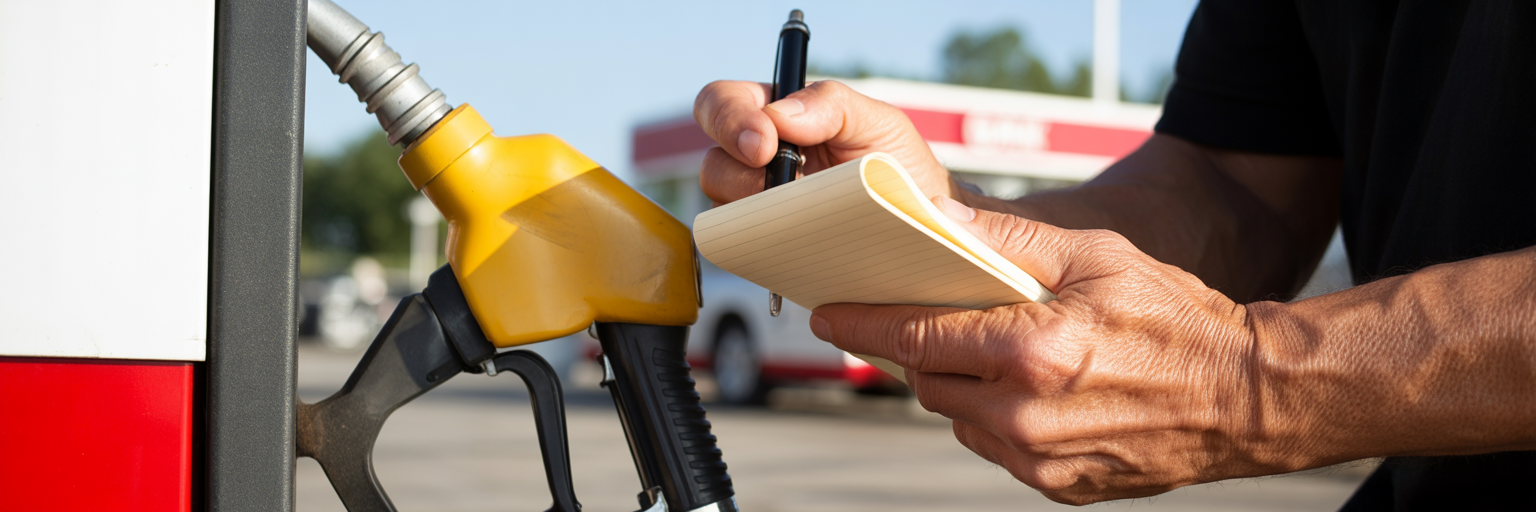
The MPG display on your dashboard is a helpful estimate, but it’s not always perfectly accurate. The car’s computer calculates this number based on factors like injector pulse width and vehicle speed, which can have a margin of error. To get a true, undeniable baseline for your vehicle’s performance, you need to do it the old-fashioned way. Learning how to calculate car MPG manually is simple and provides the most reliable data for tracking your fuel efficiency.
Follow these five simple steps:
- Fill your gas tank completely. Don’t stop at the first click; let the pump shut off automatically and then stop. Do not top off.
- Reset your trip odometer to zero. Make a note of your car’s total mileage if you don’t have a trip meter.
- Drive normally. Use at least half a tank of gas to ensure you have a good sample of your typical driving conditions.
- Return to the gas station and fill the tank completely again. Use the same pump if possible and let it shut off automatically just as before. Write down the exact number of gallons you added.
- Divide the miles driven by the gallons used. Take the number from your trip odometer (or the difference in your total mileage) and divide it by the number of gallons you just pumped. The result is your true MPG for that tank.
While calculating from one tank is a good start, it can be misleading. Small variations in the gas pump’s automatic shut-off can slightly alter the “gallons added” figure. More importantly, the driving conditions for a single tank might not be representative of your average use. You might have been stuck in more traffic than usual or done more highway driving.
For the most accurate baseline, you should average your results over three to five consecutive fill-ups. This process smooths out any outliers and gives you a reliable number that you can use to track changes and measure the effectiveness of any improvements you make.
Your Troubleshooting Checklist for Better MPG
Now that you understand all the factors that can hurt your fuel economy, it’s time to put that knowledge into action. Instead of guessing, follow a logical, step-by-step process to figure out how to improve car gas mileage. This checklist will help you systematically rule out the most common issues.
- Start with the Basics. This is the low-hanging fruit. Get a quality tire pressure gauge and check your tires when they are cold. Inflate them to the pressure listed on the sticker inside your driver’s door jamb, not the number on the tire itself. While you’re at it, look in your trunk and remove any unnecessary weight. If you have a roof rack you’re not using, take it off.
- Review Your Habits. Be honest with yourself. Are you an aggressive driver? Have you been making more short trips lately or spending more time idling in traffic? Consciously practicing smoother acceleration and anticipating stops can make a noticeable difference.
- Consult Your Records. When was your last oil change? When were the spark plugs and engine air filter last replaced? If you’re overdue for scheduled maintenance, now is the time to catch up. A well-maintained car is an efficient car.
- Heed the Warnings. Is your check-engine light on? Don’t ignore it. This is your car’s computer telling you that it has detected a problem. Most auto parts stores will read the diagnostic codes for free. This code is the single most valuable clue you can get to pinpointing a mechanical issue.
Just as a growing business might need a strategic guide to franchise tech consolidation to ensure all its systems work together efficiently, a car owner needs to consolidate all these data points—driving habits, maintenance logs, and fuel calculations—to get a clear picture of their vehicle’s performance. Finally, be wary of products that promise miraculous gains in fuel economy. There are no magic additives or devices that will double your MPG. The path to better fuel efficiency is paved with proper maintenance and sensible driving, not quick fixes.
Frequently Asked Questions About Fuel Efficiency
Many myths and questions surround the topic of fuel economy. Here are clear, straightforward answers to some of the most common ones.
- Does using premium fuel improve gas mileage?
Only if your vehicle’s manufacturer requires or recommends it. Premium fuel has a higher octane rating, which resists premature detonation (knock) in high-compression or turbocharged engines. Using it in a car designed for regular gas provides no benefit and is a waste of money. It will not improve your MPG. - Will a new air filter boost my MPG?
In modern, fuel-injected cars, not really. The car’s computer measures the air coming into the engine and adjusts the fuel accordingly. A clogged air filter will reduce horsepower and performance long before it has a significant impact on fuel economy. That said, it’s still an important and inexpensive maintenance item. - Can a wheel alignment really improve gas mileage?
Yes, absolutely. When your wheels are misaligned, they are essentially fighting each other and scrubbing against the road surface instead of rolling freely. This creates rolling resistance, which forces your engine to work harder. A proper alignment can improve your fuel economy by up to 10% in some cases. - Is cruise control more efficient?
It depends on the terrain. On flat, open highways, cruise control is generally more efficient because it maintains a perfectly steady speed, avoiding the small, wasteful throttle adjustments a human driver makes. However, in hilly areas, it can be less efficient because it will aggressively apply the throttle to maintain speed up a hill, whereas a human driver might let the speed drop slightly. - Why is my gas mileage so much worse in cold weather?
Several factors are at play. Cold air is denser, increasing aerodynamic drag. Engine fluids are thicker, creating more friction. Winter-blend gasoline has less energy content. And your engine takes longer to warm up, spending more time in its inefficient warm-up cycle. For short trips, it’s not uncommon to see a 15-30% drop in MPG during the winter. - Does a degrading hybrid battery affect gas mileage?
Yes, directly. A hybrid vehicle’s efficiency comes from its ability to use the electric motor to assist the gasoline engine or run on its own. As the high-voltage battery degrades, it can’t hold as much charge or deliver as much power. This forces the gasoline engine to run more often and for longer periods, which directly reduces the vehicle’s overall MPG.