Assess Your Driving Habits and Environment
The search for the right tires often begins with technical questions, but the best starting point is much more personal. It’s about your daily life. The perfect tire for a driver navigating stop-and-go city traffic is fundamentally different from one suited for long, open highway commutes. Your daily routine holds the answer to how to choose tires for my car.
Consider the rhythm of your drive. If your days are filled with short trips, frequent braking, and varied speeds, an all-season tire offers a great balance of durability and comfort. They are designed to handle the demands of urban driving without sacrificing a quiet ride. However, if your commute involves hours on the motorway, a touring or highway tire becomes a better fit. These are engineered for stability at high speeds, providing a smoother experience and reducing the constant drone of road noise that can make long journeys tiring.
Beyond where you drive, think about how you drive. Are you the type of person who carefully accelerates to maximize fuel efficiency, or do you enjoy a more spirited connection with the road? For the economy-minded driver, longevity and low rolling resistance are key. For the performance enthusiast, grip and precise handling are non-negotiable. This is where ultra-high-performance (UHP) tires come in, offering exceptional traction for cornering and braking. But this performance comes with clear trade-offs: they wear out faster, provide a firmer ride, and carry a higher price tag.
Finally, what surfaces do you travel on? Is it always smooth asphalt, or do your routes include gravel paths, dirt roads, or poorly maintained pavement? The tire’s internal construction is just as important as its tread pattern for handling these challenges. As you consider these factors, you can explore how manufacturers pair specific tires with new models by checking out the latest car news for more insights. The most important takeaway is that there is no single “best” tire. The right choice is a direct reflection of your unique driving profile.
Match Tires to Your Local Climate

Once you have a clear picture of your driving habits, the next step is to look outside at the weather. Your local climate is not a minor detail; it is a critical factor that dictates which tire compound will keep you safe. The science is straightforward. As temperatures drop, the rubber on standard tires begins to stiffen, losing the flexibility needed to grip the road effectively.
This brings us to the 45°F (7°C) rule. Below this temperature, the performance of all-season tires diminishes significantly. Winter tires, in contrast, use a softer rubber compound that stays pliable in the cold. Combined with deep grooves and thousands of tiny slits called sipes, they bite into snow and ice, providing essential traction when you need it most. As safety experts at Consumer Reports highlight, matching tires to your climate is a crucial safety decision.
The common all season vs winter tires debate often overlooks a third, valuable option: all-weather tires. All-season tires are truly best for regions with mild winters and little to no snow. All-weather tires, however, are a hybrid solution designed for year-round performance in areas with moderate snowfall. You can identify them by the Three-Peak Mountain Snowflake (3PMSF) symbol on the sidewall, which certifies their capability in severe snow conditions. For drivers in hot and wet climates, the primary concern is hydroplaning. Here, tread design is paramount. Look for tires with a high wet-traction rating, as their patterns are specifically engineered to channel water away from the contact patch, keeping you in control during heavy rain. The guiding principle should always be to choose tires for the worst conditions you regularly face, not the best.
| Tire Type | Optimal Temperature Range | Snow/Ice Traction | Wet Traction (Rain) | Best Use Case |
|---|---|---|---|---|
| All-Season Tires | Above 45°F (7°C) | Minimal / Not Recommended | Good to Excellent | Regions with mild winters and infrequent snow. |
| All-Weather Tires (3PMSF) | Year-Round, including below 45°F (7°C) | Good | Excellent | Regions with moderate snowfall that don’t require dedicated winter tires. |
| Winter Tires | Consistently below 45°F (7°C) | Excellent | Good (in cold) | Regions with harsh winters, heavy snow, and ice. |
| Summer/Performance Tires | Consistently above 45°F (7°C) | Not Recommended | Excellent | Hot climates and performance driving in dry or wet conditions. |
Select Tires Based on Your Vehicle Type
With your driving style and climate addressed, the focus now shifts to the vehicle itself. A tire is not a one-size-fits-all product; it must be engineered to support your vehicle’s specific weight, size, and intended purpose. Fitting the wrong type of tire can compromise handling, reduce stability, and create a genuine safety risk.
- Sedans and Passenger Cars: These vehicles offer the most flexibility, allowing you to choose tires that align with the driving habits we discussed earlier. A driver of a classic like a first-generation Honda Accord might prioritize a quiet, comfortable touring tire, while someone with a sport sedan will lean toward performance-oriented options.
- SUVs and Crossovers: As heavier vehicles, SUVs require tires with a higher load index and more robust construction. This is where finding the best tires for SUVs becomes crucial. For those who primarily drive on paved roads, highway-terrain (H/T) tires provide a car-like ride and low noise. However, if you occasionally venture off-road, all-terrain (A/T) tires offer a blend of on-road comfort and off-road capability. Understanding the features of a vehicle like the 2026 Jeep Grand Cherokee can help clarify whether an H/T or A/T tire is the better choice for your needs.
- Pickup Trucks and Work Vehicles: For these vehicles, durability and load-carrying capacity are paramount. Truck tires feature reinforced sidewalls to handle heavy loads and the rigors of a job site. All-terrain (A/T) tires are a versatile choice for trucks like the 2025 Ford F-150 that see a mix of highway and worksite use. For more extreme off-roading, mud-terrain (M/T) tires provide maximum grip, but be prepared for significant on-road trade-offs, including increased noise and reduced ride comfort.
Decode Tire Specifications and Ratings

The string of letters and numbers on a tire’s sidewall can seem intimidating, but it’s simply a label containing vital information. Think of it like reading the nutrition facts on a food package. Once you know what to look for, understanding tire ratings becomes a straightforward process that empowers you to make an informed choice.
Let’s break down a common example: P225/60R17.
- P: This indicates the tire type, in this case, “P” for a passenger vehicle.
- 225: This is the tire’s width in millimeters from sidewall to sidewall.
- 60: This is the aspect ratio, meaning the height of the sidewall is 60% of the tire’s width.
- R: This stands for the construction type, with “R” signifying radial construction, the standard for modern cars.
- 17: This is the diameter of the wheel in inches that the tire is designed to fit.
For a quick way to check these details, resources like Goodyear’s tire size calculator can be very helpful.
Beyond size, you will find the load index and speed rating. The load index is a number corresponding to the maximum weight each tire can support, while the speed rating is a letter indicating the maximum safe speed. It is essential that these ratings meet or exceed your vehicle manufacturer’s specifications, which you can find on a sticker inside the driver’s door jamb or in your owner’s manual.
Finally, look for the Uniform Tire Quality Grading (UTQG) rating. This is a comparative tool mandated by the government. It has three parts: Treadwear (a higher number suggests a longer potential lifespan), Traction (rated from AA to C, with AA being the best for wet braking), and Temperature (rated A, B, or C for heat resistance). This data transforms confusing codes into a practical guide for matching a tire’s capabilities to your needs.
Balance Your Budget with Long-Term Value
It’s natural to consider cost when buying new tires, but the sticker price only tells part of the story. The smartest approach is to think in terms of long-term value rather than short-term savings. While premium tires from established brands have a higher upfront cost, their advanced rubber compounds and engineering often deliver superior performance, better fuel economy, and a longer tread life.
This is where the concept of “total cost of ownership” comes into play. A budget tire that wears out 15,000 miles sooner is not truly cheaper. When you factor in the cost of more frequent replacements and mounting fees, the “bargain” quickly disappears. A better way to compare is by calculating the cost per mile. A more durable, slightly more expensive tire often proves to be the more economical choice over its lifespan.
Warranties also offer a clue to a tire’s quality. A tread life warranty is the manufacturer’s promise of durability and serves as a form of insurance on your investment. A longer warranty typically signifies a higher-quality product built to last. Investing in quality components from the start is the best way to ensure reliability. After all, if you are already asking yourself, “why is my car squeaking when I drive,” you know that cutting corners on maintenance or parts can lead to more significant issues down the road. Prioritizing safety and durability is an investment that always pays off.
Perform Essential Maintenance for Longevity and Safety
Your responsibility doesn’t end once the new tires are installed. Protecting your investment and ensuring your safety requires a few simple, consistent habits. These basic car tire maintenance tips will help you get the most out of your tires, maximizing their performance and lifespan.
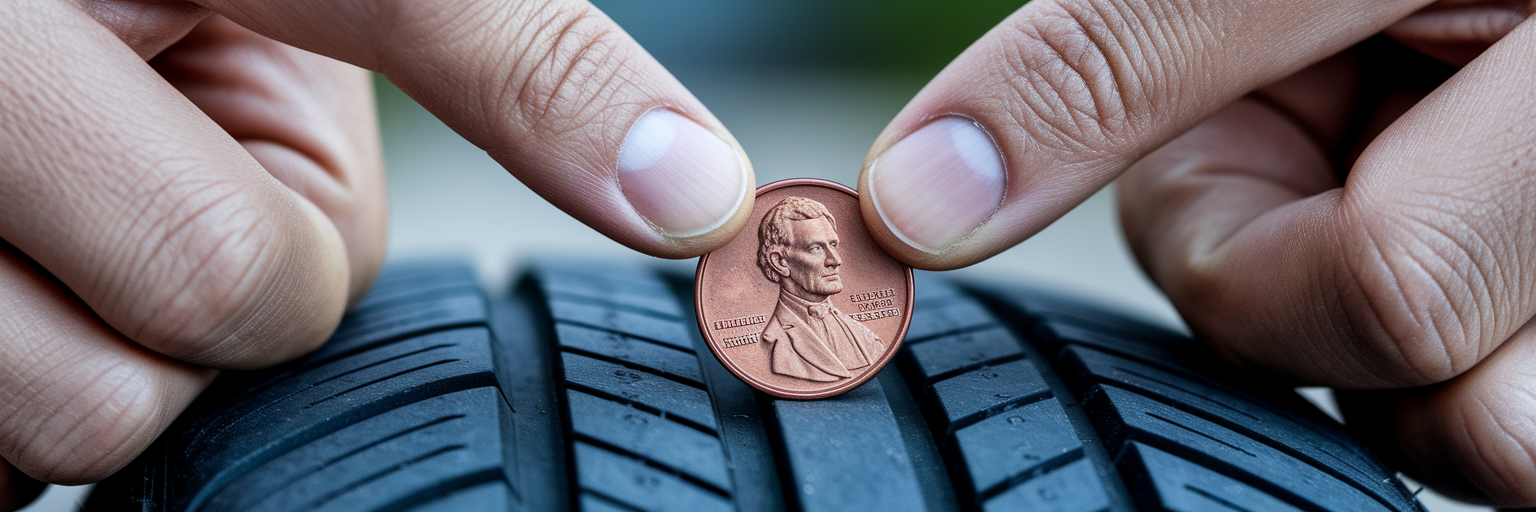
- Check Tread Depth: As the NHTSA points out, tires are legally worn out at 2/32 of an inch of tread depth. However, for safety, especially in wet conditions, it is wise to consider when to replace car tires before they reach this minimum. You can check the depth using the built-in treadwear indicator bars or with the simple penny test. Just place a penny upside down in a tread groove. If you can see all of Abraham Lincoln’s head, it’s time for new tires.
- Maintain Proper Tire Pressure: Correct inflation is the single most important factor for tire health. Underinflation causes excessive wear on the outer edges and can lead to overheating, while overinflation causes wear in the center and results in a harsh, bumpy ride. Check your tire pressure monthly with a reliable gauge when the tires are cold, and inflate them to the pressure listed on your vehicle’s door jamb sticker.
- Rotate and Align: Regular rotations, typically every 5,000 to 7,000 miles, ensure that all four tires wear down evenly. If you notice uneven wear patterns or if your car pulls to one side, it’s time for a wheel alignment check. This is especially important after hitting a large pothole or curb.
Buying the right tires is the first step. Consistent maintenance is what unlocks their full potential for safety and performance on every drive.