
The Reality of Towing an 8,000-Pound Travel Trailer
The vision of hitting the open road with a family and travel trailer in tow is a cornerstone of American adventure. Central to this dream is the half-ton pickup truck, but the reality of towing an 8,000-pound travel trailer safely is far more complex than manufacturer advertisements suggest. While truck makers promote impressive towing figures, often exceeding 12,000 pounds, these numbers frequently apply to stripped-down models that few families actually buy. The real-world capability of a well-equipped crew cab 4×4 comes down to a much less-advertised number: payload capacity.
To investigate this, we will use a consistent and realistic scenario. Imagine a family of four preparing for a trip. Their travel trailer, fully loaded with water, propane, and supplies, weighs 8,000 pounds. A properly balanced trailer should place between 10% and 15% of its weight on the hitch ball to ensure stability. We will use a conservative 12.5%, resulting in a 1,000-pound tongue weight. Add a 100-pound weight-distributing hitch, which is essential for a load this size. Inside the truck are two 180-pound adults, two 80-pound children, and 200 pounds of cargo like coolers, bags, and gear. This adds up to a total payload demand of 1,820 pounds. This entire weight presses down on the truck’s suspension and is subtracted directly from its available payload.
The critical conflict arises between the massive towing numbers used in marketing and the payload capacity listed on the Tire and Loading Information sticker inside the driver’s door jamb. A truck might be advertised to tow 13,000 pounds, but if its payload is only 1,600 pounds, our family scenario would overload it by 220 pounds before even leaving the driveway. This overload compromises braking, handling, and overall safety. This article moves beyond the misleading marketing to conduct an investigative comparison of five major 2026 half-ton trucks. We will determine which, if any, can safely and legally handle our 1,820-pound payload requirement for a family adventure.
Key Towing Metrics Beyond the Advertised Maximum
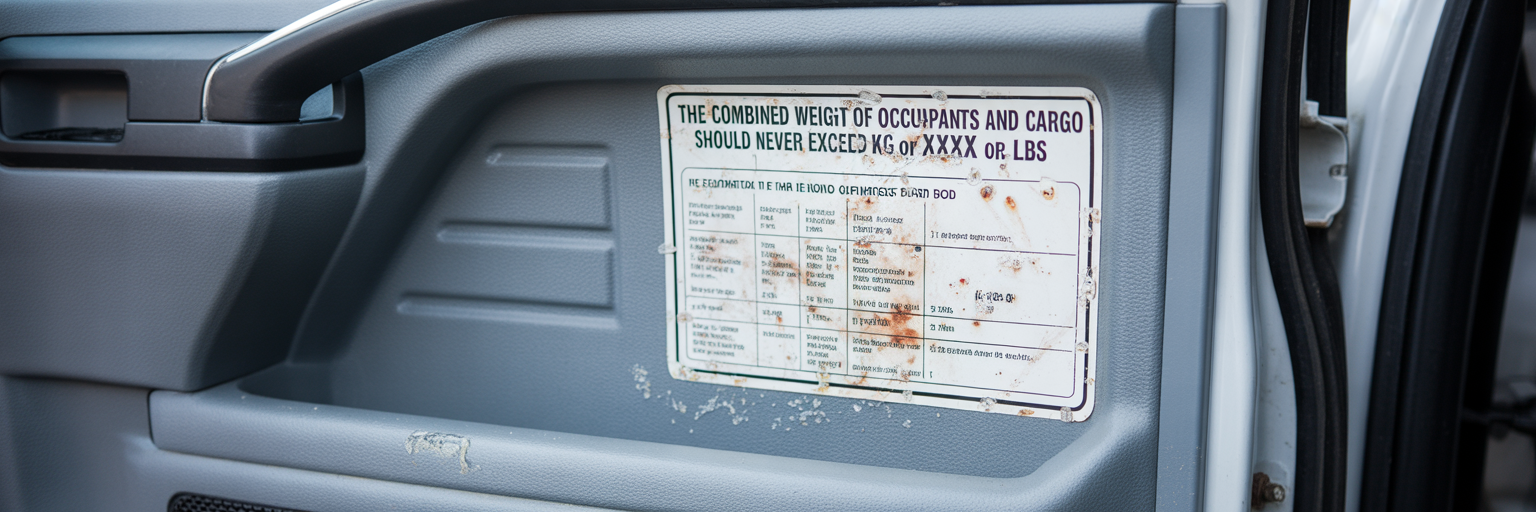
To understand a truck’s true capabilities, you must look past the single advertised tow rating and examine several interconnected metrics. These figures work together to define the safe operating limits of your vehicle. Understanding them is essential for determining a truck’s real world towing capacity and ensuring your family’s safety on the road.
1. Payload Capacity: This is the most critical number for our family towing scenario. Payload is the total weight a truck can carry in its cab and bed, including passengers, cargo, and the trailer’s tongue weight. The only payload number that matters is the one printed on the yellow and white “Tire and Loading Information” sticker inside the driver’s door jamb. This figure is specific to that exact truck as it left the factory, accounting for all its options. A luxury trim’s panoramic sunroof and power running boards can reduce payload by hundreds of pounds compared to a base model.
2. Gross Vehicle Weight Rating (GVWR): Think of this as the maximum legal weight of your fully loaded truck. It is the sum of the truck’s curb weight (its weight when empty) and its payload capacity. Exceeding the GVWR puts excessive strain on the frame, suspension, brakes, and tires. It is a hard limit that should never be surpassed.
3. Gross Combined Weight Rating (GCWR): This is the maximum allowable weight of the loaded truck and the loaded trailer combined. While it is an important safety metric, most families towing a large travel trailer with a half-ton truck will exceed the payload capacity or GVWR long before they approach the GCWR.
4. Rear Gross Axle Weight Rating (RGAWR): This often-overlooked limit specifies the maximum weight the rear axle can support. In our scenario, the 1,000-pound tongue weight and 100-pound hitch place immense pressure directly on the rear of the truck. Overloading the rear axle can lead to instability, poor handling, and potential mechanical failure.
5. Weight-Distributing Hitch (WDH): For a trailer of this size, a WDH is not optional; it is a required safety device. It uses spring bars to leverage some of the tongue weight off the truck’s rear axle and distribute it to the truck’s front axle and the trailer’s axles. This creates a more level and stable rig. However, it is crucial to remember that a WDH does not increase the truck’s total payload capacity. The full tongue weight and the weight of the hitch itself still count against your payload.
Navigating these specifications is key to choosing the right vehicle from the wide world of modern trucks we cover, ensuring your choice has the half-ton truck payload capacity needed for safe travels.
2026 Ford F-150 Analysis
The Ford F-150 has long been a leader in towing, and for 2026, it remains a formidable contender for our 8,000-pound trailer scenario, but only with a very specific configuration. The key is to equip the truck with the 3.5L EcoBoost V6 engine and the Max Trailer Tow Package. This package provides necessary upgrades like a 36-gallon fuel tank, an integrated trailer brake controller, and a robust rear axle, typically with a 3.55 or 3.73 ratio for optimal pulling power.
However, the true game-changer for the F-150 is the available Heavy-Duty Payload Package (HDPP). This often hard-to-find package is a tower’s best friend, upgrading the frame, springs, wheels, and axles to deliver class-leading payload. Critically, HDPP is typically only available on lower to mid-range trims like the XL and XLT. An F-150 XLT Crew Cab 4×4 with HDPP can boast a payload capacity well over 2,000 pounds, sometimes approaching 2,500 pounds. This configuration would handle our 1,820-pound payload demand with a comfortable safety margin.
The impact of trim level is stark. As you move up to luxury trims like the Platinum or Limited, the payload plummets. The added weight of features like a panoramic sunroof, power-deployable running boards, massaging seats, and 22-inch wheels directly subtracts from the truck’s carrying capacity. A 2026 F-150 Platinum Crew Cab 4×4 might have a payload sticker as low as 1,550 pounds. Applying our 1,820-pound scenario to this truck would leave it 270 pounds overloaded, creating an unsafe towing condition despite its high price tag.
The verdict for the F-150 is clear. It is an excellent choice for this task, but buyers must be disciplined. You must bypass the tempting luxury trims and seek out an XL or XLT with the 3.5L EcoBoost, the Max Trailer Tow Package, and, ideally, the HDPP. Verifying the door jamb sticker is non-negotiable. With the right equipment, the 2026 F-150 towing capacity is not just a number but a real-world capability. For those who find the search for a specific new configuration daunting, many capable used trucks can also get the job done effectively.
2026 Chevrolet Silverado 1500 & GMC Sierra 1500 Analysis
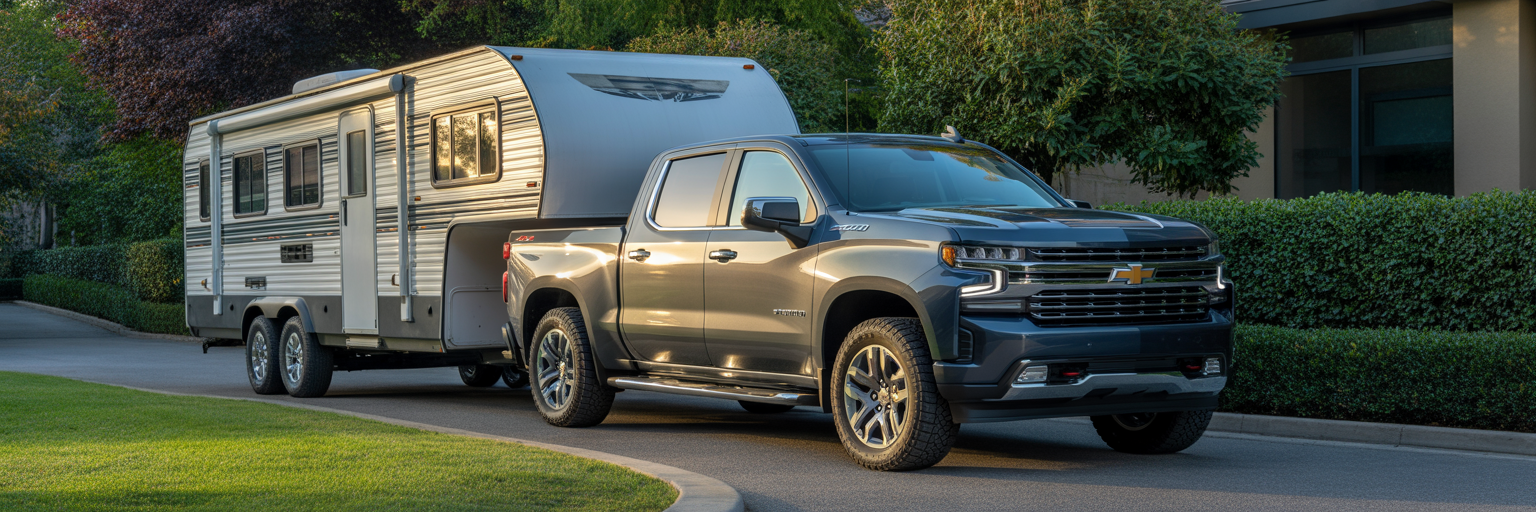
The 2026 Chevrolet Silverado 1500 and its corporate cousin, the GMC Sierra 1500, are analyzed together because they share the same frame, powertrains, and core architecture. For our 8,000-pound trailer challenge, the optimal powertrains are the proven 5.3L V8 or the more powerful 6.2L V8. To unlock their full potential, either engine must be paired with the Max Trailering Package. This essential option group typically includes an enhanced cooling system, a stronger rear axle with a 3.42 ratio, retuned shock absorbers, and a crucial integrated trailer brake controller.
When examining payload, the GM twins live on the edge of our scenario’s requirements. A commonly found Crew Cab 4×4 configuration in a popular trim like the Chevy LT or GMC SLE will often have a payload capacity sticker reading between 1,600 and 1,900 pounds. This places them directly in the decision-making crosshairs. A model with a 1,900-pound payload rating would have just 80 pounds of capacity remaining after our family and trailer are accounted for. This slim margin can disappear quickly once you account for tablets, snacks, and other travel essentials, including everyone’s phones, which are often protected by cases that, as some style guides note, add to the packed weight.
Like with other brands, luxury and off-road packages are the enemies of payload. A GMC Sierra 1500 Denali or a Silverado High Country loses significant capacity to heavy premium features. Similarly, the popular AT4 and Trail Boss trims, with their specialized off-road suspension, skid plates, and heavy all-terrain tires, see a notable reduction in their Silverado 1500 payload and towing numbers. These models prioritize trail capability over maximum hauling.
The verdict for the Silverado and Sierra is that they are capable, but require careful and diligent shopping. A buyer must prioritize finding a model equipped with the Max Trailering Package and, most importantly, must verify the payload sticker on the specific truck they intend to buy. Seeing a sticker that reads 1,750 pounds means that truck is not suitable for our 1,820-pound scenario. You must be prepared to walk away and find one with a higher rating. This level of detail is what separates a safe hauler from an overloaded risk, a topic we explore in other detailed comparisons like our Nissan Frontier vs. Chevrolet Colorado analysis.
2026 Ram 1500 Analysis
The 2026 Ram 1500 is widely praised for having the best ride quality in the half-ton segment, a direct result of its standard multi-link coil spring rear suspension. This design choice sets it apart from the traditional leaf springs used by some competitors. However, this engineering decision involves a significant trade-off. While the coil springs provide a smoother, more car-like ride when the truck is unladen, they generally offer less payload capacity than a comparable leaf spring setup.
To maximize the Ram 1500’s towing potential for our scenario, a buyer would need to select the 5.7L Hemi V8 with the eTorque mild-hybrid system. This powertrain must be paired with the Trailer-Tow Group and the aggressive 3.92 rear axle ratio to get the best performance. Even with this optimal configuration, the payload numbers remain a primary concern. A typical Crew Cab 4×4 model in a popular Big Horn or Laramie trim frequently has a payload capacity listed on its door jamb sticker in the 1,500 to 1,700-pound range.
When we apply our 1,820-pound payload requirement, the challenge for the Ram becomes immediately apparent. A truck with a 1,650-pound payload sticker would be overloaded by 170 pounds before it even pulls out of the campground. This deficit puts excessive strain on the suspension and braking systems, creating an unstable and unsafe condition. While the truck might be able to pull the weight, it cannot legally or safely carry the associated load from the family and trailer tongue.
Our verdict on the Ram 1500 is direct: while it is a fantastic daily driver and an exceptionally comfortable truck, most standard configurations are likely to be overloaded in our specific family towing scenario. A buyer would have to search for a very specific, likely lower-trim Tradesman model with the right options to find a payload sticker that could safely accommodate the 1,820-pound load. This highlights the balance between daily comfort and heavy-duty utility, a common theme when choosing from the best family road trip vehicles available today.
2026 Toyota Tundra Analysis
The 2026 Toyota Tundra represents a modern approach to the half-ton truck, having moved to a standard i-FORCE twin-turbo V6 engine and an optional i-FORCE MAX hybrid powertrain. While these engines are powerful and efficient, the Tundra’s engineering choices directly impact its suitability for heavy towing. Like the Ram 1500, the Tundra features a multi-link coil spring rear suspension that prioritizes ride comfort, which generally comes at the expense of maximum payload capacity.
A significant factor for the Tundra is the i-FORCE MAX hybrid system. While it boosts horsepower and torque, the large battery pack and electric motor add several hundred pounds of weight to the truck. This added curb weight is directly subtracted from the truck’s payload capacity, making hybrid models less suitable for our heavy payload scenario. Therefore, the most likely configuration for our task would be a non-hybrid Tundra equipped with the factory tow package.
When examining the payload stickers on typical CrewMax 4×4 models in popular SR5 or Limited trims, the numbers are often a cause for concern. These trucks frequently have payload ratings ranging from 1,400 to 1,650 pounds, with the hybrid models falling at the lower end of that spectrum. Applying our 1,820-pound payload demand reveals a significant shortfall. A Tundra with a 1,500-pound payload capacity would be dangerously overloaded by 320 pounds. This would severely compromise the vehicle’s stability, braking performance, and overall safety, placing it well over its Gross Vehicle Weight Rating (GVWR).
The verdict for the 2026 Tundra is firm. While it is a reliable, technologically advanced truck with a strong reputation, its inherent payload limitations make it a poor choice for towing an 8,000-pound travel trailer with a family and their gear. Buyers focused on this specific task will find that most Tundra configurations are very likely to be overloaded. This focus on specific capabilities is something we explore in other Toyota comparisons, such as our deep dive into the Jeep Gladiator vs. Toyota Tacoma for off-road use.
Final Verdict: The Best Half-Ton for Your Family Trailer
After analyzing the data and running the numbers, our investigation reveals a clear and critical takeaway for any family looking to tow a heavy travel trailer: advertised tow ratings are misleading. The single most important number is the payload capacity, found only on the Tire and Loading Information sticker inside the driver’s door jamb. For our 1,820-pound family scenario, this number separates the capable from the overloaded.
Based on our findings, the 2026 half-ton trucks fall into distinct categories:
- Handles the Load Comfortably: The 2026 Ford F-150 stands out, but only when properly configured. An XL or XLT trim with the 3.5L EcoBoost, Max Trailer Tow Package, and the Heavy-Duty Payload Package (HDPP) provides the payload capacity needed to handle this task with a confident safety margin.
- At or Near the Limit: The 2026 Chevrolet Silverado 1500 and GMC Sierra 1500 are capable, but leave very little room for error. They require a V8 engine, the Max Trailering Package, and a verified door-jamb payload of at least 1,900 pounds. Buyers must be extremely diligent in checking the sticker.
- Likely to Be Overloaded: The 2026 Ram 1500 and 2026 Toyota Tundra, despite their excellent ride quality and modern features, are poor choices for this specific task. Their coil-spring rear suspensions prioritize comfort over payload, and most common configurations will not safely support the 1,820-pound load.
To make the findings even clearer, here is a summary of our investigation.
| Truck Model | Verdict Category | Key Consideration for an 8,000-lb Trailer |
|---|---|---|
| 2026 Ford F-150 | Handles the Load Comfortably | Requires 3.5L EcoBoost, Max Trailer Tow, and ideally the Heavy-Duty Payload Package (HDPP) on an XL/XLT trim. |
| 2026 Chevy Silverado / GMC Sierra 1500 | At or Near the Limit | Requires V8 engine, Max Trailering Package, and a verified door-jamb payload of 1,900+ lbs. Leaves little room for error. |
| 2026 Ram 1500 | Likely to Be Overloaded | Coil-spring suspension prioritizes ride over payload. Most common configurations will exceed GVWR. |
| 2026 Toyota Tundra | Likely to Be Overloaded | Payload is limited by coil-spring suspension and further reduced by the heavy hybrid battery option. |
Ultimately, the best truck for towing your travel trailer is the one that can do it safely. Before you sign any paperwork, perform this final check: take your entire family to the dealership, find the payload sticker on the truck you want, and subtract your family’s weight from that number. If the remaining capacity is not at least 1,300 pounds (to cover the 1,000-lb tongue, 100-lb hitch, and 200-lb cargo), you must find a different truck.