
Rack and pinion steering systems transfer over a thousand pounds of lateral force every time you maneuver a modern passenger car at low speeds. When an unexpected clunking noise when turning steering wheel interrupts your drive, it indicates that one of those high-load joints or mounts has developed dangerous mechanical play.
How Driving Conditions Narrow Down a Clunking Noise When Turning Steering Wheel
Pinpointing an elusive front-end sound begins long before you reach for a flashlight or a wrench. Because dozens of moving joints connect your steering column to the front tires, the exact state of the vehicle when you hear a clunking noise when turning steering wheel serves as your primary diagnostic clue. A sound that appears only while parked points to a completely different mechanical failure than a sound triggered while accelerating out of a tight intersection or driving over broken pavement. As highlighted in an engineering bulletin from the National Highway Traffic Safety Administration, isolating front suspension and steering noises requires matching the specific acoustic signature to exact vehicle maneuvers like steep driveway entries, speed bumps, and slow sharp turns.
Stationary and Low-Speed Parking Lot Maneuvers
Think about pulling into a tight grocery store parking spot where you have to crank the wheel from lock to lock while barely creeping forward. Without forward rolling momentum to help the rubber tread pivot, dry tire scrub against the rough asphalt puts maximum twisting load on the entire steering system. Power steering pumps or electric assist motors work at peak output during these stationary maneuvers, forcing the steering column, intermediate shaft, tie rods, and upper strut mounts to absorb immense rotational tension. If any of these components have worn clearances or seized bearings, the built-up tension releases suddenly as a heavy thud or metallic pop right as you turn the wheel.
Accelerating Through Sharp Corners vs. Turning Over Bumps
Dynamic turning scenarios shift the burden from pure steering leverage to torque delivery and vertical suspension travel. When you hear a rhythmic noise while pressing the gas pedal through a sharp 90-degree turn, your focus should immediately move toward rotational drivetrain parts that are transferring engine torque to angled wheels. Conversely, a front suspension clunk over bumps or sloped driveway aprons implicates vertical and lateral suspension joints that must compress and pivot at the exact same moment. When a tire drops into a pothole mid-corner, the control arms, ball joints, and sway bar links experience sudden load reversals that expose even a fraction of a millimeter of internal wear.
One of the trickiest aspects of chassis diagnostics is how steel unibody frames and heavy front subframes conduct sound waves. A worn bushing on the passenger side can easily send vibrations across the steel cradle, making the driver swear the impact is coming directly beneath their own feet. As we explored in our analysis of why some high-mileage cars age better than others, the gradual degradation of rubber chassis isolation mounts dictates how well a vehicle masks or amplifies road stress over time. Before picking up any tools, take five minutes on a quiet street to log the exact vehicle speed, throttle input, steering angle, and road surface that reliably reproduce the sound.
Decoding the Sound Profile and Steering Feel

Once you know which driving maneuver triggers the issue, paying close attention to the exact acoustic profile and physical sensation in your hands will keep you from chasing the wrong parts. Automotive technicians separate front-end noises into distinct categories because hardened steel ball sockets, rubber elastomers, and spinning roller bearings all fail with unique sound signatures.
Single Heavy Clunks vs. Rhythmic Clicking
The fundamental physics of a single heavy clunk differ completely from a repeated clicking sound. A single clunk happens when a loose linkage, un-torqued bolt, or torn bushing shifts across its worn clearance and slams against a metal stop as steering direction reverses. Once that joint bottoms out against the other side of its housing, it stays quiet until you turn the wheel back the opposite way. Repeated rhythmic clicking, on the other hand, occurs inside a spinning drivetrain joint. Because the damaged component is rotating alongside the wheel hub, the clicking speeds up and slows down in direct proportion to your road speed.
Popping, Grinding, Creaking, and Tactile Column Feedback
Other acoustic variations tell an equally specific story about what is happening behind your front wheels. When drivers report a sharp car popping sound when turning at low speeds, the culprit is frequently rotational wind-up inside a coil spring. If the bearing at the top of the strut freezes up, the heavy steel spring twists under tension as you turn the wheel and then snaps free with a loud metallic twang. Dry ball joints or deteriorating rubber bushings that bind against their steel sleeves generate a slow, groan-like creaking noise similar to an old wooden door. Meanwhile, play inside the intermediate steering shaft slip yoke sends a rapid knocking sensation straight up the column into the steering wheel rim, whereas harsh grinding points to metal-on-metal contact at the rotor dust shield or inside a starved wheel bearing.
- Single clunk: A one-time heavy thud heard when reversing steering direction or hitting a dip, caused by a loose joint or bolt shifting across a gap.
- Repeated clicking: A rapid, speed-dependent snapping noise during sharp turns under throttle, pointing to worn rotating axle joints.
- Popping: A resonant metallic twang or sharp snap caused by a coil spring binding and releasing against a seized upper strut mount bearing.
- Grinding: A continuous harsh scraping sound indicating metal-to-metal contact from a collapsed hub bearing, bent brake backing plate, or worn brake pad.
- Creaking: A drawn-out squeak or groan heard during slow steering input or suspension compression when a dry ball joint or rubber bushing loses lubrication.
- Knocking: A hollow, repetitive tapping sound during minor steering adjustments, frequently tied to inner tie rod slack or intermediate shaft play.
- A clunk felt through the steering wheel: A sharp tactile pulse transmitted directly to your palms, confirming the play lives in the steering rack, column shaft, or tie rods rather than the lower suspension.
- A clunk that happens over bumps: A dull impact triggered by vertical wheel travel, pointing toward load-bearing ball joints, strut internals, sway bar links, or control arm bushings.
Pairing the exact sound signature with what you feel through the steering wheel rim and floorboards narrows down your inspection list considerably before you ever look under the fenders.
Steering System and Drivetrain Culprits
When a noise responds directly to steering input or throttle application in a corner, the rotational drivetrain shafts, steering linkages, and powertrain mounts are the prime suspects. These components manage the constant push and pull of steering geometry alongside engine torque.
Worn CV Joints and Torn Axle Boots
Front-wheel-drive and all-wheel-drive vehicles rely on constant velocity (CV) axle shafts to deliver power from the transmission to front wheels that must simultaneously pivot left and right and bounce up and down. Each CV joint is packed with heavy molybdenum disulfide grease and sealed inside a ribbed thermoplastic or neoprene rubber boot. When road debris or age splits that outer rubber boot, centrifugal force flings the grease out across the inner wheel well while water and abrasive grit work their way inside.
That road grit acts like sandpaper against the precision-machined steel ball tracks. A worn outer CV joint almost always reveals itself through a rapid clicking or snapping noise when you accelerate through a tight turn, because the sharp angle forces the steel balls into the most chewed-up sections of the outer cage. Inner tripod CV joints, which sit closer to the transmission case, behave differently when worn. Instead of a sharp click, a failing inner joint produces a dull thud or lateral shudder across the front floorboard when you apply heavy torque while accelerating out of a corner.
Loose or Worn Inner and Outer Tie-Rod Ends
Your steering rack connects to the front steering knuckles through two piece linkages made up of an inner and outer tie rod on each side of the car. Both joints use a precision ball-and-socket design that allows the linkage to pivot smoothly as the suspension moves vertically. When drivers try to distinguish a bad cv joint vs tie rod noise, the secret lies in rotational rhythm versus directional slack.
While a CV joint clicks continuously as the wheel turns, a worn inner or outer tie rod end develops axial play inside its socket. Every time you rock the steering wheel left or right, the loose ball stud slams across that worn gap, producing a sharp single clunk or knock accompanied by vague steering response. Because a loose tie rod cannot hold the wheel at a consistent angle down the highway, the tire toe alignment constantly wanders, scrubbing the inner or outer tread blocks into a rough, feathered texture.
Steering-Rack Mounts, Intermediate Shafts, and Drivetrain Mounts
Sometimes the tie rods are tight, yet the entire steering mechanism shifts underneath the vehicle. The steering rack housing is bolted to the front subframe using thick rubber isolator bushings. If power steering fluid or engine oil leaks onto those rubber bushings over the years, the rubber swells and turns gummy. Turning the steering wheel then causes the entire metal rack housing to slide side to side inside its mounting brackets, creating a heavy thud and delayed steering reaction.
Higher up the system, the intermediate steering shaft connects the cabin steering column to the input pinion of the steering rack. This shaft incorporates universal joints and a telescoping slip yoke designed to collapse safely in a collision and absorb frame flex. When the factory grease inside that slip yoke dries out, the splines stick and release intermittently as you turn the wheel, sending a startling knock straight into the driver’s hands. According to investigation documentation from the National Highway Traffic Safety Administration, intermediate steering shaft slip-yoke movement and front chassis clearances are primary sources of knocking sensations felt directly in the steering wheel rim. This exact intermediate shaft knock is a classic headache on many domestic pickups and sedans, which we cover in detail in our guide on how to diagnose common issues in the Chevrolet Silverado.
Finally, do not overlook the heavy rubber or hydraulic mounts that secure your engine and transmission to the chassis. When a lower torque strut or transmission mount tears apart, the combined weight of the powertrain shifts laterally during hard cornering forces or sudden throttle transitions, producing a deep metallic thud that easily mimics a broken steering component.
Suspension Structural and Linkage Causes
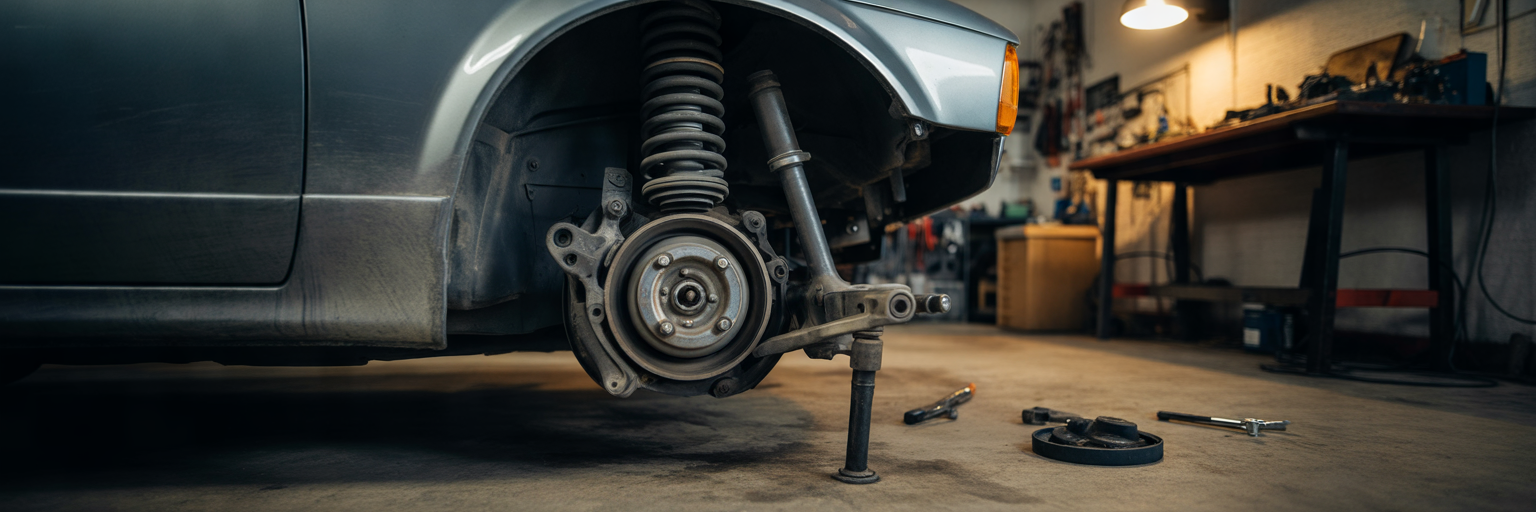
If your steering linkages and axles inspect clean, the noise likely originates in the load-bearing suspension hardware that supports the vehicle’s weight and controls body roll during cornering.
Worn Ball Joints and Damaged Control-Arm Bushings
Lower ball joints serve as the primary load-bearing pivot between your suspension control arms and the steering knuckles that hold the wheels. Because they support the weight of the front end while pivoting on two axes simultaneously, ball joints endure relentless pounding. When the internal polymer bearing seat wears down or loses grease through a cracked dust boot, the steel stud develops vertical and lateral play inside its housing. Turning the wheel while rolling over an uneven driveway curb causes the heavy knuckle to shift abruptly on that loose stud, generating a dull, heavy clunk or dry metallic creak.
At the inboard side of that same control arm, thick cylindrical or hydro-filled rubber bushings bolt the arm to the vehicle subframe. Years of ozone exposure, road salt, and potholes eventually tear the rubber webbing away from the outer steel sleeve. Once torn, cornering forces or light braking during a turn push the steel control arm straight against the subframe mounting ears, resulting in a deep metal-on-metal bang underneath the footwell and a steering wheel that pulls slightly when you touch the brakes.
Bad Strut Mounts and Broken Coil Springs
On the vast majority of modern passenger cars and crossovers equipped with MacPherson strut front suspension, the entire strut and coil spring assembly rotates on its vertical axis every time you turn the steering wheel. To make this rotation smooth, an upper strut mount containing a flat thrust bearing sits bolted inside the top of the fender tower.
When water and road grit work into that upper bearing, the ball bearings rust and seize. As you turn the steering wheel, the bottom of the coil spring turns with the steering knuckle while the top of the spring gets stuck in the seized mount. The spring winds up like a heavy clock spring until the tension overcomes the rust, jumping violently across the perch with a loud metallic pop or resonant twang. You will also notice the steering wheel fails to return smoothly to the center position after completing a turn. In northern rust-belt climates, the bottom coil of the steel spring itself frequently snaps off due to corrosion, leaving a jagged piece of spring steel that shifts and clanks noisily against the lower strut cup whenever weight transfers in a corner.
Worn Sway-Bar Links and Loose Suspension Bolts
Connecting the left and right sides of your suspension is a thick torsion spring called the sway bar or anti-roll bar, which keeps the car flat during cornering. Short connecting rods known as sway-bar end links join the ends of this bar to the struts or control arms using miniature ball sockets. Because these tiny sockets cycle furiously every time one front wheel hits a bump or the vehicle leans into a turn, they are often the very first front-end component to wear out. A worn sway-bar link produces a hollow, rapid rattling or clattering noise over minor road imperfections while turning.
Additionally, if your vehicle recently had suspension work or a frame alignment performed, slightly under-torqued subframe bolts or control-arm cam bolts can slip across their slotted mounting holes under high lateral cornering loads. This sudden micro-slippage releases a sharp, startling crack sound that occurs once per hard left or right turn.
Comparing Front-End Steering and Suspension Clunk Sources
| Component | Primary Sound Signature | Exact Trigger Condition | Secondary Handling Symptom |
|---|---|---|---|
| Outer CV Joint | Rhythmic rapid clicking | Sharp turns under throttle | Grease splattered inside wheel rim |
| Upper Strut Mount | Single metallic pop or twang | Turning wheel stationary or slow | Steering wheel fails to self-center |
| Lower Ball Joint | Heavy dull clunk or creak | Turning over driveway curbs or bumps | Wandering steering and inner tire wear |
| Tie-Rod End | Sharp knock on direction change | Rocking steering wheel left and right | Loose steering play and feathered tread |
| Sway-Bar End Link | Hollow rattle or rapid clatter | Cornering body roll over uneven road | Slightly increased body lean in turns |
| Control-Arm Bushing | Deep thud under floorboard | Braking while turning into a corner | Steering pulls slightly under braking |
This diagnostic table summarizes mechanical failure signatures based on ASE master technician inspection criteria, allowing drivers to cross-reference sound profiles with physical steering feedback.
Wheel End, Brake, and Cabin Sources Often Mistaken for Steering Failure
Not every noise heard during a turn comes from the steering rack or suspension pivots. Several components at the outer wheel hub and even inside the cabin routinely trick vehicle owners into pricing out expensive front-end rebuilds they do not actually need.
Wheel-Bearing Damage and Loose Lug Nuts
Most drivers associate a failing wheel bearing with a continuous airplane-like hum or growl that gets louder at highway speeds. However, if a sealed hub bearing assembly is ignored long enough for the internal roller cages to pit and deteriorate, the hub develops severe axial play. When you turn the steering wheel and thousand-pound cornering loads shift onto that outside tire, the loose hub assembly tips slightly on its races, creating a harsh clunk followed by intermittent grinding as the brake rotor tilts against the caliper bracket.
Even more urgent is the possibility of loose wheel lug nuts. If a tire shop recently rotated your tires and forgot to torque one wheel properly, the wheel rim will rock slightly against the threaded hub studs as lateral cornering forces push against the tire sidewall. This creates a rhythmic knocking or clicking noise that worsens when turning and rapidly elongates the wheel’s tapered lug holes, leading quickly to sheared studs and complete wheel separation if not tightened immediately.
Shifting Brake Caliper Components and Loose Cabin Cargo
Your front disc brakes also ride directly on the steering knuckle and experience lateral forces during turns. Brake pads sit nestled inside a steel caliper mounting bracket, cushioned by thin stainless steel anti-rattle clips. If those clips rust away, or if an aftermarket brake pad backing plate is stamped slightly undersized, the pad develops vertical clearance inside the bracket. When you turn into a driveway while lightly brushing the brake pedal, the rotor drags the loose pad upward or forward until it hits the iron bracket with a sharp, single metallic clack. Understanding how these hardware shims control pad movement is much easier once you review our guide where front and rear brake pads are explained for new owners. Replacing worn abutment clips and lubricating seized caliper slide pins during a routine brake pad replacement for safer everyday driving eliminates this annoying caliper clatter completely.
Before blaming mechanical hardware at all, check for loose objects shifting inside the vehicle. An unbolted spare tire or loose scissor jack sliding around the metal trunk well, a heavy socket set sliding across the cargo floor, a glass water bottle rolling beneath the passenger seat tracks, or an unfastened 12-volt battery sliding back and forth inside its plastic under-hood tray during hard turns can all produce remarkably convincing suspension thuds. Ruling out these free, five-minute fixes should always precede ordering replacement chassis parts.
Safe Driveway Checks You Can Perform Without Lifting the Car

Before you touch a single tool, keep one critical safety rule in mind: never place any part of your head, arms, or body underneath a vehicle supported only by a hydraulic floor jack or emergency roadside scissor jack. Jacks rely on small hydraulic seals or thin threaded rods that can fail instantaneously, dropping thousands of pounds of steel without warning. Fortunately, you do not need to lift the vehicle at all to narrow down most front-end noises. You can perform a comprehensive safe driveway steering inspection with all four tires resting firmly on flat pavement and the parking brake securely engaged.
The Two-Person Stationary Steering and Strut Spring Observation
Because many steering clunks only happen under the heavy resistance of tire friction on pavement, keeping the car on the ground actually helps reproduce the fault. Enlist a trusted helper to sit in the driver’s seat with the engine idling so the power steering assist is active. While your helper slowly turns the steering wheel back and forth about a quarter turn in each direction, crouch down outside the front fender well, keeping your hands and clothing completely clear of the moving tire tread and suspension pinch points.
Look directly past the top of the tire at the thick black coil spring. A healthy strut mount allows the spring to rotate smoothly and silently as the wheel pivots. If you see the coil spring shudder, jerk in small increments, or jump accompanied by a metallic twang, you have visually confirmed a binding upper strut mount bearing.
Ground-Level CV Boot, Lug Nut, and Under-Hood Mount Checks
With the engine switched off and the vehicle parked on level ground, walk through this exact sequence of ground-level inspections to rule out common culprits:
- Check every front and rear wheel lug nut using a calibrated torque wrench or your vehicle’s factory lug wrench while the tires are on the ground to verify that no nuts have backed off.
- Have your helper turn the steering wheel all the way to full left lock, shut off the engine, and shine a bright LED flashlight behind the front tires to inspect the inner and outer rubber CV axle boots for split ribs or thick dark grease flung across the inner wheel rim and control arm.
- Pop the hood and watch the center nuts at the top of both front strut towers while your helper restarts the car and rocks the steering wheel left and right; excessive vertical movement, torn rubber, or knocking right under your fingertips confirms upper strut mount failure.
- Stand cleanly to the side of the open engine bay (never directly in front of the bumper) while your helper holds the foot brake firmly down and shifts the transmission from Reverse to Drive and back; if the engine block leaps upward more than an inch or slams down with a clunk, a broken engine or transmission mount is to blame.
If you spot a jumping spring, a grease-covered axle boot, or a shifting strut nut during these driveway tests, capture a quick 15-second video with your smartphone. Showing that clip to your service advisor saves diagnostic time and ensures the shop addresses the exact symptom you experienced.
When Is It Unsafe to Drive and How Do Professionals Diagnose It
Once you hear a new noise up front, the most pressing question is whether you can safely drive the car to work for the rest of the week or if it needs to be parked immediately.
Urgent Warning Signs That Require Immediate Towing
The severity depends entirely on whether the worn component is a secondary stabilizer or a primary steering and load-bearing link. A rattling sway-bar end link or a dry upper strut bearing is annoying and will slowly accelerate tire wear, yet neither part will cause a sudden loss of control on your drive to the repair shop. Conversely, a severely worn outer tie-rod end, a failing lower ball joint, or loose wheel lug nuts represent critical safety hazards. If a ball joint stud pulls out of its socket or a tie rod separates at 60 miles per hour, the front wheel folds outward instantly, resulting in complete loss of steering control.
Do not drive the vehicle and arrange for a flatbed tow truck immediately if your steering clunk is accompanied by any of these red-flag warning signs:
- Excessive steering wheel free play where you can turn the wheel an inch or more before the front tires respond.
- The vehicle wandering unpredictably across highway lanes or requiring constant steering corrections to stay straight.
- Visible wheel tilt (camber change) or physical movement at the hub when pushing the top of the tire with your foot.
- Severe vibration or rhythmic wobbling felt through the steering column or floorboards as speed increases.
- Rapid, uneven tire tread wear concentrated on the inner or outer shoulder, especially if steel cords are showing.
- Harsh metallic grinding or screeching sounds coming from the wheel hub regardless of brake application.
- A steering wheel that suddenly sits off-center or crooked while the car is traveling straight down a flat road.
- Any heavy clunk that causes the front end to dart, pull, or feel unstable during cornering or braking.
How a Professional Repair Shop Pinpoints the Exact Fault
When you bring the car into a professional shop, certified technicians follow a methodical process to isolate the exact worn joint so you do not pay for guesswork. They start with a controlled road test, often clipping multi-channel electronic chassis ear microphones directly onto the control arms, tie rods, strut housings, and steering rack. As the technician drives over bumps and turns the wheel, a receiver inside the cabin displays decibel spikes and allows them to listen to each individual suspension part in isolation.
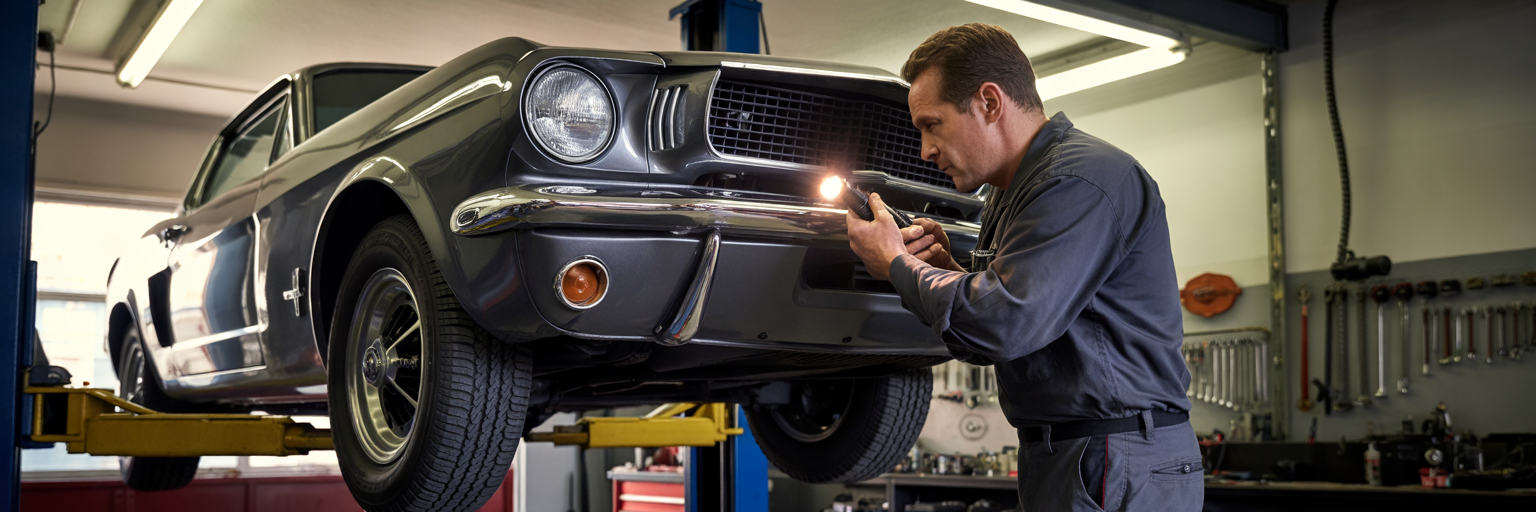
Back in the service bay, the technician raises the vehicle safely on a hydraulic lift to take the vehicle’s weight off the suspension. Using a long mechanic’s pry bar leveraged beneath the tire and against the control arm mounts, they measure axial and radial play inside the lower ball joints and rubber bushings with a dial indicator. Finally, they grip the suspended front tire at the 12 and 6 o’clock positions to rock the hub and test for wheel-bearing or ball-joint looseness, followed by gripping the tire at the 3 and 9 o’clock positions to isolate play in the inner and outer tie-rod ends and steering rack bushings.
Frequently Asked Questions About Steering Clunks and Repairs
Can I Replace Just a Torn CV Boot or Strut Mount Without Replacing the Whole Assembly?
If you catch a cracked rubber CV boot during a routine oil change before any noise starts, a shop can clean the joint, repack it with fresh moly grease, and install a new boot. However, once a CV joint starts clicking or clunking during turns, abrasive dirt has already ground permanent grooves into the internal steel ball tracks. Installing a new boot over a clicking joint will not stop the noise, and replacing the entire CV half-shaft axle assembly is almost always cheaper in labor than rebuilding a damaged joint. Similarly, while you can buy an upper strut mount bearing by itself and use a heavy-duty spring compressor to swap it onto your old strut, if your vehicle has over 60,000 miles on the original dampers, installing a pre-assembled complete strut unit saves significant shop labor and restores factory ride control at the same time.
How Do Tie-Rod and Wheel-Bearing Noises Differ on the Highway?
At neighborhood speeds, both a severely loose wheel bearing and a worn tie-rod end can produce a dull knock when turning into a driveway. Once you merge onto the highway, their personalities diverge completely. A worn inner or outer tie rod stays relatively quiet during straight cruising, only clunking during abrupt steering reversals while making the car feel floaty and imprecise in crosswinds. A damaged wheel bearing, on the other hand, transitions into a continuous, speed-dependent humming, droning, or roaring noise above 40 miles per hour that noticeably changes pitch when you gently weave left and right within your lane to shift weight on and off the bad bearing.
Do I Need a Wheel Alignment After Fixing a Steering or Suspension Clunk?
A computerized four-wheel alignment is mandatory anytime you replace tie-rod ends, steering racks, control arms, ball joints, or MacPherson struts. Even if a mechanic counts the threads when threading on a new outer tie rod, minute manufacturing tolerances between aftermarket forgings alter your front toe and camber angles by fractions of a degree. Driving with misaligned toe angles drags the tires sideways down the pavement, which can scrub the tread off a brand-new set of tires in just a few hundred miles. The only time you can safely skip an alignment after fixing a front-end clunk is when the repair involves strictly non-geometry parts like sway-bar end links, brake hardware, powertrain mounts, or a CV axle replacement where the upper strut-to-knuckle bolts were not loosened.
Addressing a front-end clunk the week it starts prevents a single loose joint from hammering neighboring bushings and chewing up expensive tires. Combining prompt chassis inspections with the foundational habits covered in our guide on how to keep your car’s engine running for years ensures your vehicle stays tight, predictable, and safe on the road for hundreds of thousands of miles.