
Setting the Stage for the Midsize Truck Showdown
In the United States, the midsize truck segment is built on more than just steel and horsepower. It is a landscape shaped by decades of brand loyalty, where a truck’s reputation is earned on dusty work sites and remote trails, not just in showroom brochures. For years, the Toyota Tacoma has been the undisputed benchmark, a name synonymous with near indestructible reliability and off-road prowess. It’s the truck many people picture when they think of this category. Its legacy is one of adventure and dependability, a vehicle that owners trust to get them anywhere and back again.
Challenging this long-held dominance is the Nissan Frontier. For a long time, the Frontier carved out its own loyal following as the tough, no-frills workhorse. It was respected for its sheer durability and straightforward value, a truck that simply got the job done without fuss. Its recent modernization represents a direct and calculated challenge to the Tacoma’s reign, aiming to blend its traditional toughness with contemporary features and comfort. This sets the stage for a classic Toyota Tacoma vs Nissan Frontier rivalry, renewed for 2026.
The 2026 model year marks a significant divergence in philosophy for both manufacturers. Toyota has pushed the Tacoma into the future, rebuilding it on the advanced TNGA-F platform shared with its larger siblings, the Tundra and Sequoia. The headline news is the introduction of the i-FORCE MAX hybrid powertrain, a clear signal of Toyota’s vision for a more technologically advanced and efficient truck. This is not just an update. It is a fundamental reinvention of what the Tacoma is and what it can be.
Nissan, on the other hand, is taking a different approach with the 2026 Frontier. After its successful 2025 redesign, the focus is on refinement. Nissan is doubling down on the strengths that buyers have responded to, primarily its powerful standard V6 engine and user-friendly technology. The strategy is not to chase every new trend but to perfect a proven formula, offering a compelling alternative for those who appreciate rugged simplicity. For those interested in exploring more options, our comprehensive guide to all kinds of trucks offers further insights into the competitive landscape.
This brings the choice for the 2026 buyer into sharp focus. The Tacoma represents the cutting edge, a feature-rich package brimming with the latest powertrain and off-road technology. It appeals to the person who wants the newest and most capable machine available. The Frontier stands for proven strength. It offers a powerful, straightforward, and value-conscious option for the buyer who prioritizes a traditional driving experience and rugged dependability over complex systems. This is more than a comparison of hardware. It is a battle of philosophies.
Performance and Powertrain Options
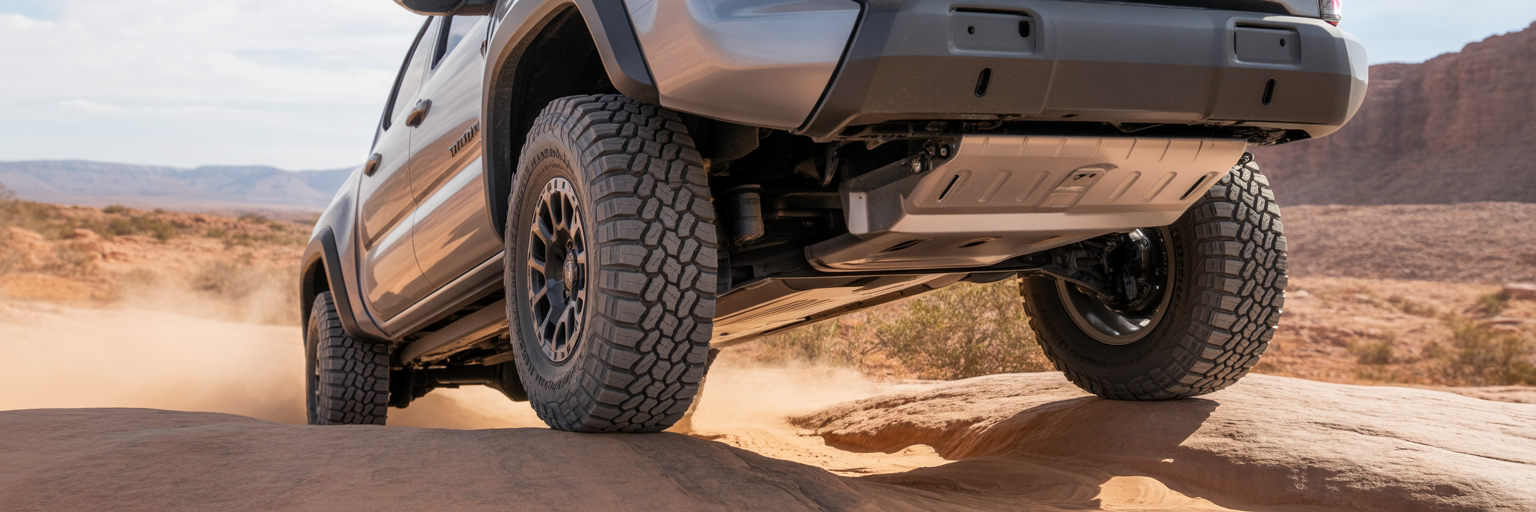
The heart of any truck is its engine, and for 2026, the Tacoma and Frontier offer distinctly different approaches to power. This is where the philosophical divide between the two trucks becomes most apparent, moving beyond brand reputation into the mechanicals that define their character on the road.
Toyota Tacoma: A Tale of Two Turbos
The 2026 Tacoma moves entirely to a turbocharged lineup, leaving its old V6 in the past. The standard engine in base and mid-tier trims is a 2.4-liter turbocharged four-cylinder. With horsepower figures ranging from 228 to 278 depending on the trim and transmission, this engine is engineered for modern efficiency and capable daily driving. It provides ample power for commuting and light work, delivering its torque low in the rev range, a characteristic of modern turbo engines.
The main event, however, is the available i-FORCE MAX hybrid. It is crucial to understand this is not a system designed purely for fuel sipping like in a Prius. This is a performance hybrid. It pairs the same 2.4-liter turbo engine with an electric motor integrated into the 8-speed transmission. The result is a potent combination that produces up to 326 horsepower and a massive 465 lb-ft of torque. The electric motor’s instant torque fills in any potential gaps before the turbo spools up, providing immediate, forceful acceleration. This positions the i-FORCE MAX as the premium, high-performance choice in the Tacoma lineup.
Nissan Frontier: The V6 Standard-Bearer
While Toyota embraces turbocharging and hybridization, the Nissan Frontier makes a powerful statement by sticking with a single, compelling powertrain: a 3.8-liter naturally aspirated V6. With 310 horsepower, it stands proud as the most powerful standard engine in the class. This is a key differentiator and a major selling point for a specific type of truck buyer.
The character of this engine is what truly sets it apart. Unlike a turbocharged engine that delivers a surge of power, the V6 provides a smooth, linear power delivery that builds predictably as you press the accelerator. There is no turbo lag to manage, just a responsive and familiar feel that many traditional truck owners prefer. It’s a proven, robust engine that offers a sense of mechanical simplicity in an increasingly complex automotive world. It comes paired exclusively with a 9-speed automatic transmission designed to keep the engine in its sweet spot.
Transmission and Driving Dynamics Compared
On the road, these different powertrain strategies create distinct driving experiences. The Tacoma, with its 8-speed automatic, feels modern and sophisticated. With the i-FORCE MAX, shifts are managed to blend the power from the engine and electric motor seamlessly, resulting in relentless acceleration when merging onto a highway. For purists, Toyota still offers a 6-speed manual transmission on some non-hybrid trims, a rare and welcome option in the segment.
The Frontier’s V6 and 9-speed automatic combination is praised for its smooth and predictable behavior. The transmission works quietly in the background, delivering the right gear without hesitation. The driving feel is straightforward and confident. You press the pedal, the engine responds with a satisfying V6 sound, and the truck moves. There are no complex modes to manage, just honest, accessible power. The choice is clear: the Tacoma offers technologically driven, efficient power in two distinct flavors, while the Frontier champions the proven muscle and satisfying response of a classic V6.
| Specification | Toyota Tacoma (Standard) | Toyota Tacoma (i-FORCE MAX) | Nissan Frontier |
|---|---|---|---|
| Engine Type | 2.4L Turbocharged Inline-4 | 2.4L Turbocharged Inline-4 Hybrid | 3.8L Naturally Aspirated V6 |
| Horsepower (Est.) | 228 – 278 hp | Up to 326 hp | 310 hp |
| Torque (Est.) | 243 – 317 lb-ft | Up to 465 lb-ft | 281 lb-ft |
| Transmission | 8-speed Automatic / 6-speed Manual | 8-speed Automatic | 9-speed Automatic |
| Core Philosophy | Modern Efficiency | High-Performance Hybrid Power | Proven V6 Simplicity |
Note: Horsepower and torque figures for the Toyota Tacoma can vary by trim and transmission. The data presented reflects the known range for the 2026 model year and is intended for direct comparison of the manufacturers’ powertrain strategies.
Off-Road Capability and Trail Readiness
For many buyers in this segment, a truck is more than a tool for commuting. It is a key to adventure. This is where the Toyota Tacoma vs Nissan Frontier battle gets truly exciting, as both trucks bring serious hardware to the table for those who prefer dirt roads to paved ones. The question of which is the best off-road midsize truck often comes down to the flagship trims designed for maximum trail performance.
Flagship Off-Roaders: TRD Pro vs. PRO-4X
The ultimate expression of each brand’s off-road philosophy is found in the Tacoma TRD Pro and the Frontier PRO-4X. While both are incredibly capable, they arrive at their trail readiness with different equipment and priorities. The Tacoma TRD Pro vs Frontier PRO-4X comparison reveals a choice between high-tech dominance and rugged effectiveness.
The 2026 Toyota Tacoma TRD Pro is a technological powerhouse equipped with:
- FOX® QS3 Internal Bypass shocks with remote reservoirs, allowing for manual adjustment of damping for different conditions.
- Segment-exclusive IsoDynamic Performance Front Seats, which use an air-over-oil shock absorber system to reduce body shake and improve comfort on rough terrain.
- A standard electronic locking rear differential for guaranteed traction.
- A high-clearance front bumper and an ARB steel rear bumper for improved angles and durability.
- Extensive underbody skid plates protecting critical components.
The 2026 Nissan Frontier PRO-4X counters with a focus on proven, robust hardware:
- Bilstein® off-road performance shocks, which are tuned to absorb harsh impacts and provide excellent control on uneven surfaces.
- An electronic locking rear differential to ensure both rear wheels turn at the same speed in low-traction situations.
- A full set of steel skid plates protecting the engine, transfer case, and fuel tank from rocks and debris.
- Aggressive all-terrain tires designed for grip on a variety of surfaces right from the factory.
Technology on the Trail: Automated vs. Mechanical Grip
Beyond the hardware, the two trucks differ in their use of technology. The Tacoma TRD Pro acts like a digital spotter. Its advanced Multi-Terrain Select (MTS) system adjusts engine throttle and brake control to suit different surfaces like mud, sand, or rocks. The CRAWL Control feature functions as a low-speed off-road cruise control, managing the throttle and brakes automatically so the driver can focus entirely on steering through difficult obstacles. It’s a system designed to make even novice off-roaders feel confident.
The Frontier PRO-4X takes a more traditionalist approach. It relies more on its strong mechanicals, including its solid suspension and locking differential, and the driver’s skill. While it includes modern aids like Hill Descent Control, which helps maintain a steady speed on steep declines, its philosophy is less about automation and more about providing a solid, predictable platform that responds directly to driver input. As noted in a head-to-head comparison by Autoblog, while both trucks are immensely capable, the Tacoma often brings more specialized hardware and technology, whereas the Frontier impresses with its rugged simplicity.
Comparing Off-Road Geometry
Hard numbers matter on the trail. Off-road geometry, specifically the approach, departure, and breakover angles, determines a truck’s ability to climb steep obstacles, descend without scraping its bumpers, and clear sharp crests without getting stuck.
| Angle | Toyota Tacoma TRD Pro (Est.) | Nissan Frontier PRO-4X (Est.) |
|---|---|---|
| Approach Angle | 33.8 degrees | 32.3 degrees |
| Breakover Angle | 23.5 degrees | 22.9 degrees |
| Departure Angle | 25.7 degrees | 23.0 degrees |
These figures show the Tacoma TRD Pro holds a slight edge in all three metrics, making it geometrically better suited for extreme terrain. However, both trucks are highly capable, and other trims like the Tacoma TRD Off-Road and Trailhunter, or the 2WD Frontier PRO-X, offer excellent capability for those whose adventures are slightly less demanding.
Towing and Hauling Practicality
While off-road adventures are a major draw, most midsize trucks spend a significant amount of time doing actual work. Whether it is hauling supplies for a weekend project or towing a boat to the lake, practical utility is non-negotiable. This is where the numbers for midsize truck towing capacity and payload become critical decision factors.
On paper, the two trucks are very closely matched. The 2026 Toyota Tacoma, when equipped with the powerful i-FORCE MAX hybrid powertrain, boasts a maximum towing capacity of up to 6,800 pounds. The 2026 Nissan Frontier is right behind it, with a competitive maximum rating of 6,720 pounds. It is important to recognize that these are best-case-scenario figures. The actual towing capacity you get depends heavily on the specific configuration of your truck. Factors like a 4WD system, a larger crew cab, and even optional equipment will reduce the final number. Always check the specific rating for the exact truck you are considering.
Payload capacity, which is the total weight of cargo and passengers the truck can carry, tells a similar story. Both trucks offer maximum payload ratings in the 1,400 to 1,700-pound range, again depending on the trim and configuration. This is more than enough for hauling bags of mulch, camping gear, or a couple of dirt bikes. The beds themselves also offer different features. The Tacoma continues to use a dent-resistant and rust-proof composite inner bed, while the Frontier uses a traditional steel bed, which some prefer for its perceived toughness. Both offer useful features like robust tie-down systems, in-bed LED lighting, and available 120V power outlets for charging tools or running small appliances.
Where the two trucks really differentiate themselves is in the technology they offer to make towing less stressful.
- The Toyota Tacoma offers a suite of advanced aids, including a factory-integrated trailer brake controller, a Trailer Back Up Guide system that helps you steer the trailer in reverse, and the innovative Straight Path Assist, which can automatically steer the truck to keep the trailer in a straight line when backing up.
- The Nissan Frontier focuses on core safety and stability. It comes standard with Trailer Sway Control, which helps keep the trailer in line during crosswinds or emergency maneuvers, and a dedicated Tow-Haul Mode for its transmission that adjusts shift points for better performance when pulling a heavy load.
So what does this mean in the real world? Both trucks can comfortably handle common American recreational loads. You can confidently tow a 22-foot travel trailer for a family vacation, a bass boat for a weekend fishing trip, or a pair of ATVs on a flatbed trailer. The choice may come down to whether you prefer the Tacoma’s high-tech assists or the Frontier’s straightforward stability features. Understanding how these figures stack up against other models is also crucial, as seen in comparisons of which 2025 trucks offer the best towing and fuel economy.
Fuel Efficiency Across Different Engines
With gas prices being a constant consideration, fuel efficiency has become a major factor in the truck-buying decision. In the 2026 midsize truck comparison, the different powertrain philosophies of Toyota and Nissan lead to clear and significant differences in what you can expect to spend at the pump. This is not just about saving a few dollars. It is about the long-term cost of ownership.
The undisputed champion of efficiency in this matchup is the Toyota Tacoma with the i-FORCE MAX hybrid. With an estimated combined fuel economy of around 26 MPG, it sets a new standard for the segment. This powertrain is designed to deliver both power and efficiency, using its electric motor to assist the engine and reduce fuel consumption, especially in city driving and stop-and-go traffic. For buyers who drive a lot of miles or are simply focused on minimizing their running costs, the hybrid is the obvious choice.
The standard non-hybrid Tacoma, with its 2.4-liter turbo engine, delivers respectable but less remarkable figures. Depending on the configuration, you can expect a combined MPG in the range of 20 to 23. This places it squarely in the middle of the pack, offering a decent balance of performance and economy that is competitive with other trucks in the class.
The Nissan Frontier, with its powerful 3.8-liter V6, is the thirstiest of the group. Its EPA estimates hover around 18 MPG in the city and 24 MPG on the highway, for a combined figure near 20 MPG. While these numbers are respectable for a strong, naturally aspirated V6, they clearly trail both of the Tacoma’s offerings. The difference is most pronounced in city driving, where the V6’s lack of a turbo or hybrid assist results in higher fuel consumption.
To put this in perspective, let’s consider the long-term cost. Assuming an average of 15,000 miles driven per year and a national average gas price of $3.50 per gallon, a Tacoma hybrid owner might spend around $2,020 annually on fuel. A standard Tacoma owner could expect to pay about $2,475, while a Frontier owner would be looking at approximately $2,625. Over five years, the hybrid could save you over $3,000 compared to the Frontier. This growing popularity of efficient powertrains is part of a market-wide trend, as seen in the rise of the best hybrid SUVs under $35k, which is now firmly taking hold in the truck segment.
However, this is a classic trade-off. Some buyers will willingly accept the Frontier’s higher fuel costs in exchange for the proven simplicity and long-term reliability associated with its V6 engine. For them, the peace of mind of avoiding a complex turbo or hybrid system is worth the extra expense at the pump.
Interior Design, Comfort, and Technology
A modern truck has to be more than just a workhorse. It also has to serve as a comfortable daily driver and a mobile office. The interior is where you spend all your time, and in this regard, the 2026 Tacoma and Frontier showcase their different personalities through design, technology, and practical features.
Cabin Aesthetics and Ergonomics
Step inside the 2026 Toyota Tacoma, and you are greeted by a thoroughly modern and rugged design. The dashboard has a strong horizontal layout, dominated by large digital screens. The controls are chunky and tactile, designed to be easily used even when wearing gloves. In higher trims, Toyota has made a significant effort to incorporate more soft-touch materials and premium finishes, giving the cabin a more upscale feel than its predecessor. It feels like a piece of modern, durable equipment.
The Nissan Frontier’s cabin, while updated, follows a more traditional design philosophy. The focus here is on function and ease of use. The layout is clean, logical, and praised for creating a feeling of spaciousness. The controls are exactly where you expect them to be, requiring almost no learning curve. While the Tacoma’s interior might look more futuristic, the Frontier’s cabin is incredibly user-friendly and built with durable, hard-wearing plastics that feel ready to stand up to the rigors of a work environment or a muddy weekend.
Infotainment and Connectivity Battle
Technology is a major battleground, and both trucks come well-armed. The Tacoma makes a statement with its available 14-inch central touchscreen, one of the largest in the segment. Paired with an available digital instrument cluster, it creates a high-tech command center. The system is responsive and packed with features, appealing to the tech-savvy buyer.
The Frontier, however, punches well above its weight in this area. While its largest available screen is a still-impressive 12.3 inches, its key advantage is convenience. Nissan makes wireless Apple CarPlay and Android Auto widely available across its trim levels. This is a feature you use every single day, and not having to fumble with a cord to connect your phone is a genuine quality-of-life improvement that many buyers will appreciate. It’s a smart, practical decision that prioritizes daily usability.
Passenger Space and Practical Storage
For those who plan to use their truck to carry people, the crew cab models of both trucks offer competitive space. Front-seat occupants will find plenty of room in either vehicle. In the rear, both offer adequate legroom and headroom for adults on shorter trips, though like most midsize trucks, it can be a bit snug for long journeys. The Tacoma TRD Pro offers a unique feature with its exclusive IsoDynamic Performance Front Seats, which are designed to absorb jolts and reduce fatigue during aggressive off-roading, a benefit that also translates to more comfort on rough pavement.
Day-to-day livability often comes down to clever storage. Both trucks offer sizable center consoles, useful door pockets, and various cubbies for storing small items. You will find thoughtful solutions like under-seat storage in the rear of both models, perfect for stashing recovery gear, tools, or valuables out of sight. The choice here is less about one being definitively better and more about which design philosophy and feature set better aligns with your daily needs.
Long-Term Reliability and Ownership Costs
For many truck buyers, the purchase decision is not just about the first year of ownership. It is about the next ten. Long-term reliability, resale value, and potential repair costs are critical factors, and this is where the Tacoma and Frontier present a fascinating and nuanced choice.
The Toyota Tacoma’s reputation for reliability is legendary. For decades, it has been the gold standard, a truck known for holding its value exceptionally well precisely because owners trust it to run for hundreds of thousands of miles with minimal issues. This history of dependability is a cornerstone of the Tacoma’s appeal and a major reason for its high resale value. However, the 2026 model introduces a new variable: complexity. The new turbocharged engine and, in particular, the i-FORCE MAX hybrid system, are inherently more complex than the simple, naturally aspirated engines of the past. They introduce new components and technologies that do not yet have the same decades-long track record.
This is where the Nissan Frontier’s primary strength comes into sharp focus for the risk-averse buyer. Its 3.8-liter V6 and 9-speed automatic transmission are not brand new. They have been on the market for several years and are widely regarded as robust and well-understood. For a buyer concerned about long-term dependability, the Frontier’s powertrain represents a known quantity. There are fewer surprises and a solid history of performance in the real world.
This sets up the core argument of long-term ownership. The Tacoma is a bet on Toyota’s renowned engineering and quality control to make new, complex technology dependable from the start. The Frontier is a bet on the peace of mind that comes from simpler, time-tested mechanicals. According to analysis from Driving.ca, the choice often comes down to a buyer’s risk tolerance. The importance of powertrain dependability is a constant concern for owners, as illustrated by events like the GM 6.2L engine recall, which underscores why some buyers prioritize proven technology.
When it comes to projected ownership costs, the picture is balanced. Historical data strongly suggests the Tacoma will continue to command a higher resale value, potentially offsetting its higher initial purchase price. However, the Frontier’s simpler V6 engine may lead to more affordable out-of-warranty repairs down the line. A turbocharger or a hybrid battery are expensive components to replace, and while Toyota’s are expected to be reliable, the Frontier simply does not have them. This creates a compelling choice between betting on high resale value versus lower potential long-term repair costs.
Making Your Final Decision
After comparing powertrains, trail readiness, and daily usability, the choice between the 2026 Toyota Tacoma and Nissan Frontier comes down to your personal priorities. Both are exceptional trucks that lead the segment in different ways. There is no single “best” truck, only the one that is best for you.
To make your decision easier, consider which of these profiles sounds more like you:
- Choose the 2026 Toyota Tacoma if: You are drawn to the latest technology and want the most advanced systems available. You prioritize fuel economy and see the hybrid option as a major benefit. You plan on serious off-roading and want the most capable hardware and software on the trail. Finally, you value long-term resale value and are confident in Toyota’s ability to make new technology reliable.
- Choose the 2026 Nissan Frontier if: You appreciate the proven power and linear response of a naturally aspirated V6 engine. You want a comfortable, highly functional interior with great standard tech like wireless phone connectivity. You are looking for a rugged, dependable truck that represents a strong value proposition. This is the choice for the pragmatist who values straightforward, time-tested mechanicals.
In this 2026 midsize truck comparison, the Tacoma clearly leads with its forward-thinking powertrain choices and cutting-edge off-road technology. The Frontier excels with its best-in-class standard V6 power and its rugged, user-friendly appeal. Both are top contenders, and your final decision will depend on whether you favor technological innovation or proven simplicity. For more automotive comparisons and news, readers can always visit CarPhanatics to stay informed on the latest models and trends.