
The Ford F-150 has long been a benchmark for versatility, adapting to the needs of millions. Now, a new variant challenges the traditional definition of a work truck, forcing a choice between specialized performance and all-around utility. This decision point arrives with the introduction of the 2026 F-150 STX Lobo, a model that reinterprets what an entry-level truck can be.
To understand its place, we must first look at the standard F-150 STX. This trim has earned its reputation as the high-value gateway to the F-150 lineup. It is appreciated for blending essential modern features with an accessible price, making it a popular choice for both work and personal use. It represents the dependable, do-it-all foundation upon which the F-150’s legacy is built.
The 2026 F-150 STX Lobo, however, is more than just a sticker package. It is a factory-engineered variant of the STX SuperCrew conceived as a dedicated “street truck.” This concept shifts the focus away from pure utility and toward on-pavement handling, a sportier stance, and a distinct aesthetic. It is designed for the driver who wants a performance-oriented feel straight from the showroom floor.
Its direct counterpoint is the standard STX equipped with the venerable 5.0L V8. This configuration represents the versatile, traditional choice. It is a dependable workhorse that comfortably balances daily driving duties with demanding job site capability. This contrast between specialized sportiness and proven utility is central to our comparison, as the F-150 lineup continues to diversify across the broader truck market.
This brings us to the core question: Does the Lobo’s specialized street performance and unique style justify its potential compromises in utility and price when compared to the proven, multi-purpose value of the standard STX 5.0 V8? The answer depends entirely on what you expect your truck to do.
The Heart of the Beast: The Shared 5.0L Coyote V8
At the core of both the STX Lobo and the standard STX is an engine that needs little introduction: the 5.0L Coyote V8. This shared powertrain is a critical point of parity, producing an identical 400 horsepower and 410 lb-ft of torque in both applications. Its legacy within the truck community is built on a foundation of proven reliability and the unmistakable, satisfying sound that only a naturally aspirated V8 can deliver. For anyone conducting an F-150 STX 5.0 V8 review, the engine itself is consistently a highlight.
The character of this engine is defined by its linear power delivery. Unlike turbocharged powertrains that often deliver a surge of torque in the low to mid-range, the Coyote V8 builds power smoothly and predictably all the way to its redline. This provides a responsive, connected feel that many enthusiasts prefer, offering precise throttle control whether accelerating from a stoplight or merging onto a highway. The engine feels eager and willing, rewarding a heavier foot with a classic V8 roar.
Mated to this engine is Ford’s 10-speed automatic transmission, a sophisticated piece of engineering that serves both trucks equally well. Its wide ratio spread is designed for optimal performance at both ends of the speed spectrum. The lower gears provide brisk acceleration off the line, while the higher overdrive gears allow for efficient, low-RPM cruising on the highway. The transmission’s intelligent shift logic adapts to driving style, ensuring the engine is always in its sweet spot.
The most important takeaway here is that the core powertrain is identical. This means that in a straight-line drag race, the two trucks would be virtually indistinguishable. The raw power and acceleration potential are the same. The significant differences in how that power is put to use on the road stem not from the engine, but from the chassis, suspension, and drivetrain components that surround it. Preserving this performance for the long haul is crucial, and as our guide on how to keep your car’s engine running for years explains, proper maintenance is key. Ultimately, the choice between the Lobo and the standard STX is not about the engine, but about the philosophy that dictates how it connects to the road.
On-Road Dynamics and the Lobo’s Handling Advantage

While both trucks share the same heart, their on-road behavior is where they diverge dramatically. The STX Lobo’s identity is forged through a series of mechanical upgrades designed specifically to enhance its street performance, creating a driving experience that feels distinctly different from its standard counterpart. The most significant of these is the inclusion of the F-150 4-Auto transfer case.
This torque-on-demand system functions like a full-time all-wheel-drive system. In its “4A” mode, it automatically detects wheel slip and sends power to the front wheels as needed, providing superior traction on wet or slick pavement without any driver intervention. This is a stark contrast to a traditional part-time 4×4 system, which is intended for off-road or severe low-traction situations and should not be used on dry pavement. This single feature fundamentally changes the Lobo’s all-weather, on-road capability.
Beyond the drivetrain, the Lobo’s handling is sharpened by several key components:
- Factory-Lowered Rear Suspension: By lowering the rear of the truck, Ford reduces its center of gravity. This engineering choice directly translates to less body roll in corners, allowing the truck to feel more planted and stable during spirited driving. It corners flatter and with more confidence than a standard-height truck.
- Large 22-inch Wheels: The Lobo comes standard with large-diameter 22-inch wheels wrapped in lower-profile tires. This combination reduces the amount of flexible sidewall, which sharpens steering response and provides the driver with a more direct, communicative feel for the road surface.
- Sport-Tuned Damping: The shock absorbers on the Lobo are specifically tuned for control rather than maximum comfort. This firmer damping helps manage the movements of the large wheels and further contributes to its planted, controlled feel, especially when navigating winding roads or quick transitions.
In contrast, the standard STX’s suspension is engineered for a balance between unladen ride comfort and payload capacity. It features a higher ride height to maximize ground clearance and suspension travel, and its handling characteristics are more in line with a traditional pickup. Its 4×4 system is highly capable off-pavement but lacks the on-road, all-weather convenience of the Lobo’s 4-Auto system.
When combined, these elements give the STX Lobo a distinct, almost car-like handling advantage on paved surfaces. It feels more agile, responds more quickly to driver inputs, and is genuinely more enjoyable for those who prioritize dynamic performance in their daily vehicle.
Utility Face-Off: Towing and Payload Realities
The Lobo’s on-road prowess comes with a direct trade-off in the world of utility. When it comes to towing and hauling, the numbers tell a clear story of two trucks designed for different purposes. This is where the standard STX reasserts its dominance as the traditional workhorse.
The 2026 F-150 STX Lobo has a reduced maximum towing capacity of up to 8,200 pounds. This limitation is a direct result of the engineering choices made to enhance its handling. The factory-lowered suspension and performance-oriented 22-inch wheel and tire package are simply not optimized for the immense stresses of maximum hauling. In contrast, a similarly configured standard STX 5.0 V8 can be equipped to tow significantly more, potentially exceeding 11,000 pounds with the right axle ratio and packages.
To put these figures into a practical context, both trucks can comfortably handle tasks like pulling a pair of jet skis or a small ski boat. However, the standard STX is the undisputed choice for heavier loads like a large travel trailer, a toy hauler with side-by-sides, or a flatbed trailer with heavy equipment. The Lobo’s capability is sufficient for many recreational users, but it falls short for serious hauling. This process of matching equipment to the task is universal; just as anglers must select the right gear, as explained in this guide on choosing trolling lures for big game, truck buyers must match capability to their needs.
Furthermore, the standard STX offers greater flexibility. It is compatible with options like the Max Trailer Tow Package, which adds hardware like an upgraded rear axle and integrated trailer brake controller to maximize its work potential. This package is not available on the specialized Lobo, cementing the standard STX’s position as the superior choice for utility.
| Specification | 2026 F-150 STX Lobo | 2026 F-150 STX 5.0 V8 (Standard) |
|---|---|---|
| Maximum Towing Capacity | Up to 8,200 lbs | Potentially 11,000+ lbs (with proper configuration) |
| Payload Capacity | Reduced due to suspension tuning | Optimized for maximum capacity |
| Suspension | Factory-lowered, sport-tuned rear | Standard height, balanced for comfort and load |
| Available Tow Packages | Not compatible with Max Trailer Tow Package | Compatible with various tow packages |
| Primary Use Case | Performance driving, light-to-moderate towing | Heavy hauling, maximum utility, work site tasks |
Note: Figures are based on pre-production information for the 2026 model year. The standard STX’s final towing capacity can vary significantly based on axle ratio and optional equipment, highlighting its greater configuration flexibility.
The decision for the consumer is clear. If your towing needs consistently fall well below the Lobo’s 8,200-pound limit and you place a high value on its handling benefits, it remains a viable option. For anyone who anticipates heavy hauling or wants to maximize their truck’s work potential, the standard STX is the more practical and capable choice.
A Tale of Two Stances: Exterior Design and Styling
Beyond performance and utility, the visual difference between the STX Lobo and the standard STX is one of the most compelling reasons to choose one over the other. The exterior styling clearly communicates the distinct personality of each truck, appealing to very different buyers.
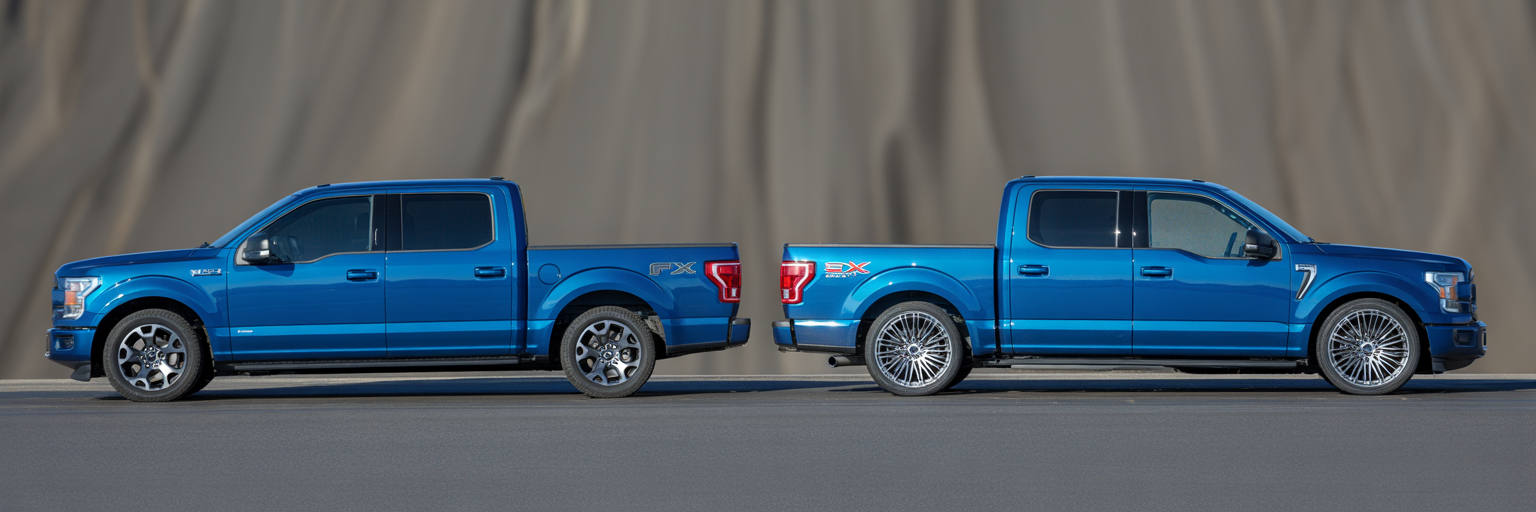
The STX Lobo embodies the aggressive aesthetic of a custom sport truck, delivered directly from the factory. Its most defining feature is its lowered, slightly “raked” stance, where the rear sits lower than the front. This, combined with the massive 22-inch wheels that fill the wheel wells, creates a muscular, ground-hugging look that is immediately noticeable. This complete F-150 street truck package is designed to look modified and purposeful without the hassle or warranty concerns of aftermarket parts.
Specific visual cues further set the Lobo apart. It features unique “Lobo” badging on the bedsides and tailgate, signaling its special status. The grille texture is often finished in gloss black, contrasting with the more common finishes on a standard STX. Ford may also offer exclusive paint colors for the Lobo, adding another layer of distinction for buyers who want their truck to stand out from the crowd.
In contrast, the appearance of the standard F-150 STX is more traditional and function-forward. Its higher ride height, greater clearance between the tires and fenders, and smaller standard wheels (typically 18-inch or optional 20-inch) create a profile that communicates readiness for any task, on or off the pavement. Its design is handsome and modern but prioritizes a classic, understated truck look over overt sportiness.
The target audience for each design is clear. The Lobo is for the enthusiast who values a sporty, custom appearance and wants to make a statement. The standard STX appeals to the buyer who prefers a timeless truck design or views their vehicle primarily as a tool where function dictates form. This choice between specialized models is common, and our comparison of the Nissan Frontier vs. Chevrolet Colorado shows how different philosophies appeal to different needs. For many Lobo buyers, the unique exterior styling is a primary part of its value proposition; it is precisely what they are paying for.
Inside the Cabin: A Shared Foundation of Tech and Comfort
While the exteriors and driving dynamics of the STX Lobo and standard STX are worlds apart, stepping inside the cabin reveals a surprising amount of common ground. This section is straightforward because the interior experience is largely neutralized as a deciding factor between these two specific configurations. From the driver’s seat, they are nearly identical.
Both the Lobo and the standard STX are built on the excellent SuperCrew cab platform. This shared foundation provides a significant practical benefit: generous interior space for up to five passengers. The rear seating area is particularly spacious, offering ample legroom and headroom for adults, making both trucks equally suitable for transporting a work crew or serving as a family vehicle.
The interior appointments are characteristic of the popular STX trim level. You will find durable and comfortable cloth seats, a functional and logically laid-out dashboard, and a level of fit and finish that feels modern and robust. The design prioritizes usability and longevity over outright luxury, which is fitting for this segment of the market. There are no unique trim pieces or special upholstery to distinguish the Lobo’s interior from a standard STX.
A major shared feature that underscores their similarity is the standard 12-inch SYNC 4 infotainment system. This large, responsive touchscreen serves as the command center for the truck’s technology. It includes wireless Apple CarPlay and Android Auto for seamless smartphone integration, along with available integrated navigation and intuitive voice commands. This ensures that both trucks are equipped with the modern connectivity and convenience features that today’s buyers expect.
The key takeaway is that from the perspective of the driver and passengers, the interior experience is almost indistinguishable. The choice between the Lobo and the standard STX depends almost entirely on exterior styling, on-road performance, and utility needs, not on interior amenities. For buyers seeking more upscale features like leather seats, a premium sound system, or advanced driver-assist technologies, they would need to look beyond the STX trim to higher levels like the XLT or Lariat.
The Daily Drive: Contrasting Ride Quality and Usability
Imagining yourself behind the wheel on a typical day reveals the subtle yet significant differences in how the STX Lobo and standard STX feel. While the previous section on dynamics focused on the “what” of the mechanical changes, this is about the subjective experience of living with them day to day.
The daily ride quality of the STX Lobo is best described as firm and connected. The combination of a sport-tuned suspension and low-profile tires means you feel more of the road surface. The benefit is a responsive, controlled ride with minimal body roll, which can be enjoyable on smooth pavement. The downside is that the ride can feel harsh over potholes, expansion joints, and poorly maintained city streets. Every imperfection in the road is more readily transmitted into the cabin.
In contrast, the daily driving experience in a standard STX is noticeably more compliant. Its suspension, with more sidewall on the tires and softer tuning, is designed to absorb bumps and road imperfections more effectively. This provides a more comfortable and isolated ride, which is often preferred for long commutes or navigating the varied pavement quality of urban environments. It delivers the relaxed, traditional truck ride that many have come to expect.
Practical usability in different weather conditions also sets them apart. Here, the Lobo’s F-150 4-Auto transfer case becomes a significant daily-driver benefit. For those living in regions with frequent rain or occasional snow, it offers a “set it and forget it” all-wheel-drive confidence on pavement. You never have to think about switching in and out of four-wheel drive. The standard STX’s part-time system is highly effective when needed but requires manual engagement and is not intended for use on merely wet roads, making the Lobo more convenient for all-weather commuting.
Revisiting the handling in a daily context, the Lobo’s sharper steering and flatter cornering can make it feel more maneuverable and fun on a winding back road or a freeway on-ramp. The standard STX offers a more relaxed driving experience, with slower steering that some may find less demanding during long highway cruises. The choice comes down to your personal preference and daily route. Are you on smooth highways where the Lobo’s sportiness can shine, or are you navigating a patchwork of city streets where the standard STX’s comfort would be more valuable?
The Ultimate Question: Cost, Alternatives, and Overall Value

After analyzing the performance, utility, and daily driving characteristics, the final decision comes down to value. This Lobo vs STX F-150 comparison reveals that the “better” truck is entirely dependent on a buyer’s priorities, budget, and intended use. There is no single right answer, but there is a right choice for you.
The specific value proposition of the 2026 F-150 STX Lobo is that of a curated, factory-warrantied package. For a single price, the buyer receives a unique aesthetic with the 22-inch wheels and lowered stance, enhanced on-road handling from the sport-tuned suspension, and the highly desirable 4-Auto all-wheel-drive system. Crucially, the STX Lobo is the most affordable entry point for the 4-Auto feature in the F-150 lineup, a system typically reserved for more expensive trims. Its value is in getting a cohesive, warrantied street truck without the complexities of aftermarket modifications.
Conversely, the value of the standard STX 5.0 V8 lies in its lower initial cost and uncompromised utility. It represents a “blank canvas” for owners who enjoy personalizing their vehicles or for those who prioritize maximum towing and hauling capability above all else. For the price difference, a buyer could invest in specialized towing equipment, off-road upgrades, or other accessories that better suit their needs. Its value is in its flexibility and raw capability.
A key alternative must be considered: the F-150 XLT trim. For a price that is often similar to the STX Lobo, a buyer could opt for an XLT. This would mean trading the Lobo’s specific performance parts and aggressive appearance for a significant upgrade in interior comfort and convenience. An XLT typically adds features like power seats, upgraded upholstery, additional chrome trim, and more available convenience options, appealing to a driver focused on daily comfort.
To simplify the decision, consider these buyer profiles:
- The STX Lobo Buyer: This is a performance enthusiast who wants a factory-built street truck with a full warranty. They value on-road handling, all-weather traction, and a standout style, and are willing to sacrifice some towing capacity to get it.
- The Standard STX Buyer: This is a traditionalist or a budget-conscious user who needs maximum towing and hauling capability. They may also be a customizer who prefers a blank slate for their own modifications and values function over form.
- The XLT Buyer: This is a comfort-focused driver who spends a lot of time in their truck. They prioritize interior amenities, convenience features, and a more premium feel over the Lobo’s specific performance upgrades and styling.
In the end, the best value F-150 trim is subjective. The STX Lobo offers a compelling package for a specific type of driver, while the standard STX remains the pragmatic choice for utility. By understanding these fundamental differences, you can determine which truck’s value proposition best aligns with your personal needs. For those where budget is the primary driver, exploring some of the top reliable used trucks under $25,000 could also present a compelling alternative.