
Before modern pickups began adopting complex hybrid systems and high-strung turbochargers to meet strict emissions targets, truck engineering prioritized cast-iron blocks, simple gearsets, and straightforward mechanical durability. For buyers in 2026 who need a single rig to haul heavy trailers and tackle backcountry trails, searching for reliable used trucks built on those proven older platforms remains the smartest investment on the market.
Why Reliable Used Trucks Dominate the 2026 Market
The Shift Back to Mechanical Simplicity
Walk onto a dealership lot in 2026 and you will find showroom pickups packed with forty-eight-volt battery packs, twin turbochargers pushing high boost pressures through small-displacement cylinders, and cabins dominated by massive touchscreens. While those systems deliver impressive brochure numbers, weekend campers and overland enthusiasts are increasingly walking past them. Experienced buyers want naturally aspirated V8s and proven six-cylinder engines that do not require proprietary dealer software to diagnose on a forest service road fifty miles from cell reception.
Choosing an older, mechanically straightforward truck brings an immediate financial advantage by avoiding the steep initial depreciation of a seventy-thousand-dollar new rig. Beyond the purchase price, simpler engine bays leave enough room to reach spark plugs, alternators, and water pumps with standard hand tools in a home driveway. Replacement components for established platforms are stocked at every rural auto parts store across the country, keeping long-term ownership costs predictable.
Towing Stiffness Versus Off-Road Articulation
Asking one pickup to pull an eight-thousand-pound travel trailer on Friday night and crawl over washouts on Saturday morning creates a fundamental engineering conflict. Suspension tuning works a lot like footwear. A soft, long-travel off-road suspension acts like a flexible pair of broken-in hiking boots that bend easily over uneven boulders to keep your feet planted on the trail. Put a heavy load on your back, however, and those soft soles collapse. When you drop eight hundred pounds of trailer tongue weight onto soft off-road springs, the rear bumper squats toward the pavement, unloading the front steering axle and causing unsettling highway sway.
Heavy-duty towing suspensions work like rigid steel-shank work boots. Stiff leaf springs carry massive vertical loads without flinching, keeping the chassis level at seventy miles per hour. Take that same stiffly sprung truck onto a rutted mountain pass, and the rear axle bounces harshly over rocks, lifting tires into the air and losing forward traction. Finding the right dual-purpose rig requires balancing spring rates with frame strength.
When shopping for pre-owned 4×4 trucks that have lived this dual life, the odometer reading tells only a fraction of the story. A truck showing one hundred forty thousand miles with a folder of receipts for regular transmission, differential, and coolant flushes is a much safer bet than a neglected sixty-thousand-mile garage queen sitting on original, oxidized fluids and brittle rubber seals. You can see why documented care beats low odometer numbers in our breakdown on why certain high-mileage vehicles age better than others.
Full-Size Half-Ton Workhorses Built for Longevity
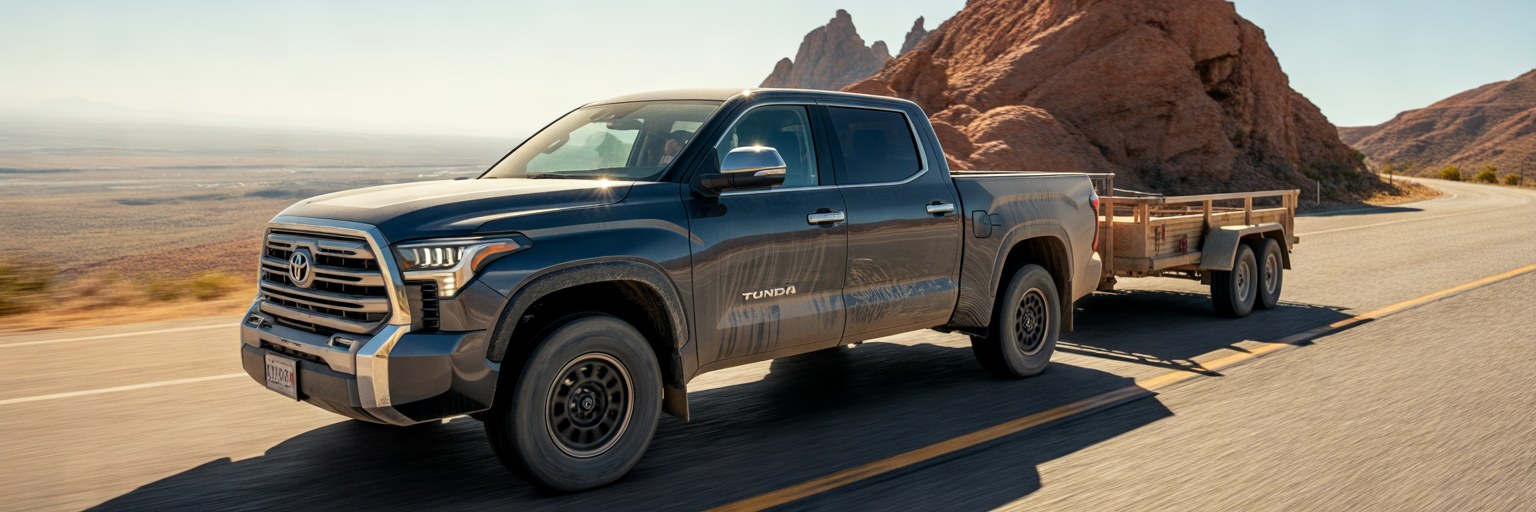
2014 to 2021 Toyota Tundra 5.7L V8
When truck owners talk about reliable V8 pickup trucks that routinely cross the three-hundred-thousand-mile mark on original internal components, the second-generation Toyota Tundra sits at the top of the list. Produced with refreshed styling from 2014 through 2021, the Tundra relies on the 5.7-liter 3UR-FE V8. Toyota engineered this engine with a robust aluminum block featuring cast-iron cylinder liners, forged steel connecting rods, and a massive cooling system designed to handle desert heat under heavy load. Paired with the Aisin six-speed automatic transmission and a giant 10.5-inch rear ring gear, the Tundra pulls nine thousand to ten thousand pounds with total composure.
The trade-off for this overbuilt mechanical hardware shows up at the gas pump. Unloaded highway mileage rarely exceeds fifteen miles per gallon, and towing a boxy camper into a headwind will drop that figure into single digits. The interior design also feels a decade behind Detroit competitors, lacking fancy infotainment tricks in favor of oversized knobs you can turn while wearing winter work gloves.
2017 to 2024 Nissan Titan 5.6L Endurance V8
Shoppers priced out of the inflated Toyota market often overlook one of the best bargains in the half-ton segment: the 2017 to 2024 Nissan Titan. Powered by the 5.6-liter Endurance V8 making up to four hundred horsepower, the Titan delivers strong low-end grunt and a remarkably low rate of catastrophic engine failure. Models from 2017 to 2019 use a durable seven-speed automatic, while 2020 and newer trucks received a smooth nine-speed JATCO transmission that keeps the engine right in its powerband on steep grades.
Because Nissan struggled to capture market share against the domestic Big Three, the Titan suffers from steep initial depreciation that benefits second-hand buyers. You get heavy-duty braking hardware, a fully boxed ladder frame, and a quiet cabin for thousands less than a comparable Tundra, making it an underrated sleeper among the best used trucks for towing. If you are weighing half-ton options for family road trips, check out our dedicated guide on the best used trucks for towing a camper under 35000 dollars.
2015 to 2020 Ford F-150 5.0L Coyote vs 3.5L EcoBoost
Ford shook up the pickup world in 2015 by switching the F-150 cab and bed to military-grade aluminum alloy, cutting up to seven hundred pounds of curb weight and eliminating body panel rust. Underneath that corrosion-proof skin, buyers face a classic choice between two exceptional engines. Data from Consumer Reports on the most reliable used pickup trucks consistently highlights the long-term durability of both the Toyota Tundra and the naturally aspirated Ford F-150 when properly maintained.
The 5.0-liter Coyote V8 uses double overhead camshafts per bank to rev freely and build horsepower cleanly without the added plumbing of turbochargers, intercoolers, or wastegates. For owners planning to keep a truck past two hundred thousand miles with minimal wrenching, the Coyote V8 is tough to beat. However, if your adventures take you up high-elevation passes like the Eisenhower Tunnel in the Colorado Rockies, the 3.5-liter EcoBoost twin-turbo V6 holds a distinct advantage. Forced induction compensates for thin mountain air, delivering massive torque below three thousand RPM, though buyers must budget for eventual timing chain and cam phaser service.
GM 5.3L and 6.2L V8s and Ram 1500 5.7L Hemi
Chevrolet Silverado, GMC Sierra, and Ram 1500 pickups from the mid-2010s through the early 2020s remain staples on American highways and boat ramps for good reason. The GM 5.3-liter and 6.2-liter small-block V8s offer effortless highway merging and unmatched aftermarket parts availability in every small town. Meanwhile, the Ram 1500 pairs the classic 5.7-liter Hemi V8 with the standout ZF eight-speed automatic transmission and a five-link coil-spring rear suspension that smooths out washboard dirt roads better than traditional leaf springs. Both platforms haul heavy trailers comfortably, provided buyers pay close attention to the history of their cylinder deactivation systems.
| Truck Model and Years | Recommended Engine | Horsepower and Torque | Realistic Max Towing Range | Primary Strength |
|---|---|---|---|---|
| 2014 to 2021 Toyota Tundra | 5.7L Naturally Aspirated V8 | 381 hp and 401 lb-ft | 8,800 to 10,200 lbs | Proven 300,000-mile mechanical durability |
| 2017 to 2024 Nissan Titan | 5.6L Endurance V8 | 390 to 400 hp and 394 to 413 lb-ft | 9,200 to 9,660 lbs | High value per dollar and low failure rate |
| 2015 to 2020 Ford F-150 | 5.0L Coyote V8 | 385 to 395 hp and 387 to 400 lb-ft | 9,000 to 11,600 lbs | Rust-free aluminum body and simple V8 upkeep |
| 2015 to 2020 Ford F-150 | 3.5L EcoBoost Twin-Turbo V6 | 365 to 375 hp and 420 to 470 lb-ft | 10,700 to 13,200 lbs | Peak low-RPM torque and high-altitude pulling |
| 2014 to 2018 Ram 1500 (and Classic) | 5.7L Hemi V8 | 395 hp and 410 lb-ft | 8,200 to 10,620 lbs | Coil-spring rear ride comfort and parts access |
Manufacturer specifications and real-world towing ranges reflect factory four-wheel-drive crew cab and extended cab configurations equipped with standard factory tow packages.
Matching these full-size rigs to your driveway comes down to where you spend your weekends. Buy the Tundra or Coyote F-150 for multi-decade mechanical peace of mind, grab the Titan to maximize your budget, choose the EcoBoost for high-altitude mountain passes, or pick the Ram 1500 if long-distance ride quality tops your priority list.
Midsize Pickups for Tight Trails and Moderate Hauling
Toyota Tacoma Second and Third Generations
While a full-size half-ton dominates the interstate, an eighty-inch-wide cab quickly becomes a liability on tight forest switchbacks and overgrown mining trails. That is where midsize used off-road trucks shine. The Toyota Tacoma has owned this category for decades, particularly the late second-generation models built between 2012 and 2015 with the 4.0-liter 1GR-FE V6. That four-liter engine produces strong low-end torque right off idle, whereas the third-generation 2016 to 2023 Tacoma switched to a high-revving 3.5-liter V6 that often hunts for gears on highway inclines.
Regardless of generation, the Tacoma offers high approach angles, a tucked-up underbody, and the largest aftermarket ecosystem in the off-road world. You can outfit a Tacoma with skid plates, sliders, and suspension kits from dozens of proven fabricators. Buyers just need to accept a few quirks, including rear drum brakes that lasted all the way through 2023 and a high cabin floor that forces taller drivers into a legs-straight-out seating posture.
2012 to 2019 Nissan Frontier 4.0L V6
If the resale markup on a clean Tacoma makes your wallet ache, the second-generation Nissan Frontier built between 2012 and 2019 offers nearly identical trail capability for a fraction of the price. By 2012, Nissan had resolved the earlier radiator and transmission cross-contamination issues, leaving a thoroughly sorted truck powered by a torquey 4.0-liter VQ40DE V6. The Frontier sits on a fully boxed F-Alpha ladder frame derived from the full-size Titan, giving it tremendous structural rigidity when flexing over deep ruts.
Behind the wheel, hydraulic power steering gives the driver direct, predictable feedback against rocks and tree roots. It lacks modern cabin flair, but it starts every morning and shrugs off hard trail abuse. For a closer look at how Nissan stacks up against domestic rivals, read our breakdown of the Nissan Frontier versus the Chevrolet Colorado.
Jeep Gladiator Rubicon and Max Tow
When the trail turns from gravel switchbacks to stair-stepped boulders in places like Moab, independent front suspension has physical limits. The Jeep Gladiator stands alone in the midsize class by placing a solid Dana 44 axle under both the front and rear of the truck. As noted in MotorTrend’s analysis of the best used off-road trucks and SUVs, factory hardware like solid axles and locking differentials makes a dramatic difference when traversing severe terrain. When one front tire climbs a rock on a Gladiator Rubicon, the opposite wheel gets pushed firmly down into the dirt, maintaining traction where independent suspension arms would lift a wheel.
Powered by the familiar 3.6-liter Pentastar V6 and an eight-speed automatic, the Gladiator also surprises buyers at the trailer hitch. Sport and Sport S models equipped with the factory Max Tow package use wide axles, heavy-duty cooling, and 4.10 gearing to achieve a class-leading 7,650-pound tow rating. Stick strictly to the gas V6 models, however, and avoid any plug-in hybrid 4xe variants in the Jeep lineup due to documented high-voltage battery recall histories. You can explore how the Jeep compares to its biggest rival in our head-to-head comparison of the Jeep Gladiator and Toyota Tacoma off-road.
The Real-World Midsize Towing Ceiling
Even when a midsize brochure advertises a seven-thousand-pound tow rating, physics still favors the bigger truck on the open highway. Pulling a six-thousand-five-hundred-pound high-profile travel trailer at sixty-five miles per hour feels far more stressful in a midsize pickup than in a full-size half-ton. The culprit is frontal surface area and wheelbase weight distribution.
An eight-foot-tall camper acts like a giant parachute catching crosswinds from passing semi-trucks. Because a midsize pickup has a narrower track width and weighs roughly a thousand pounds less than a full-size truck, the trailer has much more leverage to push the tow vehicle around the lane. For comfortable, low-fatigue highway hauling with a midsize rig, treat five thousand pounds as your realistic ceiling and opt for low-profile teardrops, pop-up campers, or open utility trailers.
Decoding Factory Off-Road and Max Tow Packages
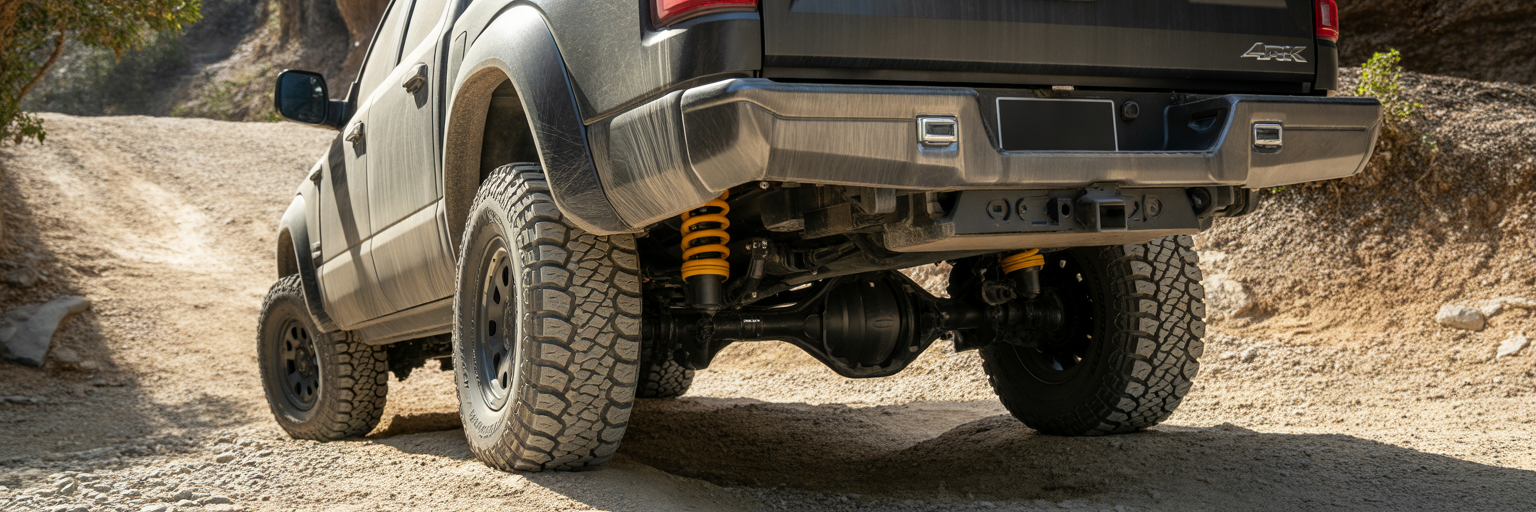
What Factory Off-Road Badges Actually Include
Bedside stickers like TRD Off-Road, FX4, Z71, and PRO-4X look great in a classified ad, but smart buyers look underneath the truck to verify what those badges actually mean mechanically. The single most valuable piece of factory trail hardware is a true locking rear differential. In a standard open differential, engine power flows along the path of least resistance, meaning if one rear tire sits on slick mud or hangs in the air over a ditch, it spins uselessly while the tire with traction sits still. Even brake-actuated limited-slip systems can overheat when worked hard on long climbs.
A selectable electronic locking rear differential, standard on the Toyota Tacoma TRD Off-Road, Nissan PRO-4X, and many Ford FX4 packages, uses an electromagnetic actuator to mechanically pin both rear axle shafts together. Both rear wheels are forced to turn at the exact same speed regardless of traction. General Motors takes a slightly different approach on Z71 trucks by installing the Eaton G80 mechanical locker, which senses wheel-speed differences and automatically locks without driver input. Alongside upgraded differentials, these packages add internal-bypass or monotube dampers like Bilstein or Rancho shocks that resist oil foaming on washboard roads, plus steel skid plates shielding the transfer case and fuel tank.
Axle Ratios, Cooling, and the Payload Capacity Trap
Just as off-road packages transform trail traction, factory heavy-duty tow packages alter the mechanical leverage of the drivetrain. Two identical-looking trucks can have wildly different pulling manners based on the ring-and-pinion gears inside their differentials. Many base pickups leave the factory with tall 3.21 or 3.31 axle ratios designed to keep highway RPMs low for fuel economy ratings. Hook a heavy boat to those tall gears, and the transmission will constantly downshift and generate excessive heat.
Stepping up to a numerically higher 3.73, 3.92, or 4.10 axle ratio works like shifting a mountain bike into a lower gear. The engine turns slightly higher RPMs at sixty-five miles per hour, multiplying torque at the wheels and taking enormous strain off the transmission torque converter. Factory tow packages pair these shorter gears with integrated dash-mounted trailer brake controllers, heavy-duty engine radiator fans, and dedicated auxiliary transmission oil coolers.
When combining off-road modifications with trailer hauling, buyers frequently fall into the payload capacity trap. Every truck has a yellow and white tire and loading information sticker inside the driver door jamb stating its exact cargo weight limit, often ranging between twelve hundred and eighteen hundred pounds on well-equipped four-wheel-drive crew cabs. Every pound of aftermarket off-road armor you bolt to the frame subtracts directly from that number. If you are planning to outfit your rig for self-recovery, review our step-by-step guide on how to install a winch on your off-road vehicle while keeping weight distribution in mind.
Add a one-hundred-eighty-pound steel front bumper, a ninety-pound winch, heavy steel rock sliders, a rooftop tent, and four heavy E-load mud-terrain tires, and you have easily consumed six hundred pounds of payload before a single person climbs into the cab. Add two adults, camping gear, and the seven-hundred-Fifty-pound tongue weight of a travel trailer, and that rig is legally overloaded and riding on its rear bump stops.
| Factory Package | Rear Differential Type | Underbody and Suspension Hardware | Key Towing and Drivetrain Upgrades |
|---|---|---|---|
| Toyota TRD Off-Road (Tacoma and Tundra) | Electronic locking rear differential (Tacoma) or Auto LSD (Tundra) | Bilstein monotube shocks and front skid plates | Multi-terrain select and crawl control on automatic models |
| Nissan PRO-4X (Frontier and Titan) | Electronic locking rear differential | Bilstein off-road shocks and steel transfer case skid plates | Lower final drive axle ratio for improved crawl and launch torque |
| Ford FX4 Off-Road | Electronic locking rear axle (commonly paired with 3.55 or 3.73 gears) | Off-road tuned front shocks and fuel tank, transfer case, and front differential skid plates | Hill descent control and optional Max Trailer Tow integration |
| Chevrolet and GMC Z71 | G80 automatic locking rear differential | Rancho monotube shocks, transfer case skid plate, and high-capacity air cleaner | 2-speed Autotrac transfer case and hill descent control |
| Jeep Gladiator Max Tow (Sport S) | Trac-Lok anti-spin rear differential with wide Dana 44 axles | Heavy-duty rear coil springs tailored for tongue weight | 4.10 axle gear ratio, heavy-duty engine cooling, and 240-amp alternator |
Equipment specifications reflect standard factory package configurations across 2014 to 2024 model years. Always verify individual VIN build sheets as standalone options vary by production year.
Because anyone can buy a twenty-dollar TRD or FX4 sticker online and slap it onto a base-model truck bed, never trust decals alone. Always check the axle code printed on the driver door jamb certification label and look on the dashboard for the physical rear locker switch and factory trailer brake controller before negotiating a price.
Common Mechanical Vulnerabilities in Older Models
Cylinder Deactivation Lifter Failures
Even the toughest V8 platforms have engineering weak points introduced in the pursuit of corporate fuel economy standards. On General Motors 5.3-liter and 6.2-liter V8s equipped with Active Fuel Management or Dynamic Fuel Management, as well as Ram 5.7-liter Hemi engines using the Multi-Displacement System, the engine computer shuts down half the cylinders under light highway cruising loads. To accomplish this, the engine routes pressurized engine oil through internal passages to unlatch special two-piece hydraulic roller lifters, preventing the intake and exhaust valves from opening.
When previous owners stretch oil change intervals past seven thousand miles or run the crankcase low on oil, fine carbon sludge restricts those tiny oil passages. A deactivation lifter can stick in its collapsed state or lose roller bearing lubrication, causing the lifter roller to seize and grind the hardened steel lobe right off the camshaft. Repairing a wiped camshaft requires pulling the cylinder heads and front timing cover, a job that easily exceeds four thousand dollars. If you are shopping for a bow-tie pickup, read our guide on how to diagnose common issues in the Chevrolet Silverado to spot early warning signs. Strict, documented five-thousand-mile synthetic oil changes are mandatory on these engines.
Heat Cycling in Transmissions and Differentials
Heat is the silent enemy of any drivetrain used for heavy hauling or slow-speed rock crawling. When a truck pulls a heavy trailer up a long summer grade without an auxiliary cooler, automatic transmission fluid temperatures can spike well past two hundred twenty degrees Fahrenheit. At those elevated temperatures, transmission fluid oxidizes rapidly and loses its frictional properties. On six-speed, eight-speed, and ten-speed automatics, baked fluid leads directly to torque converter shudder, which feels like driving over highway rumble strips during light acceleration between forty and fifty miles per hour.
Rear differentials suffer a similar fate when neglected. Pulling ten thousand pounds puts tremendous shearing force on the thin film of hypoid gear oil separating the ring and pinion teeth. Furthermore, launching boats at steep ramps or crossing creek beds on trails can submerge a hot rear axle in cold water, causing the housing to cool rapidly and suck water past the axle seals or breather vent. Milky, broken-down gear oil quickly pits the pinion bearings, creating a distinct whining howl that changes pitch as you get on and off the throttle.
Front-End Suspension Wear and Snow-Belt Frame Rot
Off-road tires and rough trails take a heavy toll on front steering and suspension linkages. On independent front suspension trucks like the Tacoma, Tundra, and F-150, oversized thirty-five-inch tires accelerate wear on lower ball joints, wheel bearings, and outer tie rod ends. On solid front axle trucks like the Jeep Gladiator, even slight wear in the track bar bushings, drag link, or ball joints can trigger a violent steering oscillation after hitting a highway expansion joint at sixty miles per hour, a phenomenon widely known as death wobble. If you hear popping sounds during parking lot maneuvers, consult our troubleshooting article on why a car makes a clunking noise when turning the steering wheel.
For buyers shopping in northern states where winter road crews spread liquid brine and rock salt, structural corrosion poses a far bigger threat than any mechanical bolt-on part. Boxed ladder frames trap wet mud and road salt inside the rails, rusting the metal from the inside out while the exterior paint still looks passable. When inspecting any older candidate, watch out for these six immediate mechanical and structural red flags:
- A sharp, rhythmic metallic chirping or ticking noise coming from the top of the engine valvetrain on a cold start that increases with engine RPM and does not quiet down within thirty seconds, pointing to a collapsed lifter rather than a simple exhaust manifold leak.
- Automatic transmission fluid on the dipstick or inspection plug that smells acrid and burnt or appears dark brown with fine metallic shimmer instead of bright translucent red.
- Heavy gear oil slinging from the front of the rear differential housing onto the underbody floor pan, indicating a worn pinion bearing and failing pinion seal from prolonged towing heat.
- Visible side-to-side movement in the front track bar mounting brackets or torn rubber boots on the lower ball joints when an assistant saws the steering wheel back and forth with the tires on the ground.
- Delaminating, flaking layers of rust scale along the bottom of the boxed frame rails, particularly where the forward leaf spring hangers weld to the frame and around the spare tire crossmember.
- Heavily pitted, swollen steel brake lines running along the inside of the driver-side frame rail that look ready to burst under an emergency panic stop with a trailer behind you.
Pre-Purchase Inspection Steps for Used 4×4 Pickups
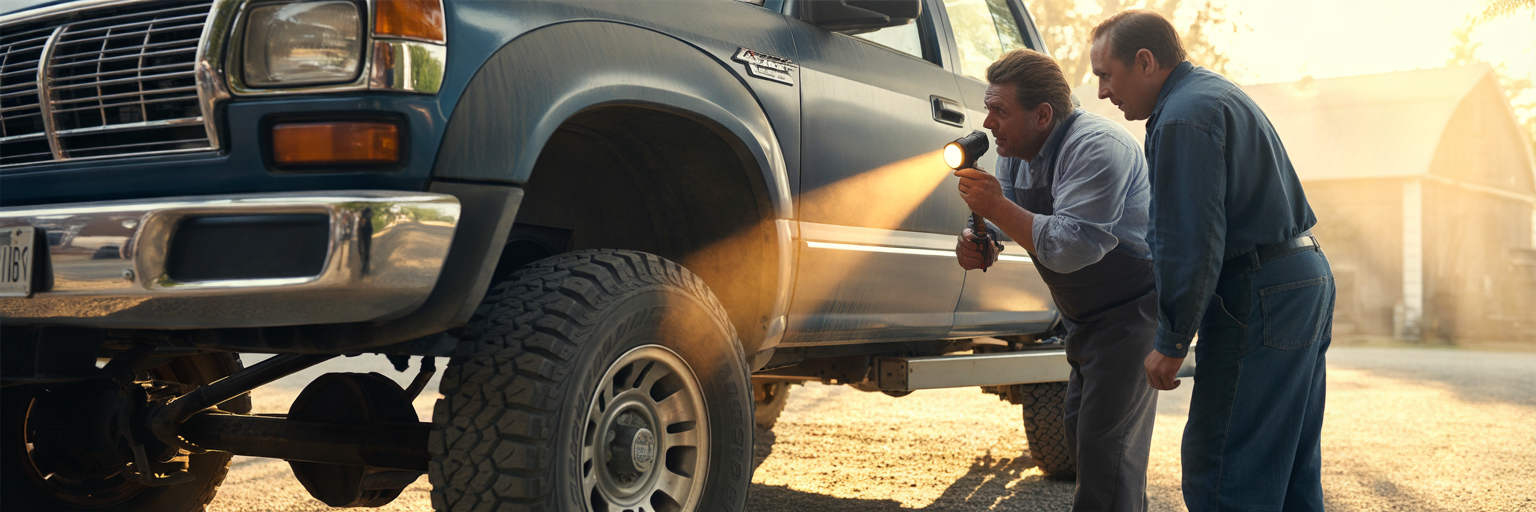
Cold-Start Checks and Frame Inspection
When buying a used pickup, the first five minutes next to the vehicle reveal more than an hour of smooth talking from the seller. Always insist when scheduling the appointment that the truck sit completely cold overnight before you arrive. Dishonest sellers know that warming an engine up to operating temperature expands internal metal parts and builds oil pressure, temporarily masking expensive noises. Before turning the key, pop the hood and place your bare hand directly on the upper radiator hose and the exhaust manifold heat shield. If the metal feels warm, the seller ran the engine before you pulled into the driveway.
A true cold start lets you listen for the distinct two-second metallic rattle of stretched timing chains and worn cam phasers on a Ford 3.5-liter EcoBoost, or the sharp tick of snapped rear exhaust manifold bolts on a Ram 5.7-liter Hemi or Toyota 5.7-liter V8. Once the engine settles into a smooth idle, grab a bright LED flashlight and a small pocket screwdriver or ball-peen hammer to inspect the underside. Follow these six field inspection steps before making an offer on any truck:
- Verify the engine is stone cold to the touch before starting it, then stand by the open hood and front wheel wells while an assistant turns the key to catch any startup timing chain slap, valvetrain ticking, or belt tensioner squeaks.
- Crawl underneath the cab and bed to tap along the lower boxed frame rails, cab mounts, and leaf spring shackles with a small hammer, listening for a crisp metallic ring rather than the dull, crunchy thud of internal rust rot.
- Inspect the two-inch rear hitch receiver tube closely, checking the five-eighths-inch hitch pin holes for oval elongation or cracked welds on the cross-tube that betray years of yanking overloaded equipment trailers.
- Look up behind the driver footwell pedals and underneath the rear bumper wiring harness for cheap plastic wire taps, melted electrical tape, or corroded splices left behind by poorly installed aftermarket brake controllers and off-road light bars.
- Find a loose gravel parking lot or dirt road shoulder to shift the transfer case through four-wheel-drive high range, four-wheel-drive low range, and engage the rear locking differential to confirm the actuators lock smoothly without flashing dashboard fault lights.
- Perform a thirty-minute highway test drive that includes a steep hill climb to monitor the transmission temperature gauge, feel for torque converter shudder under light throttle in overdrive, and ensure the steering wheel tracks straight without wandering.
Testing the Transfer Case and Locking Differentials
Four-wheel-drive transfer cases and locking differential actuators suffer from lack of use just as much as from trail abuse. When an electric shift motor sits untouched on a commuter truck for five years, moisture corrodes the internal contact pins and the shift fork seizes up. Testing these systems properly requires the right surface. Never engage four-wheel drive or lock a rear differential on dry asphalt and turn the steering wheel. Because the front and rear axles travel along different arcs in a turn, locking them together on high-traction pavement causes severe driveline wind-up that can snap an axle shaft or stretch a transfer case chain.
Pull onto a dirt shoulder, a gravel lot, or even wet grass. Shift into 4-High while rolling slowly, confirming the dashboard indicator light turns solid rather than blinking endlessly. Next, come to a complete stop, shift the main transmission into neutral, and move the transfer case selector into 4-Low. You should hear a solid mechanical engagement clunk from underneath the floorboards and feel an immediate change in throttle gearing. Finally, press the rear differential locker button if equipped; the indicator light may blink as you roll forward a few feet until the locking pins align and drop into place.
Vehicle History Reports and Certified Pre-Owned Value
Once a truck passes your physical inspection, verify its paper trail. Checking the VIN reveals title brands, odometer rollbacks, and whether the truck spent its first five years hauling road salt in upstate New York before being detailed and shipped to an auction lot in Arizona. You can learn how to spot hidden red flags in our resource on how vehicle history reports help used car buyers. Even with a clean report in hand, paying an independent mechanic one hundred fifty dollars to put the truck on a two-post shop lift for an hour is money well spent. A technician with pry bars can check wheel bearing play, scan the engine computer for recently cleared diagnostic trouble codes, and spot coolant seepage hidden behind skid plates.
If you are shopping at the higher end of the budget for a late-model 2020 to 2024 Nissan Titan, Toyota Tundra, or Ford F-150, consider looking for a manufacturer Certified Pre-Owned rig. Factory CPO programs extend powertrain warranty coverage up to one hundred thousand miles, protecting your wallet against unexpected transmission or differential repairs during your first few years of ownership.
The weekend you bring your used truck home, before you hook up a camper or air down the tires for a trailhead, establish your own baseline maintenance schedule. Drain and refill the front and rear differentials, the transfer case, the transmission pan, and the radiator coolant. Starting with fresh, high-grade fluids ensures your proven pickup will keep pulling heavy loads and climbing backcountry passes for years to come.