
The Balance Between Towing Power and Fuel Economy
For decades, a truck’s worth was measured by its toughness and raw power. Today, that equation has changed. The modern truck buyer faces a constant negotiation between strength and efficiency, a direct result of unpredictable fuel prices. This guide is designed to help you navigate the critical trade-offs in the towing capacity vs mpg debate, ensuring you find a truck that works for both your weekend adventures and your weekly budget.
The physics are straightforward. Think of a truck like a weightlifter who needs more calories, or fuel, to lift heavier weights. A vehicle engineered to pull 10,000 pounds requires a stronger frame, a larger engine, and more robust components. All this added hardware increases the truck’s own weight, which means it demands more fuel even when you are not towing anything at all.
This brings us to the core principle of smart truck buying: right-sizing your vehicle. It’s time for an honest assessment of your needs. Are you buying a truck for the one week a year you tow a heavy camper, or for the other 51 weeks you commute to work and run errands? Overbuying on capability means you pay a penalty at the pump every single day. Choosing a truck that precisely matches your typical use is a long-term financial decision. The fuel savings from a properly sized truck can easily add up to thousands of dollars over its lifespan.
Powertrain Elements That Define Capability
Moving from the ‘why’ to the ‘how’, understanding a truck’s powertrain is essential. The engine, transmission, and axle ratio work together as a team to deliver both power and efficiency. This section of our light duty truck towing guide will demystify the technical jargon you see on a window sticker, helping you choose the right combination for your needs. You can explore various models and their specifications in our comprehensive section on trucks.
The engine is the heart of the operation, and in 2025, you have several distinct options. Each is suited for different tasks, from daily driving to heavy hauling.
| Powertrain Type | Best For (Towing) | Best For (Fuel Economy) | Key Trade-off |
|---|---|---|---|
| Turbocharged V6 | Mid-range towing, good all-around performance | Good highway MPG when not towing | Can be thirsty when towing heavy loads |
| Traditional V8 | Heavy loads, proven reliability, satisfying sound | Less efficient in daily driving | Higher fuel consumption is the primary drawback |
| High-Torque Diesel | Maximum towing capacity, long-distance hauling | Excellent highway MPG, especially under load | Higher initial cost and maintenance expenses |
| Hybrid (e.g., F-150 PowerBoost) | Strong initial torque, onboard power supply | Significant efficiency gains in city driving | Complex system with higher purchase price |
Next is the transmission. Modern 8- and 10-speed automatic transmissions have replaced older, less efficient 4- and 6-speed units. Having more gears allows the engine to stay in its most efficient RPM range, much like a cyclist shifting gears to maintain momentum on a hill. This improves both acceleration under load and fuel economy on the highway.
Finally, do not overlook the axle ratio. According to an analysis by Byron Center Motors, this is a critical but often misunderstood factor. A higher number, like 3.73, acts like a low gear on a bicycle, providing excellent power for getting a heavy load moving but requiring more fuel at highway speeds. A lower number, like 3.31, is better for highway cruising efficiency but offers less initial pulling power. For most on-road towing, a 4×2 drivetrain is lighter and more efficient, while 4×4 is essential for slippery surfaces like boat ramps, though it comes with a slight fuel penalty.
Midsize Trucks for Daily Driving and Light Hauling
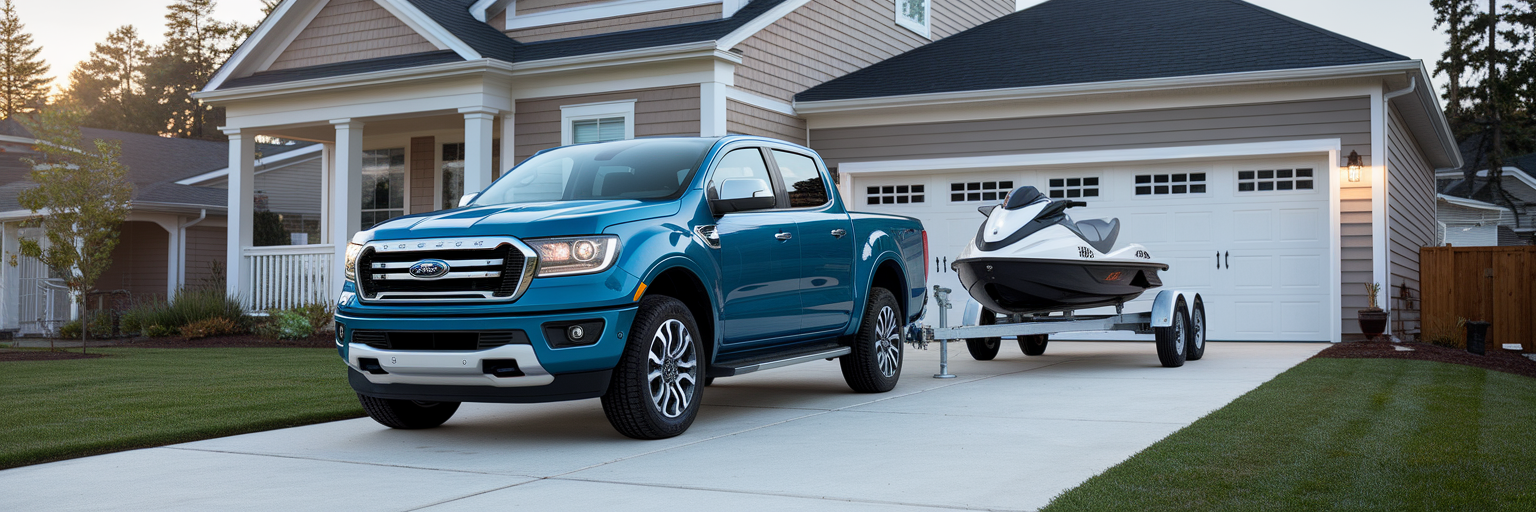
For many buyers, the ideal solution is a midsize truck. This category is perfect for someone who needs truck utility for weekend hobbies, like towing a small boat, jet skis, or a pop-up camper under 7,500 pounds, but uses the vehicle as a daily driver during the week. The key appeal here is versatility and a balanced lifestyle. These trucks prove you do not have to sacrifice everyday usability for occasional capability.
The midsize truck fuel economy available in 2025 models is compelling. For instance, models like the Ford Ranger, which you can learn more about on our Ford brand page, offer a combined MPG rating around 22 mpg. The Nissan Frontier is another strong contender at 21 mpg combined. As reported by Dominant Motoring, the 2025 GMC Canyon achieves a combined 20 mpg, making it a solid choice for those who prioritize efficiency. These figures represent a smart compromise between power and economy.
The benefits extend beyond fuel savings. Think about the practical advantages in your daily routine. A midsize truck is far easier to park in a crowded grocery store lot or navigate through tight city traffic. Its more nimble handling makes it feel less like a commercial vehicle and more like a comfortable SUV. This everyday livability is a significant factor that spec sheets often fail to capture.
However, it is important to set realistic expectations. We believe in honesty to help you make the right choice. These trucks are not designed for heavy fifth-wheel trailers or large construction equipment. Their strength lies in their adaptability. By understanding their limits, you can confidently decide if a midsize truck is the right fit, preventing a costly purchasing mistake and ensuring your vehicle serves you well in all aspects of your life.
Full-Size Options for Greater Towing Demands
If your needs genuinely exceed what a midsize truck can offer, the full-size category provides the necessary muscle without completely abandoning efficiency. This buyer is someone who regularly tows between 7,000 and 13,000 pounds, whether it is a large travel trailer for family vacations, a multi-horse trailer, or heavy work equipment. The goal here is to find a truck that can handle the load comfortably while still being mindful of fuel consumption.
Even in this powerful class, manufacturers have made significant strides. There are several 2025 trucks with good gas mileage that deliver impressive capability. The Chevrolet Silverado 1500, for example, offers an optional diesel engine that achieves a remarkable 26 mpg combined, blending serious towing prowess with long-haul efficiency. Another standout is the hybrid powertrain in the Ford F-150 PowerBoost. As we cover in our detailed review of the 2025 Ford F-150, this system provides V8-like torque for confident towing while delivering excellent fuel economy in stop-and-go city driving when the trailer is unhitched.
Of course, there are trade-offs. While these trucks are more capable and often provide a more stable, comfortable platform for long-distance towing, their sheer size and weight mean they will never match a midsize truck’s MPG in daily driving. Acknowledging this reality is key to making an informed decision. You are choosing maximum capability when you need it, with the understanding that it comes with higher daily running costs.
It is also important to know where this category ends. If your towing needs consistently push past the 13,000 to 14,000-pound mark, the conversation must shift to heavy-duty trucks like the F-250 or Ram 2500. In that class, maximum capability is the undisputed priority, and fuel economy becomes a much more distant, secondary consideration.
Essential Towing Technologies for Safety and Control

A truck’s powertrain gets it moving, but modern electronic systems are what make towing safer and less stressful. When you are looking at a spec sheet, these features are just as important as horsepower and torque figures. They are designed to give you confidence and control, especially when managing a heavy load. Here are some of the key technologies to look for:
- Trailer Sway Control: Think of this as an invisible co-pilot. It uses the truck’s stability control sensors to detect dangerous trailer movement caused by crosswinds or sudden steering inputs. It then automatically applies specific brakes to bring the trailer back in line, preventing a potential loss of control.
- Integrated Trailer Brake Controller: This factory-installed system synchronizes the truck and trailer brakes for smooth, controlled stops. Unlike some aftermarket units that can feel jerky or disconnected, an integrated controller provides proportional braking that inspires confidence.
- Hill Start Assist: We have all seen it at the boat ramp. This feature solves the nerve-wracking problem of rolling backward when starting on a steep incline. It holds the brakes for a few seconds after you move your foot to the accelerator, giving you time to get moving smoothly.
- Pro Trailer Backup Assist: For many, reversing a trailer is the most intimidating part of towing. This feature turns a complex task into a simple one. Instead of counter-intuitive steering, you simply turn a knob in the direction you want the trailer to go, and the truck handles the steering for you.
- Multi-Angle Camera Systems: These systems remove the guesswork. With a 360-degree overhead view, a dedicated hitch-assist line, and side views, you can connect your trailer and navigate tight spaces with complete visibility and confidence.
Making the Right Choice for Your Needs
Ultimately, finding the right truck comes down to a clear-eyed assessment of your own life. To walk into a dealership with confidence, you need to have answers before you start shopping. This final section of our guide synthesizes everything into an actionable plan.
Start with this simple self-reflection checklist. Do not just think about it, write it down:
- What is the exact weight? Know the fully loaded weight of the trailer, boat, or camper you plan to tow.
- Be honest about frequency. How many days per month or year will you actually be towing that load?
- Track your daily driving. What is your average daily mileage when you are not towing?
With these answers, your next step is practical. We strongly recommend test-driving a midsize and a full-size truck on the same day. Pay attention to how they feel in the real world. Numbers on a page cannot tell you how a truck handles in a tight parking lot or how comfortable its ride is on your daily commute. This direct comparison is often more revealing than any brochure.
Remember the central theme: choose the truck that fits your 95% use case, which is your daily life, not the 5% use case of your heaviest possible tow. This is the secret to long-term satisfaction and financial savings. The best fuel efficient trucks for towing are not always the ones with the biggest numbers, but the ones that offer the smartest solution for your unique needs. As you continue your search, you can explore our homepage for the latest news, reviews, and guides on all things automotive.