
Since the first pickup trucks rolled off assembly lines nearly a century ago, they have been the backbone of American industry. At the core of every great workhorse is an engine whose reputation was forged not in showrooms, but in fields, construction sites, and cross-country hauls.
What Forges an Engine’s Legacy
An engine’s reputation isn’t built on a single dyno pull or a flashy marketing campaign. It’s earned over decades of service, through freezing mornings when it still turns over and scorching afternoons when it pulls a heavy load without complaint. This trust, passed down from one generation of owners to the next, is what separates a good engine from a legendary one. To understand what makes these powerplants so revered, we have to look beyond horsepower figures and focus on the qualities that matter when real work needs to get done.
We judge these mechanical titans on three core pillars. The first is raw torque, the brute twisting force that gets a heavy trailer moving from a dead stop. The second is mechanical simplicity, a design philosophy that values fewer failure points and easier repairs over complex, cutting-edge technology. The final pillar is unwavering reliability, the proven ability to withstand abuse and high mileage while asking for little in return. These are the traits that define a true workhorse.
These engines became more than just machinery. They are symbols of American resilience and ingenuity, often outlasting the very trucks they were installed in. You can still find them powering farm equipment, generators, and custom builds, a testament to their overbuilt nature. The stories of these legendary truck engines are written in oil stains on garage floors and in the logs of cross-country truckers. This ranking celebrates function over flash, honoring the powerplants that have proven their mettle through years of hard labor and have earned the respect of the mechanics who keep them running.
The Pillars of Powertrain Greatness

Before we rank the legends, it’s important to understand the principles that put them on this list. These are not abstract concepts but tangible engineering choices that separate a disposable motor from a million-mile icon. Mechanics and seasoned truck owners know these truths intimately, recognizing them in the rattle of a diesel at idle or the ease of access to a starter motor. The greatness of these engines is rooted in physics, smart design, and a commitment to durability.
The Unyielding Force of Torque
Horsepower sells cars, but torque moves trucks. Imagine trying to loosen a stubborn, rusted bolt. A short wrench requires immense effort, but a long wrench allows you to apply the same force with far less strain. That leverage is torque. In an engine, it’s the rotational force the crankshaft produces, and for a truck, nothing is more important. High torque truck engines that deliver their peak twisting force at low RPM can get a 10,000-pound trailer moving without screaming at the redline. This low-end grunt reduces strain on the entire drivetrain, from the transmission to the axles, contributing to a longer service life and a more confident towing experience.
The Virtue of Mechanical Simplicity
There’s a certain beauty in an engine you can understand just by looking at it. The legends on our list come from an era before engine bays were cluttered with plastic covers and a dizzying web of sensors. Their simplicity is their strength. With robust cast-iron construction, gear-driven timing components that won’t stretch or snap, and fuel systems that rely on mechanical pressure instead of complex electronics, there are simply fewer things to go wrong. When a problem does arise, this simplicity makes diagnosis straightforward. Many of these engines can be repaired on the side of the road with a basic toolkit, a virtue that has become almost unthinkable in modern vehicles.
The Meaning of Bulletproof Reliability
Bulletproof reliability means more than just starting every morning. It’s the ability to tolerate a missed oil change, survive a tank of questionable fuel, and endure constant, heavy loads without catastrophic failure. This reputation is born from over-engineering, using materials and designs that are far stronger than they need to be for their rated output. Mechanics develop a deep respect for these engines not just because they last, but because they were designed to be maintained. The satisfaction of working on an engine built to be serviced, not replaced, is a feeling many modern technicians rarely experience.
- Ease of access to common maintenance items like filters, belts, and sensors.
- Widespread availability and affordability of replacement parts due to long production runs.
- Logical design that makes tracing a problem intuitive.
For those who prefer to handle their own maintenance, our collection of DIY articles offers valuable tips for keeping these classics in top shape.
Legend #5: The Chevrolet 350 Small-Block V8
If there was a people’s champion of V8 engines, it would be the Chevrolet 350 Small-Block. Its inclusion on this list isn’t because it out-pulls the massive diesels, but because of its sheer ubiquity and cultural impact. For decades, this was the default engine for millions of American light-duty trucks, from the C/K series pickups to the Suburban. It was the reliable, easy-to-fix heart of countless work fleets and family haulers. Its accessibility and the colossal aftermarket support it spawned make it a cornerstone of American automotive culture.
| Specification | Details |
|---|---|
| Displacement | 5.7 Liters / 350 Cubic Inches |
| Configuration | 90-Degree Pushrod V8 |
| Typical Truck HP | 185 – 255 hp |
| Typical Truck Torque | 280 – 330 lb-ft |
| Production in Trucks | Late 1960s – Late 1990s |
Note: Power figures varied significantly by year and application, with these numbers representing common truck configurations.
The 350’s reputation was built on its simplicity. The classic pushrod V8 design is easy to understand and work on, making it the engine that generations of mechanics first learned to rebuild. With millions produced, you could find parts for a Chevy 350 in any small-town auto parts store, and they were always affordable. This engine wasn’t intimidating; it was approachable. It powered everything from farm trucks to hot rods, and its interchangeability became legendary.
However, it’s important to maintain a balanced perspective. While the 350 is a fantastic, durable engine for a half-ton pickup or an SUV, it lacks the low-RPM grunt needed for serious, heavy towing. It has to work much harder than the larger displacement or diesel engines on this list to move a heavy load, which is why it sits at number five. Its legacy is one of versatility and accessibility, not brute force.
Legend #4: The Ford 300 Inline-Six
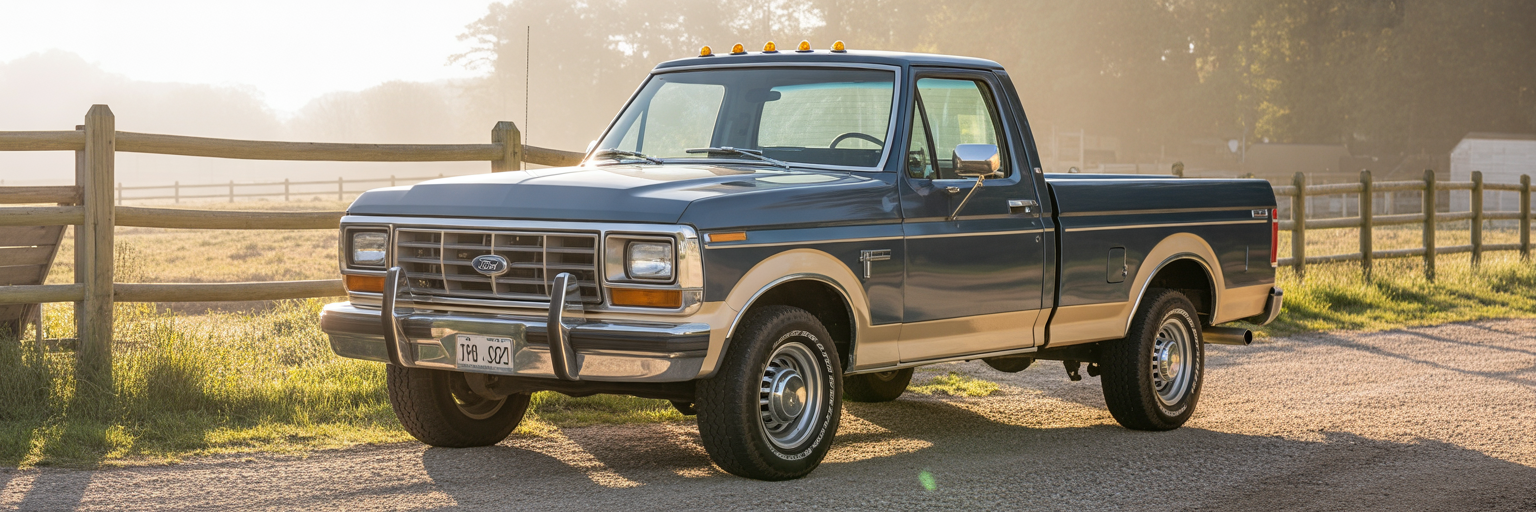
In a world dominated by V8 rumble, the Ford 300 inline six stands as the ultimate unsung hero. This engine is the embodiment of industrial-grade thinking applied to a consumer vehicle. It was never flashy, and its horsepower numbers were never impressive on paper. But anyone who has ever used a truck with a 300-six for actual work knows its secret. Its legend is built on relentless, low-end torque and a design so tough it bordered on indestructible. It’s the engine that simply refused to quit.
| Specification | Details |
|---|---|
| Displacement | 4.9 Liters / 300 Cubic Inches |
| Configuration | Inline-6 |
| Horsepower | ~150 hp |
| Torque | ~260 lb-ft @ 2,000 RPM |
| Production Years | 1965 – 1996 |
Note: While horsepower seems low, the key is that peak torque arrives very early in the RPM range, making it feel much stronger than paper specs suggest.
The mechanical strength of the Ford 300 comes from its design. As an inline-six, it is inherently balanced, running smoother than many V-configured engines. Its long stroke was perfect for generating torque right off idle. Critically, it featured seven main bearings supporting the crankshaft, providing exceptional rigidity and durability under load. Most models also used gear-driven timing instead of a chain or belt, eliminating one of the most common and catastrophic failure points in other engines. This robust design is why Ford used the 300 in everything from F-150s to medium-duty F-600s, as well as industrial applications like wood chippers, generators, and tractors.
Ask any seasoned mechanic about the Ford 300, and you’ll likely hear a story of one that was horribly neglected but kept running. They are famous for surviving coolant leaks, infrequent oil changes, and immense workloads. They might tick, they might smoke, but they almost never leave you stranded. This engine’s story is one of pure, unadulterated toughness. For more information on the classic models these engines powered, you can explore our general section on trucks.
Legend #3: The Ford 7.3L Power Stroke V8
In the mid-1990s, if you were serious about towing, there was one engine that stood above the rest: the 7.3L Power Stroke. This turbocharged diesel V8 cemented Ford’s dominance in the heavy-duty truck market and became the benchmark for reliability and power in its era. It represents a sweet spot in diesel history, offering modern-enough direct injection power without the complex and often troublesome emissions systems that came later. For many, it remains one of the best diesel truck engines ever built.
| Specification | Details |
|---|---|
| Displacement | 7.3 Liters / 444 Cubic Inches |
| Configuration | Turbocharged Direct Injection V8 |
| Horsepower | 210 hp (1994.5) to 275 hp (2003) |
| Torque | 425 lb-ft (1994.5) to 525 lb-ft (2003) |
| Production Years | 1994.5 – 2003 |
Note: The power increases throughout its production run reflect improvements in turbocharging and fuel system tuning.
The 7.3L’s reputation for reliability is well-earned. Its relatively low-stress design and heavy-duty internals, built by Navistar International, meant it could handle immense workloads without breaking a sweat. It’s not uncommon to see these engines surpass 500,000 miles with only routine maintenance. Its legendary status was further solidified by the problematic nature of its successor, the 6.0L Power Stroke. The contrast between the two engines powerfully illustrates just how special the 7.3L was. Its reputation for longevity is well-documented; as an example, publications like SlashGear frequently list it among the most dependable pickup truck engines ever produced.
From a mechanic’s perspective, the 7.3L is revered, though not seen as perfect. It has a few well-known and predictable failure points, such as the camshaft position sensor (CPS) or the exhaust back pressure valve (EBPV). However, these are seen as manageable quirks. The parts are cheap, the fixes are well-documented, and the repairs are straightforward on an otherwise bulletproof platform. It’s an engine that communicates its needs clearly, earning the trust of those who depend on it daily.
Legend #2: The AMC/Jeep 4.0L Inline-Six

Born on the rugged trails of Moab and proven over millions of miles of daily commutes, the Jeep 4.0L inline-six is the undisputed king of reliability for SUVs and light trucks. Its legend wasn’t forged by towing massive trailers but by its incredible toughness and ability to run forever in some of the most beloved off-road vehicles ever made, like the Jeep Cherokee (XJ) and Wrangler (TJ). This engine’s reputation is built on a foundation of simplicity and a direct lineage from famously durable AMC powerplants.
| Specification | Details |
|---|---|
| Displacement | 4.0 Liters / 242 Cubic Inches |
| Configuration | Inline-6 |
| Horsepower | ~190 hp |
| Torque | ~225 lb-ft |
| Production Years | 1987 – 2006 |
Note: Like the Ford 300, the 4.0L was prized for its strong low-end torque, which is essential for crawling over obstacles off-road.
The engine’s heritage is key to its toughness. It evolved from the AMC inline-six engines of the 1960s, inheriting a philosophy of over-built, simple design. With a full cast-iron block and head, it was made to last. This robust construction is why stories of Cherokees and Wranglers easily exceeding 300,000 miles on the original powertrain are so common in the Jeep community. It delivered its torque low in the RPM range, making it perfect for the slow, careful throttle inputs required for technical off-roading.
Of course, no engine is without its personality. The 4.0L is famous for a few well-known quirks, most notably a tendency to develop a rear main seal leak. Yet, the enthusiast community doesn’t see these as serious flaws. Instead, they are often referred to as endearing “character traits” or proof that “if it’s not leaking oil, it must be empty.” This perspective captures the deep affection owners have for an engine that has proven time and again that it will get them home. You can explore more about the history of Jeep and other manufacturers on our general brand page.
Legend #1: The Cummins 5.9L 12-Valve 6BT
We now arrive at the undisputed champion, the titan of torque, the legend against which all other heavy-duty truck engines are measured: the Cummins 5.9L 12-valve 6BT. This wasn’t a pickup truck engine. It was a medium-duty industrial engine, originally designed for tractors and commercial equipment, that was ingeniously fitted into a Dodge Ram. In doing so, it set a benchmark for durability and pulling power that competitors would chase for decades. It is the pinnacle of everything this list celebrates: torque, simplicity, and reliability.
| Specification | Details (1994-1998 Dodge Ram) |
|---|---|
| Displacement | 5.9 Liters / 359 Cubic Inches |
| Configuration | Turbocharged Inline-6 |
| Horsepower | 160 – 215 hp |
| Torque | 400 – 440 lb-ft |
| Injection Pump | Bosch P7100 (Mechanical Inline) |
| Governed RPM | ~2,500 RPM |
Note: The low horsepower and massive torque delivered at low RPM are the defining characteristics of this industrial-derived engine. The Cummins 12 valve specs tell a story of pure pulling power.
The Million-Mile Mechanical Heart
What makes the 12-valve one of the most reliable truck engines of all time can be summarized in four words: Bosch P7100 injection pump. Used from 1994 to early 1998, this purely mechanical inline pump is a masterpiece of industrial engineering. Devoid of any complex electronics, it is incredibly durable, famously reliable, and highly tunable. It is the heart of the 12-valve’s legendary status. This simplicity is why mechanics idolize the 6BT. As noted truck expert Mike Levine puts it, “The 12-valve Cummins is a workhorse that just keeps going, and its simplicity makes it a dream to work on.” This sentiment is echoed in workshops across the country. Its mechanical nature is a key reason why outlets like Jalopnik have called it one of the greatest truck engines of all time.
The 6BT is a block of cast iron with a gear-driven camshaft and an inline-six design that is inherently strong and balanced. It was built to run at its peak torque all day long in a farm tractor, so the duty cycle of a pickup truck was a walk in the park. This over-built nature created a massive tuning potential. With simple and affordable modifications to the fuel plate and air system, owners could easily double the stock torque without compromising the engine’s core reliability. The 12-valve Cummins is not just an engine; it is an institution.
The Enduring Spirit of Mechanical Workhorses

Looking back at these five legends, a common thread emerges. Each one was a product of a design philosophy that prioritized long-term durability and serviceability above all else. They were not engineered to be the most powerful, the quietest, or the most fuel-efficient. They were built for a purpose, whether it was hauling lumber, crawling over rocks, or crossing the country with a heavy trailer, and they fulfilled that purpose exceptionally well for a very long time.
The modern engine landscape is vastly different. Driven by emissions regulations and consumer demand for refinement, today’s powerplants are smaller, more complex, and heavily reliant on sophisticated electronics. They produce incredible power from small displacements, but they have lost the “fix-it-with-a-wrench” character that defined these iron giants. Can any modern engine, with its tight tolerances and web of sensors, ever achieve the same million-mile legendary status? It’s a question worth asking.
There is an undeniable trade-off. Modern trucks offer comfort, efficiency, and power levels that were once unimaginable. Yet, they have sacrificed the mechanical soul that made their predecessors so endearing to those who worked with them. For those curious about how today’s trucks stack up, it’s worth exploring which 2025 trucks offer the best towing and fuel economy. But the spirit of these old workhorses endures. Their continued presence on our roads, farms, and trails is a living testament to a golden era of engineering where longevity was the ultimate measure of success.